
A perspective piece from The Listening Market.
There is a paradox unfolding in 2026. As machines become capable of making more things — better, faster, cheaper — the things made by human hands are becoming more valuable, not less. This is not the story that was supposed to happen. The assumption was that automation would make human craftsmanship obsolete, that handmade would become a niche for purists and museum-goers. Instead, the opposite has occurred.
Human-made is having a moment. And that moment is turning into a movement.
The Inverse Relationship Between Supply and Value
When something becomes abundant, its value drops. When something becomes scarce, its value rises. This is economics, and it applies to craftsmanship in a way nobody quite predicted. As AI-generated content, machine-manufactured goods, and automated everything flooded the market, the supply of the machine-made became effectively infinite. And the supply of the human-made — objects shaped by hands, decisions made by a person, imperfections that tell a story — became, by contrast, rare.
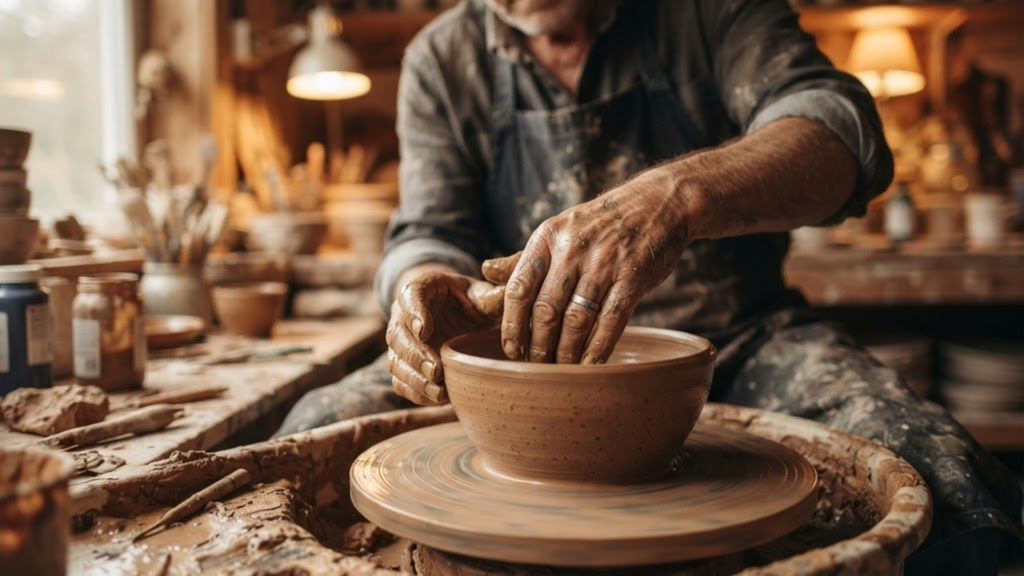
Rarity creates value. But it is not just economic value. It is emotional value. People are willing to pay more for a handmade ceramic mug not because it holds coffee better, but because it holds meaning better. Someone made this. Someone sat at a wheel, shaped the clay, chose the glaze, fired the kiln, and opened it not knowing exactly what would come out. That uncertainty — that humanness — is what people are paying for.
The Imperfection Premium
Machine-made products are perfect. Every copy is identical. Every edge is precise. Every finish is uniform. And somewhere along the way, perfection became boring. The mug that is exactly the same as a million other mugs does not tell a story. The mug with a slight wobble in the rim, a glaze that pooled a little deeper on one side, a base that is not quite flat — that mug has character. It has evidence of the hands that made it.
This is the imperfection premium, and it is reshaping how people shop. The marks of process — tool marks, grain patterns, variations in colour — are no longer seen as flaws. They are seen as signatures. Proof that a human was involved, that a decision was made, that something was not simply extruded by a machine programmed to minimise variation.
The irony is rich. For a century, manufacturing worked to eliminate variation. Now, consumers are seeking it out.
The Story Economy
When a product is made by a person, it comes with a story. The potter who has been working in the same studio for twenty years. The weaver who learned from her grandmother. The knife-maker who forges each blade individually and can tell you which fire it came from. These stories are not marketing. They are provenance. And in 2026, provenance is becoming a primary factor in purchasing decisions.
People want to know where things came from. Not just the country of origin, but the person. The rise of maker markets, direct-to-consumer artisan platforms, and “meet the maker” content reflects this desire. When you buy a handmade product, you are not just buying an object. You are buying a connection to the person who made it. That connection is something no machine can replicate, no matter how good it gets.
The Durability Argument
There is a practical dimension to the human-made revival that should not be overlooked. Handmade products are often repairable. A hand-stitched leather bag can be re-stitched. A forged knife can be re-sharpened. A wooden chair can be re-sanded and re-finished. These objects are designed to be maintained, not replaced.
This stands in stark contrast to the disposable culture that mass manufacturing enabled. The cheap chair that breaks after two years and cannot be fixed. The appliance designed to fail just after the warranty expires. The garment that falls apart after a season. People are tiring of this cycle, and they are investing in objects that last — objects that are worth repairing because they were worth making in the first place.
What This Means for the Future
The rise of human-made products does not mean the end of mass manufacturing. The world needs affordable goods, and automation makes them possible. But it does mean a bifurcation of the market. Machine-made for function. Human-made for meaning. The two coexist, serving different needs.
What it also means is that the skills that were supposed to become obsolete — pottery, weaving, forging, woodwork, bookbinding — are becoming some of the most valuable skills a person can have. Not because everyone will buy handmade everything, but because enough people will value it to sustain the people who make it.
The future was supposed to be fully automated. It is turning out to be something more interesting: automated where efficiency matters, human where meaning does. And it turns out meaning matters a great deal.