
A perspective piece from The Listening Market
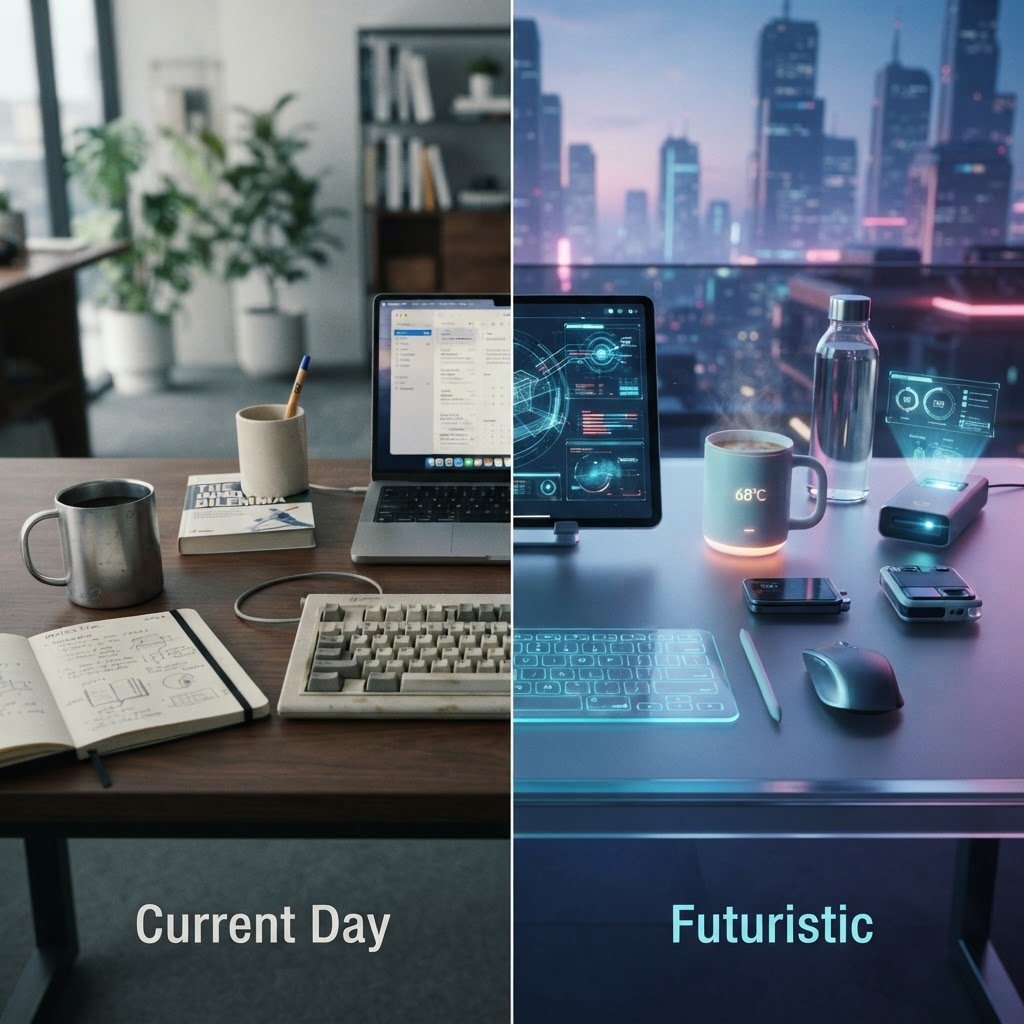
The slow march of technological evolution rarely announces itself with thunderous public reveals or overnight revolutions. Instead, the most profound transformations occur quietly, slipping into daily routines until the objects once deemed essential fade into historical relics. Think of the public payphone, the paper road map, or the incandescent lightbulb. Each was once an immutable fixture of modern life, yet each dissolved into nostalgia within a single generation. Looking forward to 2036, a similar quiet revolution is underway across material science, artificial intelligence, microfluidics, and solid-state physics. The ordinary, tactile world is on the cusp of a profound reshaping. Understanding how everyday things look different in 10 years requires peering past the flashy headlines of speculative science fiction and examining the subtle laboratory breakthroughs maturing today.
What makes this upcoming decade distinct is the convergence of ambient computing and bio-integrated materials. Objects that were once entirely passive—a brass key, a bathroom mirror, a woven cotton label—are acquiring sensing abilities, computing power, and dynamic adaptability. Rather than adding more digital screen real estate to existence, the future of industrial design points toward the deliberate invisibility of technology. The objects people touch, hold, and interact with every day are becoming smarter without becoming louder. Here is an exploration of ten familiar objects on the verge of total structural and functional transformation by 2036.
The Domestic Sanctuary Reimagined
Keys and locks are among humanity’s oldest security mechanisms, relying for millennia on shaped metal pins entering mechanical cylinders. By 2036, physical keys will exist largely as decorative artifacts or antique curiosities. In their place, secure entry is transitioning toward ultra-wideband ambient spatial awareness and electro-dermal recognition. Rather than fumbling for a brass key ring or punching a code into an electronic keypad, entry systems will measure unique physiological micro-vibrations, gait mechanics, and secure cryptographic handshakes emitted from wearable devices or skin-contact micro-transponders. The physical lock itself will dissolve into solid-state magnetic seals embedded seamlessly within doorframes, activating only when an authorized individual reaches for the handle. Loss of physical keys, locked-out panics, and duplicated metal teeth will be replaced by encrypted permission protocols that grant entry seamlessly as a person approaches.
Bathroom mirrors have remained functionally unchanged since sixteenth-century Venetian craftsmen silvered glass plates. Over the next decade, however, reflection will meet non-invasive clinical diagnostics. The mirror of 2036 will function as a daily health terminal without requiring a single touch or manual screen interaction. Utilizing multi-spectral optical cameras and micro-photoplethysmography, the glass surface will scan sub-surface vascular blood flow to measure blood pressure, pulse oxygenation, and heart rate variability in real time. Spectral analysis of facial skin will detect micro-pigmentation changes, early markers of vitamin deficiencies, and subtle signs of cellular stress long before physical symptoms emerge. Integrated ambient lighting will automatically calibrate color temperatures to match optimal circadian rhythms, transforming the morning routine into a quiet health consultation that alerts medical providers only when significant biomarkers drift off baseline.
Light switches and power outlets represent two of the most stubborn friction points in modern architectural design—rigid wall plates bound to copper wiring running behind drywall. Within ten years, physical toggle switches and standard plug sockets will appear as clunky artifacts of early electrification. Ambient energy harvesting and ultra-low-power kinetic switches are rendering wired wall controls obsolete, replacing them with paper-thin piezoelectric stickers that can be repositioned anywhere on glass, wood, or stone without electrical conduits. Simultaneously, directional wireless power transfer utilizing focused radio-frequency beamforming will begin replacing traditional prongs and wall sockets. Everyday appliances—lamps, wall clocks, desk accessories—will draw power continuously through ambient waves, eliminating tangles of cords and allowing furniture to be rearranged without regard to copper outlets set in baseboards.
Commerce, Consumption, and Household Waste
Paper receipts and physical currency have served as the tactile foundation of economic exchange for centuries, but their decline is entering its final stage. Paper receipts, printed on non-recyclable thermal paper coated with synthetic compounds, are rapidly being phased out in favor of encrypted, ephemeral transaction tokens. By 2036, physical register printouts will be completely replaced by automatic zero-knowledge cryptographic receipts pushed directly to personal financial ledgers at the moment of payment. Cash wallets, already diminished, will transition into historical relics as central bank digital currencies and unified peer-to-peer protocols eliminate physical bills and plastic cards entirely. The leather wallet, long a pocket staple, will be superseded by secure biometric authentication chips embedded in everyday wearables or personal communication hubs, turning commerce into an ambient, frictionless background event.
Kitchen refrigerators currently function as passive insulated cold boxes, relying on human memory and visual checks to prevent food decay. By 2036, the refrigerator will operate as a fully autonomous closed-loop food management engine. Outfitted with hyperspectral camera arrays and volatility gas sensors, future refrigeration units will continuously inspect every item inside, identifying microscopic fungal spores and chemical indicators of spoilage days before smell or visible decay occurs. Rather than relying on static printed expiration dates, internal software will dynamically calculate true freshness curves based on temperature history and biochemical decay. Integrated inventory ledgers will cross-reference regional farm availability and dietary needs, auto-generating meal plans that minimize waste and placing automated orders for staples before supplies run dry.
Trash cans and waste bins are historically passive receptacles that rely on manual human sorting—often leading to contaminated recycling streams and inefficient landfill disposal. The waste bin of 2036 will incorporate robotic micro-sorting mechanisms and optical sorting technology directly at the point of disposal. Utilizing rapid near-infrared spectroscopy and ultrasonic sensors, household waste units will identify material compositions—distinguishing compostable bioplastics, high-density polyethylene, metals, and organic matter in milliseconds. Internal mechanical baffles will segregate items into micro-compactors, reducing volume while sterilizing organic waste to prevent odor. By processing waste at the household level, municipal sanitation systems will transition from bulk trash collection to targeted resource recovery, dramatically boosting circular economy efficiency.
Personal Wearables and Adaptive Optics
Eyeglasses and screens are on a collision course that will fundamentally redefine human visual interaction. For decades, vision correction and digital screens existed as separate technological categories. By 2036, liquid crystal adaptive lenses and lightfield optical displays will merge prescription eyewear with spatial computing interfaces. Traditional static glass lenses will be replaced by dynamic liquid-crystal layers that adjust focal points instantaneously based on eye-tracking sensors, eliminating the need for bifocals or progressive lenses. Simultaneously, transparent micro-LED display arrays embedded directly in the glass will project high-resolution context layers—navigation prompts, real-time language translations, and ambient notifications—directly onto the retina. As lightweight optical frames mature, standalone television monitors, computer monitors, and smartphone displays will begin to seem unnecessarily bulky and redundant.
Clothing tags and fabrics currently rely on stitched polyester care labels, printed size tags, and static synthetic threads. Over the next decade, textile engineering will replace static fibers with energy-harvesting smart yarns and bio-responsive materials. Printed care labels will disappear entirely, replaced by microscopic, washable radio-frequency threads that store complete supply chain provenance, fiber composition, and wash instructions accessible via a quick scan. On a structural level, advanced fabrics will incorporate thermo-electric micro-fibers that harvest body heat to generate tiny electrical charges, powering integrated biometric sensors or active thermal regulation channels. Clothes will actively expand or contract weave density to respond to outdoor temperatures, rendering static seasonal wardrobes and scratchy interior tags obsolete.
Medicine, Diagnostics, and Personal Mobility
Prescription pills and medication bottles have long relied on mass-produced, standardized dosage strengths distributed in orange plastic bottles with printed labels. By 2036, this standardized pharmaceutical model will yield to 3D-printed personalized therapeutics and smart dosage delivery. Rather than taking multiple daily pills with fixed milligram dosages, patients will receive single multi-layer 3D-printed bio-compatible tablets designed to release active ingredients at precise circadian intervals throughout the day. Medication containers will evolve from plastic bottles into connected micro-dispensers that calibrate daily formulas based on real-time feedback from wearable blood-chemistry sensors. If metabolic rate or liver enzyme activity fluctuates, the dispenser adjusts the next morning’s dose accordingly, dramatically reducing adverse drug reactions and ending the era of one-size-fits-all pharmaceuticals.
Vehicle dashboards and steering wheels are undergoing a structural overhaul as autonomous driving systems move from experimental trials to widespread operational reality. The traditional vehicle cabin—dominated by a fixed steering column, mechanical pedals, physical instrument clusters, and rigid dashboards—will undergo a complete ergonomic transformation. By 2036, steering controls in personal mobility vehicles will be retractable or entirely solid-state, folding flush into the front bulkhead when autonomous highway pilot modes are active. Dashboards will transform into seamless, reconfigurable OLED surfaces that display environmental telemetry, productivity applications, or immersive relaxation visualizers. Physical switches and gear shifters will be replaced by gesture-based haptic interfaces and natural voice parsing, converting the automobile interior from a driver’s cockpit into an ambient living and working space.
The Invisibility of Tomorrow’s Objects
The reality of how everyday things look different in 10 years is not defined by flying cars or humanoid robots filling every doorway. Instead, the true revolution lies in the subtle, intelligent re-engineering of the ordinary. As material science, ambient sensing, and machine intelligence intertwine, the static objects that populated the twentieth century are awakening into adaptive, responsive partners. Keys that know their owners, mirrors that understand vascular health, and fabrics that regulate temperature are not distant science fiction—they are the logical outcome of research happening in laboratories today. By 2036, the most extraordinary technology will be the technology that disappears entirely into the background of everyday life, leaving behind a world that feels simpler, quieter, and remarkably more intuitive.