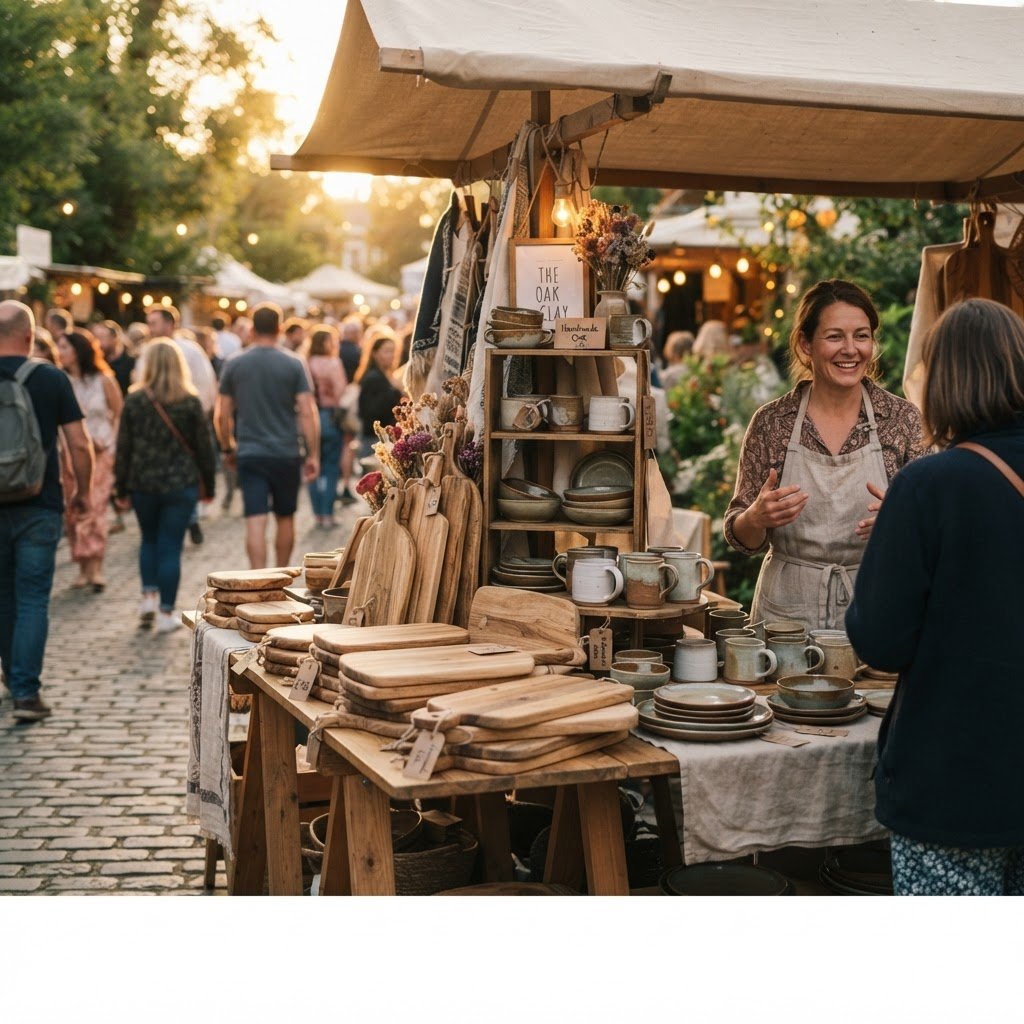
A perspective piece from The Listening Market
It usually starts with a friend saying the same thing twice. You bake, and people mention the baking. You build a little side table, and someone asks whether you could make one for them. You fix a neighbour’s bike on a Sunday and get handed a twenty they insist you take. The moment arrives quietly, without a business plan or a lighting rig: the realisation that a hobby is not only a pleasure but a product, and possibly a livelihood. What happens next is where the real story begins.
Turning a hobby into a small business has never been more plausible, and the evidence is everywhere. Markets report record applications from first-time stallholders. Ecommerce marketplaces overflow with one-person shops selling candles, cutting boards, illustrations, and sourdough. Governments have simplified micro-business registration to the point where a trading name can exist within an afternoon. The bridge between weekend passion and weekday income is shorter than it has ever been, and thousands of people are crossing it every month.
The honest audit comes first
Before any logo is drawn, the most useful move is an audit, and it needs to be ruthlessly honest on both sides of the ledger. On one side sits the craft: what is actually being made, at what standard, and how consistently. A hobby tolerates mood, fatigue, and inspiration-dependent output; a business does not. The brownies that arrive early to the market stall, the commissioned piece that lands when promised, the product that looks the same every single time. Professionals are people who show up after the warm feelings have gone home.
On the other side of that ledger sits demand, which is the only vote that matters. Friends are wonderful, and friends lie gently. Enthusiasm over a gifted batch of biscuits is affection, not a sales forecast. Real demand is a stranger parting with money without encouragement, more than once, and mentioning you to other strangers unprompted. That demand can be tested cheaply before anything permanent is committed to: a few paid sales at a market, a limited run, a notice on a community board. If the offers come, the idea has legs. If they don’t, the audit just saved a year.
Start small, on purpose
The businesses that survive their first year tend to share a discipline: they start embarrassingly small, and they stay small on purpose. A single product. A single channel. A stock level sized to one market table rather than a warehouse. This is not timidity; it is structural wisdom borrowed from manufacturers who never build the full production line before the prototype sells. Small means mistakes are cheap, feedback is fast, and the hobbyist can keep their day job and their savings intact while the idea proves itself.
Growth, when it comes, should be pulled by customers rather than pushed by ambition. Order backlog before extra equipment. Waitlists before extra product lines. Revenue before premises. Each stage of expansion funded by the last one tends to build a business that fits its owner, which matters more than it sounds, because the fatal failure mode of hobby-to-business journeys is not running out of money. It is running out of joy, and joy goes first when finances overreach. A profitable little business done at a humane pace beats a stressed empire built on sixty-hour weeks every time.
The craft is the easy part
Here is the part nobody warns you about, and every hobbyist-turned-founder learns within a quarter. Actually doing the craft is now a minority of the job. When the woodturner stops turning wood long enough to photograph it, price it, pack it, post it, chase the courier, answer the message about whether it comes in oak, and do the bookkeeping required to keep the tax office calm, the picture changes completely. Making the thing was the visible part of the operation, and the visible part was never the whole business.
Waiting respectfully at the gates of that realisation are the tools that soften it. Scheduling payments, automated receipts, a simple spreadsheet, an early session with an accountant so everything is set up right rather than fixed up later. None of these are glamorous, and all of them are load-bearing. The crafters who last are frequently not the most talented, but the ones who made peace with the admin, treating it as the professional half of the job rather than the boring half.
Pricing like you mean it
If the admin is the unglamorous half, pricing is the sacred and dangerous half, because nothing determines a small business’s survival like the number on the tag. The classic hobbyist mistake is counting materials and forgetting the human. Hourly craft time, equipment wear, packaging, platform fees, the portion of the power bill, and something for the future. Underpricing feels humble and generous, but it quietly guarantees exhaustion, because the business is working full hours for pocket money, and pocket money cannot carry a life.
Hobbyist pricing also warps the market for everyone else, a fact worth sitting with. If a market stall sells hand-thrown mugs for a price that barely covers clay, the stallholder down the row trying to earn a living from identical clay is sunk by generosity. Fair pricing is not just the seller being kind to their future self. It is an act of solidarity with an entire ecosystem of makers, and a sign to buyers that the work of hands carries actual value.
And buyers, at least the ones worth keeping, respond to that value rather than running from it. The customer who quibbles over price is rarely the customer who returns. People who buy from small makers are, overwhelmingly, buying the story as much as the object, and stories hold their value. The maker who charges properly attracts the audience that stays.
The tools that make one person enough
A large part of why this era is so kind to hobbyist businesses is the machinery now available to a single operator. Website builders, marketplace listings, card readers that fit in a pocket, bookkeeping software that does in minutes what once took a weekend. On top of the software sits the AI assistance layer, and it changes the arithmetic of solo business more than it gets credit for. Product descriptions, social captions, customer emails, listing copy, the email to a supplier drafted politely in the third attempt. The jobs that used to require either a partner or a hired pair of hands can now, in large part, be delegated to tools that cost a fraction of an assistant.
The result is a genuine historical anomaly. For most of the last century, going into business meant building a small organisation around yourself. Now it means assembling a toolkit. One person with discipline and a phone can operate like an organisation of five, and the hobbyists who embrace that stack frequently outperform established small businesses who are still doing everything by hand. Size is no longer the advantage it once was. Adaptability is.
Names, numbers, and the official world
Most jurisdictions have made the leap to official status mercifully light, but the leap still has to be made properly. A business name registered. A tax situation understood before, not after, the money arrives. Insurance considered, especially once the public is invited to touch the product. Rules around food handling checked before the first market stall, since councils take drinking, eating, and selling seriously, and rightly so. None of this is the fun part, and every founder who skipped a piece of it has a story about the day it caught up with them. The paperwork is, in its dreary way, the moat that separates the businesses that get to keep being businesses from the ones that end abruptly.
When the hobby needs to stay a hobby
There is a final honest question worth asking before any of it, and it is not about the market. It is about the relationship between the person and the thing they love. Some hobbies are sacred precisely because they owe nothing to anyone, and monetising them changes what they are. The baker whose every weekend already means twenty orders has lost the idle Sunday bake. Prices, deadlines, and customer expectations reshape the craft from inside, and not everyone finds the reshaped version still feels like theirs.
For some, the answer is keeping the hobby pure and finding income elsewhere, which is a perfectly good business decision in disguise. For others, the commercial version of the craft sits comfortably beside a small private one, the paid work funding the materials for the play. And for a lucky group, the work itself remains the joy, and the business is simply the joy wearing a nicer jacket. Distinguishing which group anyone belongs to, early, is the single most valuable piece of market research a hobbyist will ever do.
The path is shorter, and it starts early
The trajectory from gifted batch to business rarely follows a straight line, but it follows a shorter one than it used to, because all the connecting infrastructure already exists. The honest audit, the deliberately small start, the pricing that respects the human behind the product, the admin done before it compounds. Somewhere out there, a friend has just said for the second time that someone really should sell these. The distance between that sentence and a real business is now a season of weekends. For the people who make the crossing, the strange discovery waiting on the other side is that the business never quite replaces the hobby. It just finds more people for it.