A perspective piece from The Listening Market
There is a particular kind of tiredness that comes not from doing too much, but from looking at bright things for too long. Anyone who has spent a full working day moving between a laptop, a phone and a television knows the feeling: a faint grain behind the eyes, a restlessness that sleep does not quite cure. It was this tiredness, more than any clever marketing campaign, that quietly revived an old technology.
Electronic ink, or e-ink, has been around for decades. For most of that time it lived a narrow life inside e-readers, where its paper-like matte finish and extremely long battery life made it the obvious choice for reading books in direct sunlight. Everywhere else, it lost out to the vivid, glowing colour screens that dominate modern life. Then, sometime in the last couple of years, something shifted. E-ink began showing up in unexpected places: as a second monitor on a software developer’s desk, embedded in the wall of a design studio, wrapped around a mobile phone case, even displayed on the side of a supermarket fridge label. The technology did not change dramatically. What changed was what people wanted from their screens.
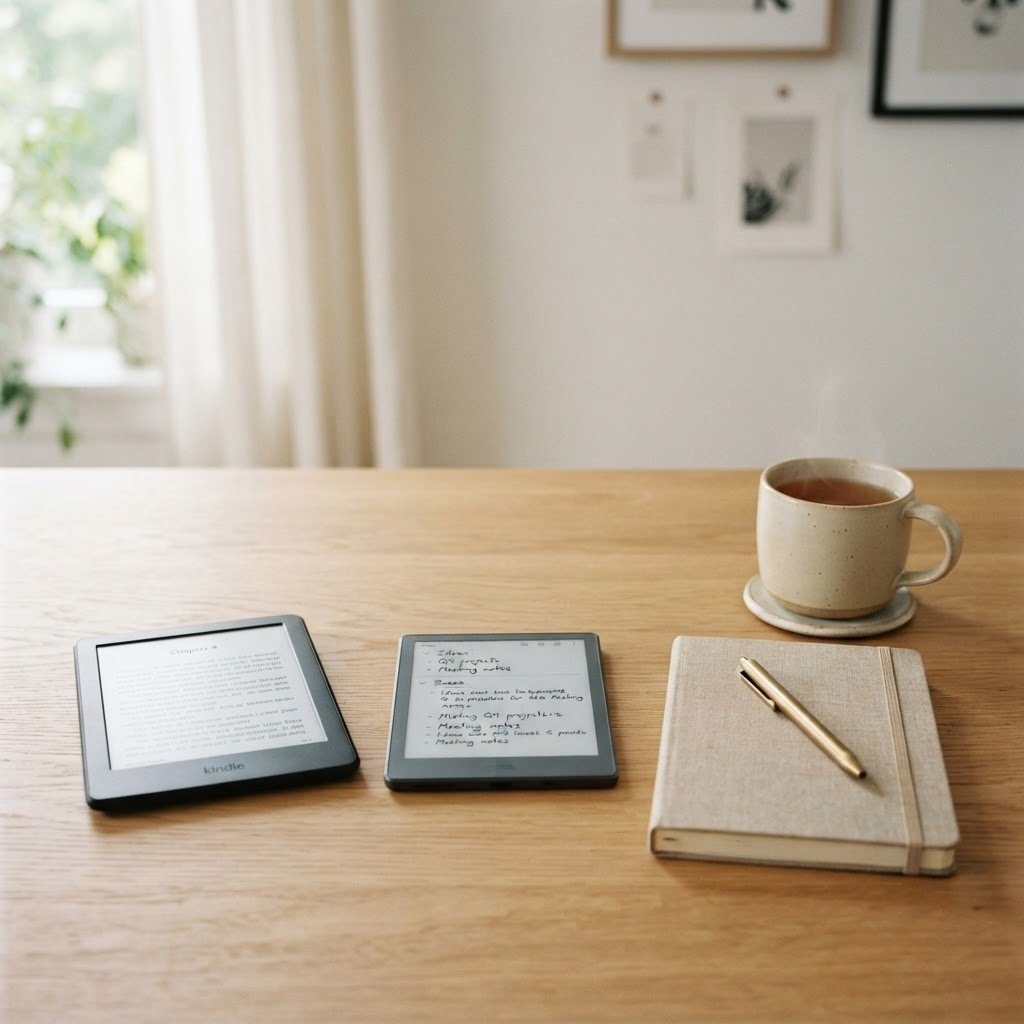
The trend has a name that has started appearing in product design circles: calm technology. The idea is simple. Most modern screens are attention machines, engineered to be bright, moving and impossible to ignore. A calm screen does the opposite. It displays one thing, it does not glow, it does not flicker, and it asks nothing of the eyes. E-ink is almost uniquely suited to this role because of how it works. Rather than shining light at the viewer, tiny pigment particles rearrange themselves on the surface of the display, the way ink settles on paper. The image stays on the screen without any power at all until it is changed. The result is a display that reads like a printed page, whether it is showing a calendar, a to-do list or a chapter of a novel.
A screen that listens
The first wave of adopters was oddly specific: programmers, writers and anyone whose work involves long stretches of text. A secondary e-ink monitor, small enough to sit beside a main display, became a cult item among software engineers who wanted their code documentation somewhere that did not glare back at them. From there the idea spread. Productivity enthusiasts began using e-ink tablets to formulate weekly plans, finding that writing on a paper-like surface produced a slower, more deliberate kind of thinking than typing into a glowing note-taking app. Some replaced the family noticeboard in the kitchen with an e-ink display synced to a shared calendar, a compromise between the paper calendar’s charm and the digital calendar’s convenience.
What all these uses share is a deliberate narrowing of what a screen is for. An e-ink display is bad at video, bad at games and bad at advertisements, and that is precisely the point. Users are not buying a better screen. They are buying a calmer one.
The numbers suggest the shift is more than a niche enthusiasm. Sales of e-ink note-taking tablets have climbed steadily, and major phone and accessory manufacturers have released e-ink companion devices, which sit alongside a smartphone and mirror only notifications worth reading. Even the fashion world has joined in, with e-ink appearing on bags and jackets, less as a gimmick and more as a statement about how much of life should glow.
The pull of the paper-like
Underneath the product trends sits a deeper rethinking of the relationship between people and their devices. The decade that just passed rewarded screens that could hold attention for as long as possible. The decade now beginning seems to be rewarding the opposite. Screen-time limits, grayscale phone displays, phone-free bedrooms and app deletions all grew from the same root: a widespread sense that the brightest rectangle in the room is taking more than it gives.
E-ink fits neatly into this new mood because it reverses the usual bargain. A colour tablet invites endless grazing through feeds and short videos. An e-ink reader offers one activity, done properly, and then runs for weeks without needing a charger. There is a quiet honesty to the format that people appear to find restorative, the technological equivalent of a room with good daylight and no television.
There are still limits, and calm technology’s advocates are usually the first to admit them. Refresh rates remain slower than liquid crystal screens, colour e-ink still looks muted next to even a modest phone display, and the devices often cost more than the glossier products they replace. For fast, visual, interactive work, the traditional screen remains unmatched, and nothing about the e-ink trend suggests it will replace the laptop monitor any year soon. Its role is complementary: the screen that handles the slow, deliberate parts of life while the vivid screens handle everything else.
Beyond the desk and the kitchen wall
The quiet spread of e-ink is easiest to see at the edges of ordinary life, in places where screens were previously considered too costly, too bright or too power-hungry. Public transport cards, shelf labels in supermarkets, hotel key cards and conference badges have all been quietly converting for years, precisely because an e-ink tag can hold a crisp image for months on a whisper of battery. Bus stop timetables that update themselves over a wireless connection, then sit perfectly readable in harsh afternoon glare, have become unremarkable in cities that would once have neededfragile, glowing panels for the same job. Each of these small conversions follows the same logic as the consumer trend: put the display where a screen’s brightness is a flaw, not a feature.
The movement indoors has followed a similar pattern of solving for the conditions rather than the spectacle. An e-ink picture frame that displays a slow rotation of family photographs does not light up a dark hallway at night or compete with the television. A bedside clock with a paper-like face answers a generation of complaints about glowing bedroom electronics. Even the lowly door sign has been quietly reinvented, with meeting-room labels that sync to a booking calendar while looking, from across the office, exactly like paper. None of these products perform any trick that a tablet could not technically manage. They simply perform it with manners, and in the post-attention economy, manners appear to be a selling point.
The reading revival that started it all
It is worth remembering that the oldest e-ink category, the e-reader, is itself enjoying a renaissance rather than a decline. Sales of dedicated reading devices have grown year after year, bucking every prediction that the smartphone would swallow the task of reading books. The explanation offered by readers themselves rarely involves the screen technology at all; it involves what the technology prevents. A book read on a phone is one notification away from becoming something else entirely. A book read on an e-ink device tends to remain a book, from the first page to the last, for hours at a time.
That distinction, between a device that makes reading possible and a device that makes reading inevitable, now drives an entire ecosystem of reading-focused products: minimalist e-readers with no app store, subscription services that reward finishing long books, and reading trackers that measure pages rather than streaks. The e-reader became, in effect, the proof of concept for the whole calm-technology movement: strip the distractions, keep the utility, and people will pay a small premium to feel human at the end of the evening. The rest of the e-ink industry, whatever it may claim about innovation, is mostly working outward from that one early, accidental piece of wisdom.
Living with less glow
It is tempting to frame every reaction against technology as nostalgia, a longing for a pre-digital past that cannot actually be revived. But the e-ink story is not really about going backwards. The displays are intensely digital, packed with microelectronics and often connected to cloud services. What is old-fashioned about them is only the texture of the experience. They suggest a future in which technology does not have to announce itself with brightness, and in which a screen can be as unobtrusive as a well-printed page.
That may be the real reason the trend is spreading quietly rather than loudly. Calm technology cannot be sold with the usual dazzle, because dazzling is exactly what it promises not to do. Instead it spreads the way good habits do, one person at a time, when someone notices that a friend’s reading device lasts three weeks on a charge, or that a colleague’s spare monitor looks like a sheet of paper from across the room.
In a world that has spent two decades racing to make screens brighter, faster and more addictive, the appeal of a screen that does none of those things says something about how people want to live now. Not less technology, but better manners from it. The printed page has been quietly dying for years, and yet its ghost keeps reappearing inside new devices, softer spoken than the original. E-ink is that ghost, and in 2026 it seems to have found a home.
◂