A perspective piece from The Listening Market
In the corner of a small café in a university town, a nutritionist sketches a diagram on a paper napkin. It is not the food pyramid her clients were taught in school, nor a plate divided into coloured wedges. It is a single wobbly outline of a human torso, with a cluster of small arrows pointing to the middle and, around the edges, lines running outward to the brain, the skin, the heart, the immune system, even the mood. She draws this napkin diagram several times a week now, because it is the fastest way to explain the idea that has quietly reshaped how people think about food: that the middle of the body, long treated as a simple digestion machine, might be the closest thing the human body has to a control room.
The centre of that control room is the gut: trillions of bacteria, fungi and other microbes living mostly in the large intestine, collectively weighing a couple of kilograms in an average adult. For most of modern history, this colony was considered either irrelevant or mildly unfortunate, a source of complaints to be managed rather than a feature of health to be cultivated. Over the past decade, that view has been steadily collapsing. Research linking the gut microbiome to digestion, immune function, skin condition, energy levels and even emotional wellbeing has moved from specialist journals to ordinary conversation. And in the last couple of years, it has moved into the supermarket.
From the laboratory to the supermarket aisle
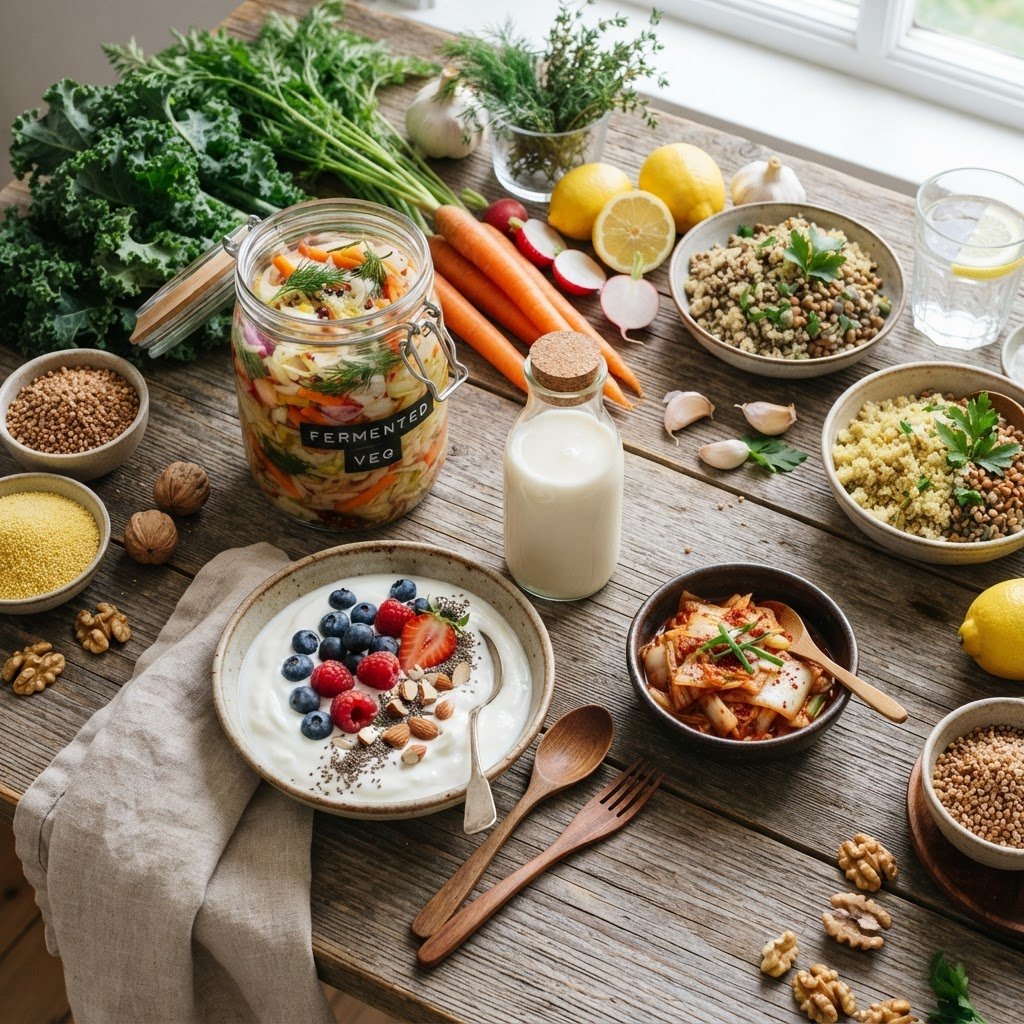
The grocery evidence is impossible to miss. Shelves that once held a modest section of yoghurt now hold entire refrigerated bays of fermented products: kefirs in a dozen flavours, kombuchas competing for the same shelf space as soft drinks, kimchi and sauerkraut migrating from specialty stores into mainstream aisles. Labels that once shouted about fat content now draw attention to cultures, fibre and something called live bacteria. Restaurants have followed, with fermented foods moving from the edge of the menu to the centre, and even fast-casual chains quietly adding a kimchi or a house-fermented pickle to their signature dishes.
Around the edges sit the fibre products. Powdered greens, chia and flaxseed, high-fibre pasta, breads whose packaging now lists fibre content more prominently than calories. None of these categories is new. What is new is the reason people give for buying them, which has shifted from general healthiness to something much more specific: feeding the gut.
The specifics matter, because the science behind the trend is more interesting than the marketing. The microbes in the gut are not passive residents; they extract energy from food, manufacture certain vitamins, train the immune system and produce chemical signals that travel elsewhere in the body. Their favourite food is fibre, which human digestion cannot break down but bacterial fermentation can. A diet low in fibre starves this colony, and a starved colony produces a narrower range of those signals. The modern diet, heavy in ultra-processed foods and light in plants, has quietly become a famine for the microbiome, and the growing pile of research connecting that famine to broader health outcomes is what the supermarket trend is actually responding to.
The second brain, carefully described
No part of the gut-health story has captured the popular imagination like the link to mood and mental wellbeing. The gut is home to an enormous portion of the body’s serotonin receptors and is wrapped in a dense network of nerves, sometimes informally nicknamed the second brain for its ability to operate independently and communicate constantly with the one in the skull. Research exploring connections between gut bacteria and conditions such as low mood and anxiety remains young, and anyone promising that fermented foods will fix a mind is selling something. But the plausible middle ground, where gut health influences energy, sleep quality and how the body responds to stress, has proven quite wide enough to change how millions of people eat.
That careful distinction is characteristic of how this trend has developed. Unlike many food fads, gut health has a rare quality: it mostly encourages people to eat things that were always worth eating anyway. Vegetables, legumes, whole grains, fermented dairy, live cultures and diverse plants form the practical core of nearly every version of the advice. The trend has also revived genuinely old food traditions, since fermentation is one of the oldest preservation methods, and the foods it celebrates, from miso to sourdough, are among the most ancient things humans make. In this sense, the gut-health movement is less an invention of modern marketing than a return, wearing laboratory confirmation, to eating patterns that predate food science entirely.
The everyday signals people actually notice
For all the laboratory language, the gut-health trend lives or dies on everyday observations, and this is where its popular endurance becomes easier to understand. People who change their eating in the direction of more plants and fermented foods frequently report the same small cluster of effects: steadier energy through the afternoon, more predictable digestion, skin that settles down, and mornings that start more easily. Medical research may debate mechanisms and magnitudes for years, but an individual noticing their own afternoon slump fade has all the proof they personally require. The trend’s self-reinforcing loop, in which people feel the difference, keep eating accordingly, and tell others, is built on direct felt experience rather than on trust in labels, and famously durable for exactly that reason.
Diversity is the other half of the practical advice, and the number most often repeated is thirty: thirty different plant foods per week, an idea popularised by researchers studying the relationship between dietary variety and microbial variety. The target sounds demanding until it is explained that herbs, spices, nuts, seeds, grains, beans and the different colours of vegetables all count separately, whereupon it becomes a surprisingly achievable planning exercise. Some home cooks have turned the count into a gentle game, keeping tally on the fridge; groceries report customers reaching for a second or third vegetable variety purely, it seems, to nudge the weekly tally upward. Whatever microbiologists eventually conclude about the precision of the number, it has already achieved something dietary advice has struggled with for decades: it makes adding plants feel like an achievement rather than a punishment.
There is also an overlooked social benefit to the way this trend is being absorbed. Gut health has quietly become a shared household language, one of the few nutrition topics that crosses generations, since fermented and fibre-rich foods exist in nearly every food tradition on earth. A grandmother’s fermented cabbage recipe, a parent’s weekday legume habit and a teenager’s kefir smoothie all belong to the same conversation now, which is rare in an era when food advice usually arrives fragmented by demographic and platform. When the science finally settles, whatever the detail, the eating habits the fashion leaves behind will be among the least harmful any food trend has ever produced, which is a low bar, but one the industry has spent decades clearing.
Where the trend goes next
The commercial end of the movement is already racing ahead of the evidence. Personalised microbiome testing kits promise a detailed readout of an individual’s inner ecosystem, and startups sell precision probiotics matched to those results. This is where the trend becomes fragile. The science of the microbiome is complex, still young, and resistant to the one-supplement-fixes-all story. Health bodies have begun cautioning consumers about overstated claims, and there is a real risk that the credibility of the whole field gets spent on products that promise more than microbes can deliver.
Yet even if the commercial froth settles, the underlying shift looks durable. For decades, healthy eating was framed mostly around subtraction: less fat, less sugar, less salt, fewer calories. Gut health, for all its hype, has introduced a new and more positive grammar into food conversation, one that revolves around adding: more plants, more variety, more fermented foods, more different kinds of daily bread. People find additive advice easier to follow and easier to keep following, which may be the quiet reason this trend has a different feel to the diet fads that preceded it.
Back at the café, the nutritionist finishes her napkin diagram and hands it over. Her client folds it carefully, pockets it, and orders a bowl of the house yoghurt with stewed fruit. It is a small scene, repeated in different forms in thousands of kitchens, supermarkets and clinics, and it adds up to something larger: the slow arrival of the gut, after years in the scientific background, as an ordinary part of how people think about being well. Not a miracle, not a shortcut, but the middle of the body, finally getting the attention it always quietly deserved.