A perspective piece from The Listening Market
It is a strange exercise to imagine the place where everyday life will happen a decade from now. The home has always been a mirror of the era that builds it, reflecting values, technologies, and anxieties in equal measure. Looking ahead to 2035, the reflections are already starting to come into focus.
The most obvious force shaping the homes of the future is artificial intelligence. Not in the way smart homes have been marketed for the past decade — a thermostat that learns a schedule, a doorbell with a camera. That version of the smart home always felt like a collection of disconnected gadgets. The home of 2035 is likely to be something more integrated, more ambient, and frankly, more useful.
Imagine walking through the front door and the house responding the way a good assistant might. Lighting adjusts to the time of day and the mood of the person entering. The kitchen has already noted that the milk is running low and added it to a shopping list. The climate system has anticipated the afternoon heat and pre-cooled the bedroom. None of this is science fiction — the building blocks exist today. What is coming is the layer of intelligence that ties them together and makes the whole thing feel seamless rather than fragmented.
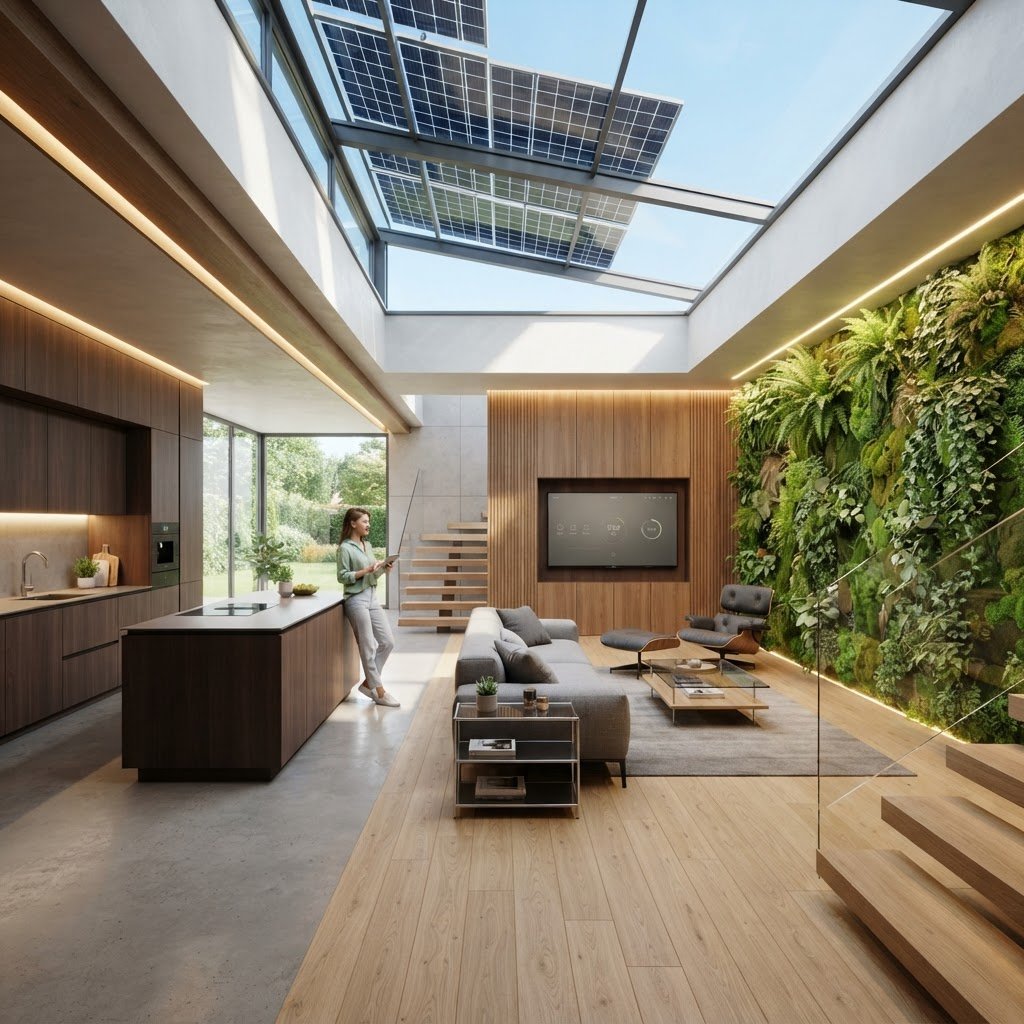
Energy will be central to how homes evolve. The push toward sustainability is not slowing down, and by 2035, the idea of a home that generates its own power could be unremarkable rather than progressive. Solar panels integrated directly into roofing materials, home battery systems that store excess energy for evening use, smart grids that sell power back to utilities during peak demand — these technologies are already available, and they will only become cheaper and more efficient.
Water is the next frontier. As climate pressures intensify, homes are likely to incorporate far more sophisticated water management than the simple low-flow fixtures of today. Greywater recycling systems, rainwater capture, and smart irrigation that responds to weather forecasts could become standard features rather than eco-luxury add-ons. The home of 2035 might use a fraction of the water a typical household uses today.
The way space is used inside the home is also changing. The pandemic accelerated a shift that was already underway — the home is no longer just a place to sleep and eat. It is an office, a gym, a school, a restaurant, a cinema. This multifunctionality is pushing design in interesting directions. Rooms that can transform throughout the day, furniture that serves multiple purposes, acoustic design that allows one person to take a video call while another reads in silence — these are becoming real considerations in how homes are planned.
The kitchen deserves particular attention. For decades, the kitchen has been the heart of the home, and that is unlikely to change. But what happens there is shifting. Automated cooking devices are improving rapidly. By 2035, the idea of a kitchen that can prepare a week’s worth of meals with minimal human involvement is not far-fetched. This is not about replacing the joy of cooking — it is about removing the drudgery from the parts of food preparation that nobody enjoys.
Growing food at home could also become more common. Hydroponic systems that fit on a countertop, producing fresh herbs and leafy greens year-round, already exist. As these systems improve and come down in price, a small kitchen garden that requires no soil, no sunlight, and almost no maintenance could become as normal as having a microwave.
Health monitoring will move quietly into the home. Beyond sleep trackers, homes of the future might include sensors that detect changes in gait, balance, or daily patterns — subtle signals that can indicate health issues before they become crises. For aging populations especially, this kind of ambient monitoring could allow people to stay in their homes longer, safely and with dignity.
The bathroom could become something of a diagnostic station. Smart mirrors that analyse skin condition, toilets that monitor hydration and metabolic markers, scales that track body composition over time — these are not wild speculations. They are products in development today, and they point toward a future where the morning routine includes a passive health check without any conscious effort.
Materials will change too. The environmental cost of construction is coming under increasing scrutiny, and the industry is responding. Engineered timber, recycled composites, 3D-printed components, and bio-based materials are all gaining ground. The home of 2035 might be built from materials that sequester carbon rather than emit it, and that can be disassembled and reused rather than demolished and sent to landfill.
Modular construction is another trend worth watching. Building a home in a factory and assembling it on site is faster, cheaper, and more precise than traditional construction. As the housing affordability crisis deepens in many parts of the world, modular approaches could make homeownership accessible to people who are currently locked out of the market entirely.
The relationship between indoor and outdoor space is shifting as well. Biophilic design — the incorporation of natural elements into built environments — is gaining evidence and adherents. Homes of the future may blur the line between inside and outside more deliberately, with indoor gardens, natural ventilation systems, and materials that connect occupants to the natural world. This is not just aesthetics. Studies consistently show that connection to nature improves mental health, and designing for that connection is becoming a priority.
Privacy will be one of the great tensions of the future home. Every smart device is a potential data collection point, and the more integrated the home becomes, the more information it generates about the people living in it. Who owns that data, who can access it, and what it is used for are questions that have not been adequately answered. The home of 2035 could be either a sanctuary of privacy or a panopticon, and which one it becomes depends on choices being made right now.
The aesthetic preferences of future homeowners are also evolving. The maximalist trends of recent years may give way to something more restrained. There is a growing appetite for homes that feel calm, uncluttered, and restorative — spaces that offer relief from the noise of the outside world. Whether this manifests as minimalism, wabi-sabi, or something entirely new, the direction is toward simplicity and intentionality.
There is also the question of what happens to existing homes. The vast majority of homes that will exist in 2035 have already been built. Retrofitting them — upgrading insulation, installing smart systems, improving energy efficiency — is arguably more important than designing new ones. The challenge is making retrofitting affordable and accessible, not just something available to the wealthy.
Community design is the often-overlooked dimension of the future home. The most thoughtful predictions about housing do not stop at the front door. They consider how homes connect to each other, to shared spaces, to transportation, and to the broader neighbourhood. The most desirable homes of 2035 might be the ones that are part of communities designed for human connection rather than isolation.
Predicting the future is a humbling exercise. The homes of 2035 will be shaped by forces no one can fully anticipate — economic shifts, climate events, technological breakthroughs, cultural movements. But the direction of travel is visible. Homes are becoming smarter, greener, more adaptable, and more focused on wellbeing. They are being reimagined not just as shelters but as systems that actively support the people who live in them.
The home has always been more than a building. It is where life happens, where relationships form, where days begin and end. The technology and design of 2035 will not change that fundamental truth. But they might make the home better at its job — more comfortable, more sustainable, more attuned to the needs of the people inside it.
If the homes of the past century were built around the automobile and the television, the homes of the coming decades may be built around energy independence, health, and the simple human need for a place that feels genuinely restorative. That is a future worth looking forward to.