
A perspective piece from The Listening Market
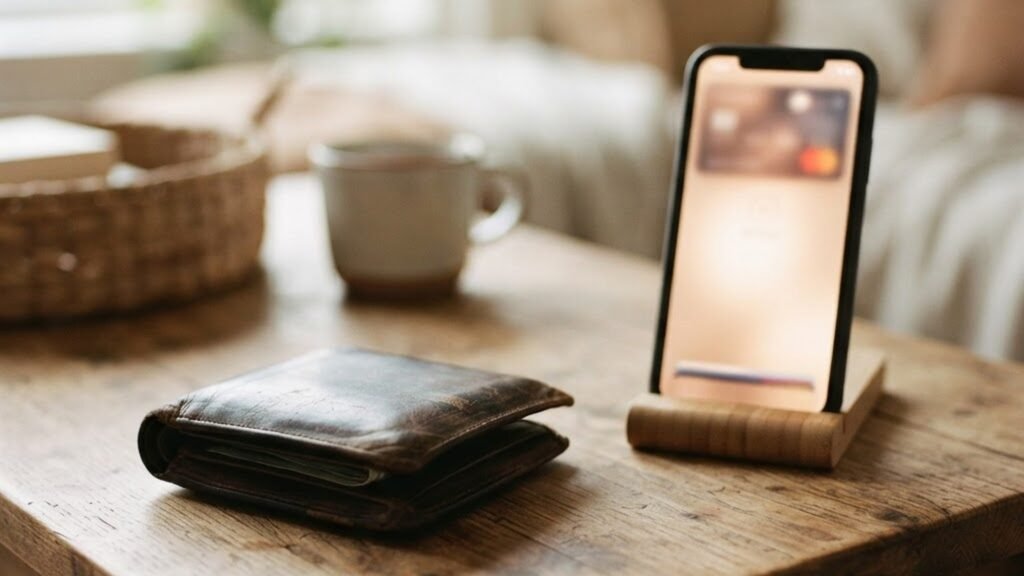
There is a specific moment of quiet panic that most people know well. The line at the cafe is moving quickly, the barista is waiting, and the wallet is nowhere to be found. Or the card is there, but it has been demagnetised by a phone case, or left in a jacket that is now hanging at home. For decades, that small rectangle of leather was so essential that leaving it behind felt like leaving the house half-dressed. Yet somewhere in the past few years, the tap of a phone replaced the fumble for a card, and the wallet quietly moved from a daily companion to a drawer’s forgotten resident.
The rise of digital wallets has been less of a revolution and more of a gentle phasing out. Nobody held a ceremony. There was no single week when the world abandoned leather and plastic. Instead, the shift happened one small convenience at a time, until a whole category of everyday object started to look like a relic of a slower, more cluttered era.
The wallet was never really about money
It is worth remembering what the physical wallet actually carried. Beyond a few banknotes and cards, it held a driver’s licence, a transit card, a coffee loyalty stamp, a folded receipt of something worth returning, a health insurance card, and photos from an era before phones stored thousands of them. The wallet was a portable filing cabinet for identity. Its magic was not the cash inside but the sense that necessary proof of existence lived in a back pocket.
Digital wallets did not simply replace the payments layer. They took on that deeper role as a container for identity. Boarding passes, event tickets, membership cards, vaccination records, hotel keys, and transit passes all migrated into the same pocket of glass and aluminium. In doing so, the digital wallet stopped being a payment tool and became something closer to a personal binder of everyday life. The physical version, emptied of its duties, now often holds little more than a licence and a forgotten gift card.
Why the shift happened so fast
Several forces aligned at once. The pandemic pushed people away from cash and shared touchscreens, accelerating the preference for contactless everything. Banks and phone makers settled their long standoffs over tokens and security, and the tap-to-pay experience became genuinely smoother than using a card. Merchants upgraded their terminals. And critically, the fallback options vanished: fewer buses accept cash, more restaurants present a QR code before a paper menu, and parking meters increasingly expect an app rather than coins.
There is also a quieter reason the shift stuck. Digital wallets removed friction so completely that going back now feels like a chore. Typing a card number into a website feels almost archaic when a browser can auto-fill it from a stored wallet. Handing over a physical card feels slower than a phone hovering near a terminal. Once convenience crosses a certain threshold, habits stop being decisions and become defaults.
The-security-story-that-changed-the-habit
For years, the biggest barrier was not technology but trust. People feared that a lost phone would become a lost fortune. The opposite turned out to be a persuasion story told by experience. A lost wallet can be emptied within minutes. A lost phone is a locked, locatable, remotely-wipeable brick of glass that requires a face or fingerprint to authorise even a single tap.
Every digital wallet transaction also uses a one-time token rather than a real card number, which means the merchant never actually sees the account details. Panicked card replacements became rarer not because breaches stopped, but because the leaked number was often a throwaway token. Security did not need to be explained perfectly; it simply had to be experienced during enough small moments of loss and recovery. Trust followed the anecdote.
What the emptied wallet leaves behind
The consequences reach further than pockets. Cash usage has declined to the point where entire categories of small businesses now run card-first operations. Vintage and designer wallets survive mostly as fashion statements rather than tools. The leather goods industry has responded with slimmer designs for a market that carries less, while a growing number of people carry no wallet at all and would struggle to produce a physical card if asked.
There is a generational edge to this too. For younger spenders, the physical wallet was never a foundational habit, but an optional accessory. Asking a teenager to produce coins is increasingly like asking them to fax something. As that cohort grows into the majority of household spending, merchants, banks and app builders are designing for a wallet-first world where cash is the edge case, not the baseline.
The remaining friction, and what it says about the change
The transition is not total. Small shops that prefer cash, rural areas with patchy connectivity, tipping screens, splitting a bill at a restaurant table, and the occasional system outage still send people digging for a card. Some keep a slim backup in a travel bag out of caution, a modest hedge against a digital hiccup. But the direction of travel is unmistakable. Each year, the exceptions shrink and the wallet-first flow becomes more standard, from transit gates to school canteens.
What makes this shift quietly fascinating is how little it demanded of anyone. Most life-changing technologies announce themselves loudly and require effort to learn. Digital wallets did the opposite. They slipped into an existing gesture, made it slightly easier, and waited. Within a handful of years, carrying a wallet of overstuffed leather started to feel like carrying a paper map on a road that already has perfect signage.
What it means to carry almost nothing
There is a subtle psychological effect worth noticing. The physical wallet imposed a kind of discipline on leaving the house. It held the cards that were needed and the small courage of preparedness. The digital wallet removed that ritual, and with it, a small but constant awareness of money as a physical thing. Some people find this freeing, a welcome abstraction away from coins and paper. Others feel it loosened their grip on how much they actually spend, since a tap hides what bills and change once made visible.
The next chapter is already forming around that abstraction. Wallets are beginning to hold digital identity credentials, driver’s licences, and workplace badges, with banks and governments testing versions that could make the phone the single object required for nearly everything. The end state of this quiet revolution is not a better wallet. It is the disappearance of the category altogether, replaced by an invisible layer woven through a device that was going to be carried anyway.
The wallet around the world
The pace of the shift varies fascinatingly by geography. In parts of Asia, mobile wallets skipped the card era almost entirely, jumping from cash to QR codes and super-apps in a single generation. In Europe, contactless cards arrived first and remain stubbornly convenient, so phones share pocket duty with plastic. In Australia, the tap-and-go habit took hold so completely that cash now accounts for a small and shrinking slice of everyday payments. The physical wallet is not dying at one speed everywhere, but everywhere it is dying.
Cash itself has become a low-frequency event, reserved for school canteens, markets and the occasional gift envelope. That low frequency has a compounding effect: the less cash is used, the less prepared businesses are to accept it, which further reduces the occasions for carrying it. Each year the loop tightens, and the wallet’s core original job, holding money, quietly disappears from the list of daily needs.
The queue that no longer exists
Consider how much of daily life once revolved around the physical trappings of payment. Queues at ticket windows, fishing for exact change at toll booths, signing paper receipts at restaurants, visits to the bank teller for notes and coins before a weekend away. The disappearance of those little rituals has quietly given people back hours of their month, and it has reshaped entire service industries around the expectation that payment is instant and invisible.
There is a trade-off hiding in that invisibility, and responsible spenders have learned to notice it. When paying becomes frictionless, the emotional speed bumps that once slowed impulse purchases vanish with it. The people who adapt best are those who rebuild guardrails in the new medium: spending summaries in banking apps, instant payment notifications, and the deliberate act of checking a balance as routinely as counting notes once was. The wallet of the future is lighter, and managing it honestly is the skill that replaces remembering to bring it.
None of this required a dramatic break with the past, which is precisely why it succeeded. The strongest habits are not broken by force. They are replaced by something that fits the same shape but asks less of the person holding it. The wallet is not being mourned, and that may be the deepest evidence of its retirement. It simply stopped being necessary, one tap at a time.