A perspective piece from The Listening Market
For a while, the foldable phone looked like technology’s most expensive punchline. The first bendable devices arrived with eye-watering price tags, visible hinges, screens that cracked along their creases, and a polite question hovering over every demo: why would anyone actually need this? Early reviewers treated them as curiosities, the kind of gadget bought to be seen with rather than used. A few short years later, the joke has quietly worn off. The devices on shelves in 2026 are thinner than the flat flagships people once defended so fiercely, and the buyers queuing for them are no longer enthusiasts with money to burn. They are commuters, students, grandparents, and accountants. Foldable phones are finally having their mainstream moment, and the story of how that happened says a great deal about how technology really matures.
The early chapters are worth remembering, if only because they were so rough. The first book-style foldables were thick enough to resemble two phones glued together, and their folds arrived with a visible seam down the middle of the screen, a crease that caught the light like a scar. The hinge attracted lint. The battery, split awkwardly across two halves of the device, struggled through a day. The software was worse: apps that were designed for rectangles simply stretched, leaving users with grey bars around stretched content and interfaces that treated half the screen as though it did not exist. It was a laptop-sized promise delivered with a first-app roughness, at more than twice the price of a very good ordinary phone.
What changed was not one breakthrough but a thousand small, stubborn refinements. Engineers shrank the hinge mechanism year after year until the fold sat nearly flush. New composite layers and ultra-thin glass let screens bend hundreds of thousands of times without showing their history. Displays became brighter and less reflective, batteries slotted more efficiently, and the devices themselves thinned down until a closed foldable no longer felt like a brick in a pocket. None of these steps was glamorous on its own. Together they did the silent work that turns a demo into a product.
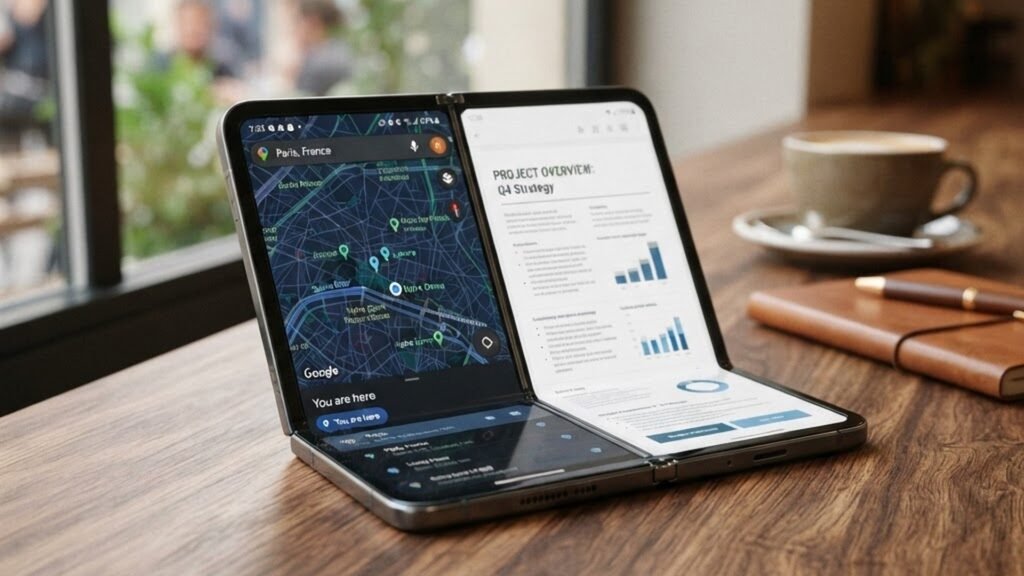
Software went through the same quiet transformation. Developers stopped stretching their apps and started designing for the fold: spreadsheets that placed two panels side by side, messaging apps that kept a conversation on one half and a photo gallery on the other, video players that filled the big screen while controls stayed on the small one. The operating systems learned new habits too, with taskbars, drag-and-drop, and app pairs that remember what runs beside what. On a modern foldable, opening the device feels less like rotating a tablet and more like unfolding a small study: the tools are simply there, arranged the way work actually happens.
Price was the third wall to fall, and it fell gradually. Early foldables sat near the very top of the market, a luxury of luxury devices. As manufacturing yields improved and competition multiplied, the numbers slid down the ladder. By 2026, a perfectly respectable flip-style foldable costs about what a mid-range flat phone did a few years ago, and trade-in programs have made even the book-style devices reachable for ordinary budgets. A technology that once signalled excess now signals little more than a preference. That shift, from status symbol to sensible option, is the exact moment when a gimmick becomes a category.
The forms themselves have settled into two clear personalities, which has helped buyers stop feeling like they were gambling on a strange new species. Flip-style devices fold in half across the middle, becoming satisfyingly small squares that vanish into a pocket or a small bag, with a cover screen for the essential glance-and-reply rituals. Book-style devices unfold into something the size of a small tablet, carrying split-screen work, reading, streaming, and maps on a surface that still fits in a jacket when closed. The two forms answer different lives: one chases compactness, the other chases a bigger canvas. Between them, they cover most of what people actually want a phone to be.
The mainstream also arrived because foldables found their people in unexpected demographics. Grandparents discovered that a seven-inch inner screen makes video calls with grandchildren feel closer and makes text large enough to read comfortably. Students found that one unfolding device replaced the phone-and-tablet combo they carried to class. Small-business owners realised they could review documents, invoices, and product photos on the train home without carrying a laptop. In each case the pitch was never about folding at all; it was about fitting more screen into the same life. The fold was simply the delivery mechanism for something people quietly wanted all along.
Durability, the loudest objection of the early years, has largely answered its critics. Water resistance that once seemed impossible in a device with a moving seam is now standard across most premium foldables. Hinges are rated for hundreds of thousands of folds, which at a hundred opens a day means years of sturdy use, and warranties have grown more forgiving as manufacturers gained confidence in their own hardware. No one claims a foldable is as indestructible as a solid slab, but the gap has narrowed to the point where it no longer dominates the buying decision. The question has moved from “will it break?” to “which size suits me?”, which is precisely the question people ask about ordinary phones.
The ecosystem played its part too. Accessory makers that once ignored the category now build cases, grips, stands, and car mounts around both fold styles, because demand justified the tooling. Repair networks have learned to service hinges and screens, and insurance products have adapted to devices that open. A technology is never just a device; it is the lattice of support that grows around it. That lattice took time to form, and its arrival is part of what makes 2026 feel different from the fragile novelty acts of previous years.
The secondary market has pushed adoption further. Early foldables depreciated brutally, but the current generation holds value like any flagship, and second-hand listings are filled with devices that have years of usefulness left. First-time buyers increasingly test the category through a pre-loved flip for the cost of a budget phone, and many of them stay. In a strange way, the used market became the category’s best advertising: nothing sells a foldable like living with one for a fortnight.
Scepticism has not vanished, of course, and some of it is even earned. Creases still exist, even if they are fainter each year and most owners stop noticing them within days. Foldables ask buyers to accept a slightly different relationship with wear and care, and for some people the ordinary rectangle remains the honest choice. That is fine and even healthy. A technology does not need to conquer everyone to be mainstream; it only needs to stop being strange. Foldables crossed that line in the space of about two product cycles.
The deeper story here is about how innovation actually wins. The foldable was never a single invention that appeared fully formed; it was a promise made years before it could be kept, and then kept slowly, millimetre by millimetre, in hinge tolerances and glass layers and app layouts. The mainstream moment arrived not when someone shouted about the future but when a pharmacist unfolded a phone on a tram to check a rotavirus schedule and nobody looked twice. Normal is what technology becomes when it stops being the point of the story.
The workplace has played its own quiet part in the normalisation. Remote and hybrid work turned half the week into a matter of small screens and cramped sofas, and the book-style foldable answered with a device that becomes a second monitor on a cafe table, a document reader on a train, a place where two spreadsheets can finally be compared without a dance of switching windows. It is telling that the strongest uptake has come from people who work on the move: the travelling salesperson running a presentation from a device folded into a stand, the nurse checking a rota beside a coffee, the consultant whose entire office needs to close into something that fits a coat pocket. Once a tool solves a real working problem, its strangeness evaporates quickly.
What comes next is already visible at the edges. Prototypes with rolling screens that expand without a seam have been quietly demoed, tri-fold concepts continue to appear, and software keeps finding new ways to use the space between open and closed. Some of those experiments will fail in public, the way the first foldables did. But the pattern is now established: patience refines the strange into the essential. A few years ago a folding phone was a question; today it is simply one of the reasonable answers to the old dilemma of screen size versus pocket size, and the market has moved on to quieter, better questions.