
A perspective piece from The Listening Market
There is a quiet irony unfolding in 2026. As artificial intelligence makes it cheaper and faster to produce almost anything — text, images, music, design, even physical goods through automated manufacturing — the things that are genuinely made by human hands are becoming more valuable, not less. This is not a nostalgic reaction against technology. It is something more fundamental, and it is reshaping how people think about what they buy, what they keep, and what they are willing to pay for.
For most of the industrial era, the value proposition was clear: machine-made goods were cheaper, more consistent, and more widely available. Handmade goods were for people who could not afford the machine-made alternative, or for niche markets that prized tradition. That logic has been turned on its head. When machines can make anything perfectly, the thing that cannot be made by a machine becomes the thing that is worth paying for.
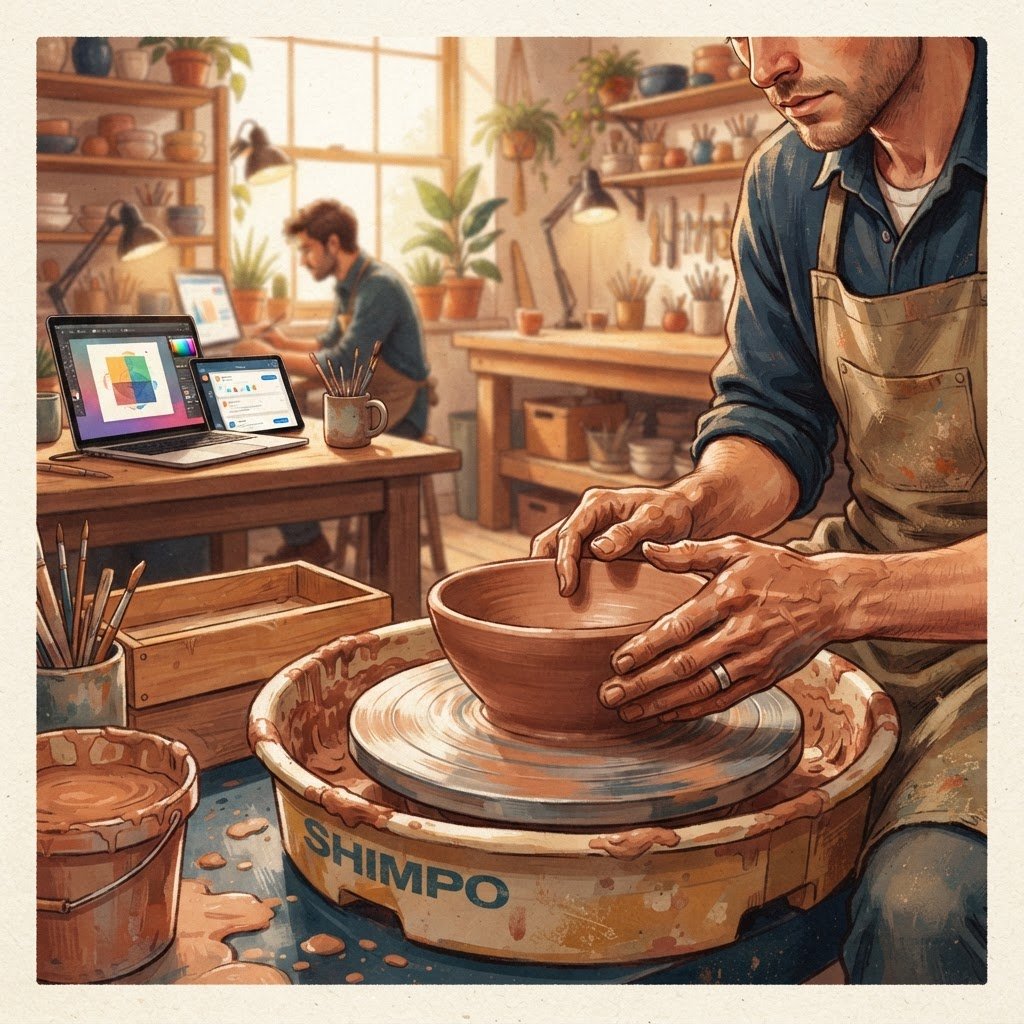
The shift is partly about scarcity. AI can generate a thousand images in the time it takes a painter to mix their colours. A factory with robotic arms can produce ten thousand identical ceramics in a day. But a single potter, sitting at a wheel, can make one. That one will have imperfections — a slight asymmetry, a variation in the glaze, a thumb print visible in the clay if you look closely. These are not flaws. They are evidence. Evidence that a person was there, that time was spent, that attention was given.
The Evidence of Human Presence
What people are increasingly willing to pay for is evidence of human presence. This is why a handwritten letter feels different from an email, even when the content is identical. It is why a painting made over three weeks by a person looking at a real landscape carries a weight that a generated image does not. The value is not in the object itself but in the knowledge of how it came to be — the hours, the decisions, the small acts of judgement that only a person can make.
This is showing up in markets that might seem surprising. The market for handmade ceramics has grown significantly in the past two years. Independent bookbinders report waitlists. Knife makers who forge by hand cannot keep up with demand. These are not luxury goods in the traditional sense — they are often modestly priced — but they carry something that mass-produced goods do not: the story of their making.
AI as a Quality Signal in Reverse
There is a second force at work. As AI-generated content becomes ubiquitous, the ability to verify that something was made by a person becomes a signal of quality. A piece of writing that is clearly human — with its idiosyncrasies, its specific observations, its willingness to be wrong — stands out in a way that polished, generated prose does not. A photograph that bears the marks of a real person holding a real camera in a real moment carries an authenticity that no generated image can match.
This is not because AI cannot produce technically excellent work. It can, and increasingly does. But technical excellence is no longer the differentiator. It is the baseline. When everything is technically excellent, the things that rise above are the ones with soul — a word that is hard to define but easy to recognise. A wooden chair made by a craftsman has soul. A chair designed by an algorithm and produced by a robot does not, no matter how comfortable it is.
The Premium on Imperfection
The market is responding. Products that were once seen as imperfect — handmade textiles with slight pattern variations, small-batch foods with batch-to-batch differences, pottery with visible maker’s marks — are now commanding premiums. The imperfections that industrialisation spent two centuries eliminating are the very things that consumers are now seeking out. This is not a rejection of quality. It is a redefinition of what quality means.
In the AI era, perfection is cheap. Imperfection — the kind that comes from a human being making something with their hands — is expensive. That is a reversal that few would have predicted, and it is one that is still working its way through the economy.
Craft as a Counterweight to Digital Life
There is also an emotional dimension. People spend their days interacting with screens, algorithms, and automated systems. The hunger for something tangible — something that can be touched, held, and felt — is growing. A hand-thrown mug is not just a vessel for coffee. It is a daily point of contact with the physical world, with the reality that a person made this, that clay and fire and human effort came together to produce something that now sits on a kitchen shelf.
This is why the human-made movement is not limited to luxury goods. It extends to everyday objects — kitchen tools, clothing, furniture, stationery. People are willing to pay more for a cutting board made by a local woodworker than for a factory-produced equivalent, not because it cuts better, but because it carries a story. And in a world where most objects carry no story at all, that matters.
The Long-Term Implication
The implication for makers is significant. Skills that were seen as obsolete — hand lettering, traditional weaving, metal forging, stone carving — are becoming economically viable again. Not at scale, and not for everyone, but for those willing to do the work and tell the story, there is a market that did not exist a decade ago. The most successful of these makers are not competing on price. They are competing on authenticity, and they are finding that authenticity has a price ceiling that is far higher than anyone expected.
The implication for consumers is equally significant. In a world where everything can be generated, the choice to buy something made by a person becomes a statement — not just about taste, but about values. It is a choice to support a person rather than a system. To value time over efficiency. To keep a connection to the physical world in a culture that is rapidly becoming disembodied.
None of this means that AI-made products will disappear. They will not. They will dominate the mass market, and they will get better and cheaper. But they will occupy a different place in the hierarchy of value. The machine-made will be the ordinary. The human-made will be the extraordinary. And in a culture that has spent two centuries chasing efficiency, the extraordinary will be the thing that was made slowly, by hand, by someone who cared.