A perspective piece from The Listening Market
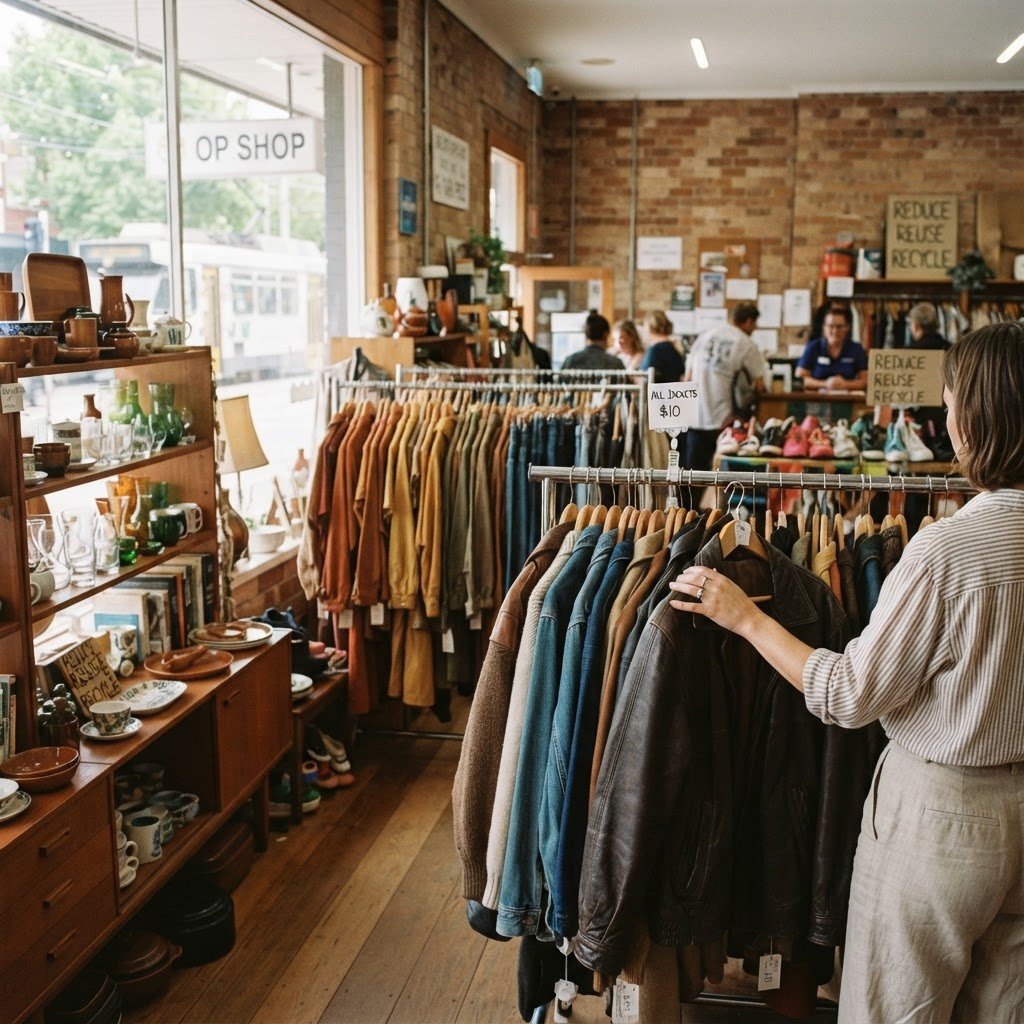
There is a particular sound a second-hand shop makes when someone walks in uncertain and walks out converted. It is the sound of a coat hanger sliding along a rack, the rustle of someone flipping through a shelf of records, the quiet laugh of a shopper recognising a dress their mother once wore. For decades that sound belonged to a certain kind of person: the bargain hunter, the vintage devotee, the student furnishing a share house on the smell of an oily rag. In 2026, it belongs to almost everyone.
Second-hand shopping has crossed a line. It is no longer a counter-culture or a compromise. It has become a mainstream habit, folded comfortably into ordinary weekly routines the way streaming subscriptions and tap-and-go payments once were. The proof is in the numbers that keep piling up: resale platforms reporting record listings, op-shops extending trading hours, major retailers launching their own pre-loved sections. What was once framed as a niche behaviour now sits squarely in the middle of the market.
When thrift stopped meaning cheap
The old associations lingered for years. Second-hand meant second-best. It carried a faint whiff of necessity rather than choice, of making do rather than making a statement. That framing has quietly collapsed, and the speed of its collapse is the real story. Buying pre-loved is now positioned as a smart, deliberate decision, and the people making it are just as likely to be affluent professionals as budget-conscious students.
Part of the shift is aesthetic. The polished minimalism of the last decade gave way to a hunger for pieces with texture and history. A mass-produced cabinet looks exactly like a million other cabinets; a 1960s teak sideboard with a small water ring on one corner looks like nothing else in the world. Character became the luxury item, and character cannot be manufactured at scale. It can only be inherited, rescued, and passed on.
The language changed along with the appetite. Nobody ambitious calls it used anymore. It is pre-loved, archive, vintage, rehomed. That vocabulary shift matters more than it seems, because it reframed the entire transaction from an admission to an accomplishment. The person who finds a perfectly broken-in leather jacket for a fraction of its retail price is not scraping by. They are winning.
The platforms that built the habit
None of this happened by accident. The resale boom was engineered, one notification at a time, by digital marketplaces that made selling as frictionless as scrolling. The moment a phone camera replaced the classified advertisement, the barrier to entry for the entire second-hand economy dropped to almost nothing. A wardrobe purge became a Saturday-morning activity rather than a chore requiring a garage and a weekend.
Those platforms also did something more subtle: they normalised the idea that goods have second and third lives. A generation grew up watching furniture, sneakers, and cameras circulate endlessly between owners, each transaction visible and unremarkable. When circulation becomes visible, it stops being stigmatised. The marketplace did not merely host the behaviour, it taught it.
Trust, historically the weak point of peer-to-peer trade, was rebuilt piece by piece. Buyer protection, seller ratings, authenticated luxury verification, detailed condition grading. Each feature shaved away another layer of risk that had kept mainstream shoppers away. The result is a market where a stranger purchasing a pre-owned handbag sight unseen is now among the most ordinary commercial acts in the economy.
The three currents flowing together
Ask ten people why they shop second-hand and the answers cluster into three currents, all flowing in the same direction. The first is economic. Household budgets have been squeezed from several directions at once, and resale offers a genuine pressure valve: the same wardrobe, the same furniture, the same musical instruments, at a fraction of the price. For a growing number of shoppers, pre-loved is not an alternative to the mainstream, it is simply how they afford the mainstream.
The second current is environmental, and it has moved from abstract guilt to concrete arithmetic. The understanding that extending a garment’s life by even a season measurably reduces its footprint has become common knowledge, particularly among younger buyers. Fast fashion’s contradictions have been picked apart so publicly that buying new, cheap, and often now carries a social cost that buying used simply does not. Sustainability shifted from a marketing word to a purchasing filter, and resale passes the filter by default.
The third current is identity. A generation raised on algorithmic sameness is reaching for whatever feels distinctive, and nothing delivers distinctiveness like an item with a story attached. In a world where trends arrive globally in a single weekend, the surest way to look like nobody else is to wear what nobody else can find. Second-hand is, in this sense, the last truly bespoke channel. Every piece is a one-off. Every purchase is a small act of curation.
The retail giants follow the customer
Perhaps the strongest evidence of mainstream status is that the mainstream’s largest players have stopped fighting the trend and started courting it. Fashion brands now run trade-in programs, crediting customers for returning worn items and reselling them under official banners. Department stores have devoted floor space to curated vintage. Luxury houses that once burned unsold stock to protect exclusivity now operate certified resale channels of their own.
This is not corporate altruism; it is a defensive adaptation. When a meaningful share of a category’s volume starts flowing through secondary channels, sitting outside those channels is a strategic risk. The suits in the boardroom did not suddenly develop a taste for retro. They watched their customers develop one, and moved to where the customers were standing.
The circular economy has acquired something no niche movement ever gets: infrastructure. Cleaning, grading, authentication, logistics, returns handling. An entire service layer has grown around pre-loved goods, professionalising a trade once run from church halls and car boots. Institutional money follows infrastructure, and infrastructure follows volume. The second-hand market now has all three, which is why analysts keep revising its growth forecasts upward.
The op-shop renaissance on main street
While the apps get the attention, one of the quieter ripple effects is happening on suburban main streets. Charity and opportunity shops, long treated as background texture in the retail landscape, have become destinations in their own right. Some now window-dress with the care of a boutique, price with the confidence of a collector, and turn over stock with the pace of a trend retailer. Fifteen years ago an op-shop was somewhere a donation box lived. Today the good ones have queues.
That transformation has ripple effects of its own. Money spent at charity retailers tends to stay local and fund community programs. Goods are diverted from landfill at scale. Volunteers gain skills, shoppers gain treasure, and the high street gains foot traffic that the closure of anchor stores took away. A habit that began as a values statement has quietly become an economic act with benefits that compound through a neighbourhood.
Not without its frictions
The mainstreaming of second-hand has not been seamless, and honesty requires acknowledging the edges. Resale Darwinism is real: as demand rises, prices rise, and the genuinely cheap finds that once made thrifting a lifeline for low-income households get scarcer. Professional resellers now trawl the same racks as hobbyists, sometimes stripping the best items before the shelves cool. The democratising force of second-hand can, in certain aisles, start to feel like the opposite.
There is also the inconvenient truth that increased consumption of used goods is still consumption. The most sustainable item remains the one already owned, worn, and sitting happily unworn out in the wardrobe. Resale softens the footprint of consumption but does not erase it, and the marketing departments of the resale platforms are not always eager to underline that distinction. A market built on the constant circulation of goods still needs buyers who decide, sometimes, to simply stop circulating.
What mainstream really means
Behaviour earns the word mainstream not when it appears in a trend report, but when it stops needing to explain itself. By that measure, second-hand shopping arrived some time ago. Nobody at a dinner party in 2026 raises an eyebrow at a thrifted lamp. Nobody confesses to buying a pre-owned coat as though admitting a shortcut. The purchase requires no backstory, because the culture has absorbed the backstory already.
The likely trajectory from here is continued integration rather than plateau. As digital marketplaces add authentication, repair services, and seamless trade-in flows, buying second-hand will feel less like a separate activity and more like simply shopping, with condition tags and a slightly better story attached. The specialness of the category may fade even as its volume grows. Future generations may find it strange that there was ever a distinction between new and used retail at all, a line drawn through the economy that no one can quite explain.
There is something fitting about that. Second-hand shopping spent its long apprenticeship at the margins, dressed in other people’s clothes, waiting patiently to be taken seriously. The mainstream did not merely accept it. The mainstream eventually realised it had been shopping in its own closet all along, and found that the best pieces were already there.