A perspective piece from The Listening Market
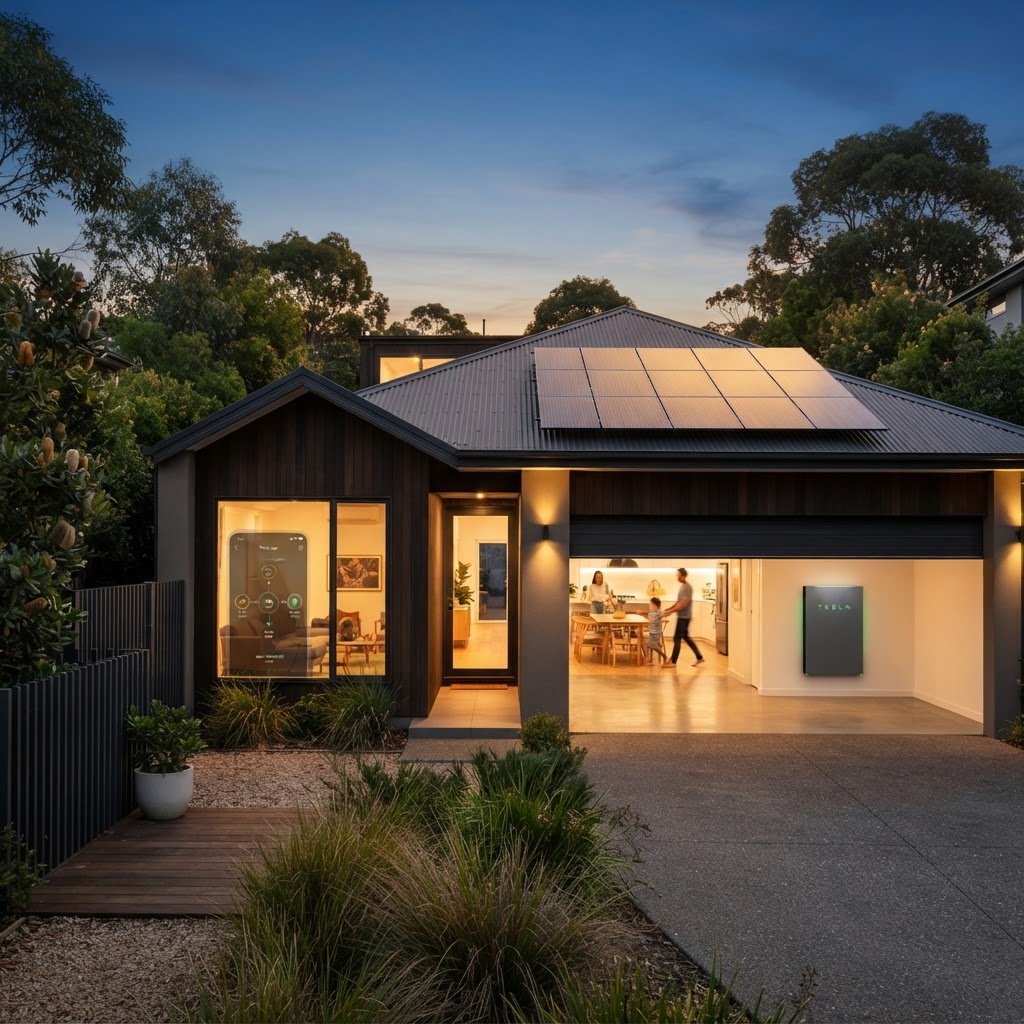
On a sticky February evening in Melbourne, a household sits around a kitchen table arguing not about school results or weekend plans, but about a battery. The family’s home battery, a matte white box on the garage wall, is holding at forty per cent while the grid next door sags under a heatwave. The app on the phone says the price of electricity is about to spike, so the airconditioning has been quietly dialled back a degree and the dishwasher has been told to wait until midnight. Nobody in the house considers any of this remarkable. Ten years ago it would have sounded like science fiction. Today it is simply Thursday.
The centre of gravity has shifted
For most of the last decade, the smart home was a story about convenience. Voice assistants answered trivia, doorbell cameras caught parcel thieves, and fridges promised to order milk before anyone noticed it was gone. The connective thread was novelty, and novelty wears off. What has changed in the past few years is the arrival of a much stronger force: money. Electricity prices have climbed across most of the world, peak-demand charges have become painful enough to notice, and more households than ever own assets — solar panels, batteries, electric cars — that turn them from passive consumers into small, occasionally strategic participants in the energy market. When the fridge starts interfering with the family budget, the novelty becomes a necessity.
Energy management has consequently moved from the edges of the smart home to its centre. Industry surveys repeatedly find that smart thermostats and energy monitoring rank among the few smart home devices that most buyers say they would replace if they broke, a loyalty that smart speakers rarely inspire. The reason is prosaic. A speaker that mishears a command is an annoyance. A system that trims a shrinking chunk off a quarterly bill is infrastructure.
The quiet stack underneath
Behind the household arguing over its battery sits a stack of technology that has matured almost invisibly. Smart meters, once controversial, are now standard in most new installations across Australia, Europe and large parts of North America, streaming usage data in near real time. That data feeds apps that translate kilowatt hours into dollars, a deceptively important trick, because a number like 2.4 kW means little to most people while “this is costing more than your coffee” means a great deal. Meanwhile rooftop solar has become the default on new builds in sun-drenched suburbs, and home batteries have followed it from curiosity to catalogue item, shrinking in price as competition among manufacturers intensified.
The electric car may be the piece that tips the whole arrangement. A typical electric vehicle carries a battery large enough to run an ordinary house for days, and newer models support bidirectional charging, meaning the car can push power back into the home when grid prices spike. Carmakers that once marketed range and acceleration now market kilowatts of vehicle-to-load output. For the family with a heatwave bearing down, the car in the garage stops being a depreciating asset and starts being a reserve tank.
When the house starts thinking
The genuinely new development is not any single device but the coordination layer above them, increasingly driven by machine learning. Modern home energy systems watch tariff signals, weather forecasts and household routines, then make decisions without being asked: pre-cooling the house in the afternoon while solar is plentiful, holding the battery for the evening peak, scheduling the car to charge at 2 a.m. when the grid is quiet and the price is low. The user clicks once on a plan and the house handles the arithmetic forever after. It is the rare kind of automation that almost never feels intrusive, because it works by shifting tasks in time rather than asking anyone to do anything differently.
Utilities, initially slower to adapt, have begun to lean into the shift. Time-of-use tariffs, which charge different prices at different hours, once punished families for running the dryer after school. Now they reward those who let software work around them. Some retailers offer plans so aggressive that a well-run home can run a significant share of its consumption at close to zero cost, particularly in Australia, where distributed solar has at times driven daytime wholesale prices below nothing. The grid operator there occasionally pleads with solar owners to export more at peak, a sentence that would have baffled an engineer in 2010.
Energy literacy as a side effect
There is a cultural dimension to this that is easy to miss. A generation is growing up fluent in a vocabulary that was once the private dialect of engineers. Teenagers explain off-peak charging to their grandparents; dinner-table conversations drift into the relative merits of feed-in tariffs; real estate listings in solar-rich suburbs boast of battery capacity alongside the number of bathrooms. The app has done quietly what a decade of pamphlets about conservation never managed, which is make energy visible. Behaviour follows visibility. Households that watch their consumption in real time consistently use less of it, not because anyone lectured them but because the feedback loop is finally short enough to feel personal.
That visibility is also changing renovation economics. Buyers now routinely ask for the house’s energy score the way they once asked about the roof’s age, and renovations that a decade ago were framed as environmental statements — insulation, heat pump hot water, better glazing — are increasingly framed as financial ones, with payback windows quoted alongside the paint colours. The smart home industry, having spent years promising that gadgets would sell themselves, has discovered that the clearest pitch of all is a bill going down.
The grid’s new dance partner
Zoom out and the stakes grow larger than any single household. When thousands of batteries and electric cars can be orchestrated together, they form what engineers call a virtual power plant: a network of small assets that behaves, to the grid operator, like one controllable generator. Trials in Australia, Germany, Texas and elsewhere have already paid households for the privilege of borrowing their stored sunshine during tight moments. The implications run in both directions. A grid thick with controllable batteries needs fewer gas peaking plants scalding the evening sky, and a household enrolled in such a scheme gets paid for equipment it already owned. It is the rare arrangement in which the spreadsheet and the atmosphere agree.
There are frictions, of course. Interoperability remains a mess, with ecosystems that refuse to speak to one another and setups that demand an evening of patience with a manual. Cybersecurity researchers point out, correctly, that a grid-connected home presents an attack surface no thermostat ever did. Landlords and renters, who together make up a huge share of households, remain largely locked out of the benefits until financing and regulation catch up. And the industry’s marketing still frequently overpromises, quoting savings achieved by tinkerers as if they were the experience of the median buyer. The learning curve is real, even if it is flattening.
Households early in the journey often ask where to begin, and the consensus from energy auditors is refreshingly untechnological. Measure first, buy second: a hundred-and-fifty-dollar monitoring clip on the switchboard routinely finds the culprit appliance — an ancient pool pump, a beer fridge in the garage, a heater left on under a window — and pays for itself within a season, no battery required. Then automate the largest loads, because water heating, climate control and the car together dominate almost every bill. The solar-and-battery conversation comes last and smoothest once the household has already learned its own rhythms.
The new heart of the home
None of those frictions appear likely to reverse the direction of travel, because the underlying incentives all point the same way. Power is not getting cheaper, batteries are not getting more expensive, and every government facing grid strain has a reason to want consumption to become flexible rather than simply growing. The smart home began its life as a party trick, a collection of gadgets that answered questions and showed who was at the door. It is finishing its third act as something closer to a metabolism: a system that quietly converts sunshine into cash, shields a family from a heatwave without being asked, and turns the largest monthly bill in the house into something a phone can argue down.
The family in Melbourne eventually stops checking the app, because the house has learned the pattern and no longer needs them. The dishwasher starts itself at midnight. The battery breathes out its stored evening sunshine. And somewhere in the quiet of a cul-de-sac, a modest brick house does something no house on that street could have done a decade ago: it pays attention, in its owner’s interest, while the rest of the street sleeps through the most expensive hour of the day. That, more than any voice assistant’s cleverness, is what the smart home was always going to become.
For the homeowner weighing where a limited budget should go, the evidence of the past few years points in a consistent direction. Skip the gadget whose main talent is novelty. Put the money where the electrons are. The smart home’s centre of gravity has already moved, and it has settled precisely where the money moves too: on the wall where the meter used to simply count, and now comprehends.