A perspective piece from The Listening Market
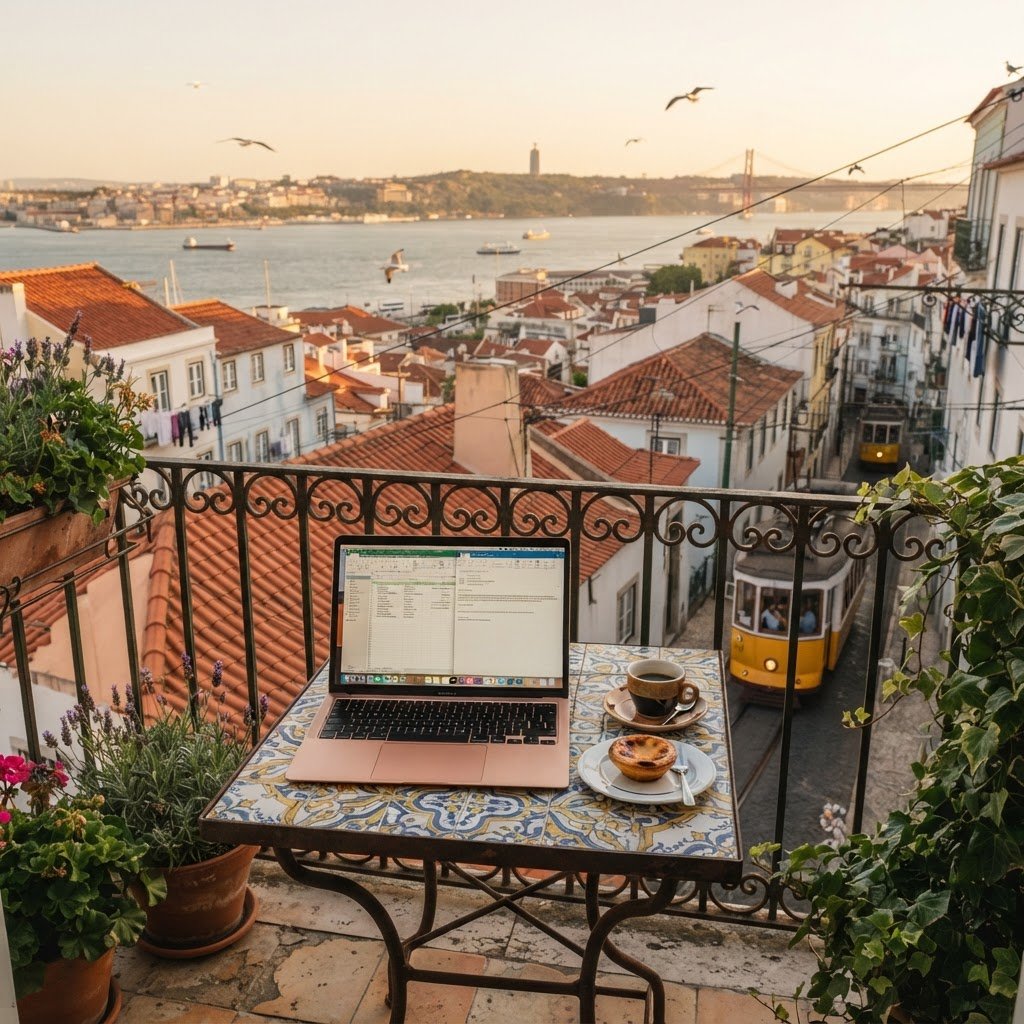
In late October, a product designer named Mariana packs for a month in Lisbon, and the packing list is telling. Swimsuit, tennis shoes, a Portuguese phrasebook, no phrasebook for grammar pedants, one formal shirt for a client meeting that will happen on a Wednesday. Also: a laptop, an external monitor ordered for delivery to the apartment, and a calendar carefully partitioned into overlapping time zones. Mariana’s employer believes she works in Sydney. For the next five weeks, with the company’s knowledge and a stable internet connection, her office will be a third-floor flat above a pastelaria in the Alfama district. She will attend the Tuesday stand-up, cook dinner at a sensible hour for once, and log off in time to watch the light leave the Tagus. Nobody at work will notice, except that she keeps mentioning the custard tarts. On paper, Mariana is on holiday for roughly none of this trip and working for approximately all of it. In reality, she has done something stranger and increasingly common: she has merged the two, continuing her life’s work inside her life’s travelling, and called the arrangement a workation.
A word that leaked out of the pandemic
The portmanteau predates the pandemic, attached originally to digital nomads, a kind of professional backpacker who codified laptop-on-a-beach into a subculture with its own visa categories and Instagram aesthetic. But the version now reshaping the travel industry is a less exotic species: ordinary salaried workers, anchored to a company and a time zone, splicing weeks of work into places they would rather be. When offices shut in 2020, white-collar workers learned that their jobs lived inside their laptops, not their commutes, and when offices reopened, a share of workers quietly declined to unlearn it. Surveys since have repeatedly found that the ability to work from anywhere now ranks among the most valued employment terms, spoken in the same breath as salary and treated with similar seriousness by candidates negotiating offers. Once the technology proved the concept, the distinction between home office and somebody else’s hometown collapsed into a matter of booking.
What dstinations now sell
The travel industry spotted the new species early, and its response constitutes one of the fastest repositionings in modern hospitality. Hotels began advertising day rates for guests who needed a desk, a desk chair that deserved the word, and guaranteed bandwidth rather than a minibar; chains built floors ofproper work rooms with ring lights and printer access; resorts invented longer-stay pricing for guests arriving with chargers rather than glamping gear. Coastal towns and mountain valleys, having watched their young adults leave for cities, discovered they could import the young adults temporarily instead, and marketed accordingly — fast internet, tolerable coffee, a trestle table with a view. A small nation on the Atlantic spent a decade building digital-nomad infrastructure out of an economic crisis and found itself with a template the rest of the world’s tourism boards rushed to imitate, from Barbados to Dubrovnik to, closer to home, parts of regional Victoria and Queensland reimagining the grey winter as a residency season for accountants and analysts.
Airlines noticed a subtler change: workationers book like locals rather than tourists, favouring shoulder seasons, midweek departures and one-way tickets bought with points of flexibility rather than the Friday-to-Sunday rhythm the industry had optimised decades of yield management around. A trip that blends five weeks of work into two weeks of holiday behaves nothing like a two-week holiday. It books earlier, stays longer, spends steadier, and returns in six months. For a hotel, the guest who stays a month and works from the lobby is less profitable per night but vastly more profitable per square metre of marketing, and the arithmetic has been run enough times that the lobby now has the standing desks.
The unromantic truth about the tan and the deadline
The glossy version of the workation conceals the friction, and the friction is real. Workationers describe timezone triage as the defining chore: calls at midnight, dinner interrupted by an American client’s morning, dinner abandoned entirely when the crunch lands on someone’s Lagos afternoon and someone else’s Lisbon evening. Partners and children, unsuspecting signatories to the arrangement, discover that a parent physically present in paradise but mentally in the Tuesday stand-up is not an improvement on a parent absent in an office. And the work itself can suffer precisely because workations are pitched as holidays with obligations attached; the flat above the pastelaria has no colleagues to absorb stress and no boundaries between the living room and the job, meaning the same laptop is simultaneously the day’s instrument of obligation and the evening’s instrument of pleasure, a conflict office walls were quietly resolving all along.
Employers discovered their own list of complications. Tax authorities in several jurisdictions began asking sharp questions about where, exactly, a permanent employee conducts their work, with some revenue agencies asserting that a five-week stay in another country could create payroll obligations or treaty headaches nobody had budgeted for. Information-security policies written for a controlled office now have to accommodate café wifi and a flatmate called Fernando. Company culture, closer to the ground, faced a simpler question: if Mariana can work from Lisbon in November, why can she not work from her parents’ house in February? The honest answer — that employers often prefer visible proximity to verifiable output, and that expectations quietly differ by location — has generated more awkward meetings than any technology ever did. The workation is a privacy negotiation wearing a swimsuit, and both sides of the table know it.
Rewriting the calendar of travel
Strip the frictions away and the deeper change remains: the boundary that ordered modern working life — leave accrued, trips allocated, workdays forbidden to be travel days — is dissolving. For two centuries, leisure was rationed: packed tightly into bank holidays, two-week blocks and, for a fortunate generation of the wealthy, a shoulder season at the disposal of anyone who lived off returns rather than salaries. Rationing by days suited a factory economy, where presence equalled output and absence was theft of a resource the employer owned. In a knowledge economy, the rationing mechanism is irrational, and workations simply route around it, one lopsided calendar at a time. Mariana accrues no annual leave for her five weeks in Lisbon. Her holiday days are spent only on the days she chooses them; the rest are ordinary Tuesdays, conducted somewhere better.
The professionals best positioned to exploit this are those with the most calendar control, and their behaviour is already visible in the data: location-independent professionals, senior consultants, developers and designers cluster in the same handful of towns, in the same months, following the weather the way a previous generation followed pension entitlements. Their example exerts pull on everyone else. A junior employee watching a team lead log in from Málaga does not merely admire the tans; the employee recalibrates what a career must provide, and recruitment conversations now include questions that would have sounded absurd a decade ago.
For those attempting the arrangement, veterans tend to converge on the same short list of survival rules, less a hack than a hygiene. Tell the employer before the airport, not after, because paperwork beats anxiety. Overlap at least a few hours with the home time zone and defend them fiercely, so collaboration does not dissolve into asynchronous misunderstanding. Watch the locals’ rhythms instead of importing old ones — a morning walk before the heat, a long lunch, a quiet evening shift — because the whole point is to let the place discipline the day. And treat the holiday part as real: days booked as leave should look, to any colleague needing something, suspiciously like someone who is genuinely away.
A lifestyle with fine print, still spreading
The workation is neither a fad nor a finished product; it is a transition in progress. Survey evidence suggests a persistent gap between workers who would work from abroad and those formally permitted to, a gap that closes a little with every hiring cycle as companies compete on flexibility and discover their rivals already ran the tax analysis. Governments, meanwhile, keep minting visas, more each year, formalising what travellers had already informally arranged, and each visa is a small admission that the old definitions of working somewhere versus visiting somewhere have quietly expired.
Mariana’s month ends in late November. She logs off a Friday night, walks to the river one last time, and flies home Saturday with a suitcase full of laundry and a suntan acquired almost entirely during lunch breaks. She has taken ten days of annual leave for a thirty-two-day trip. Her employer received a month of unremarkably competent work, plus a designer whose slides now contain suspiciously Lisbon-shaped colour palettes. The old categories would file her trip under holiday or business and be wrong about both. The new category files her under the growing stack of people, companies and destinations who have understood that the working year need not happen in one place, and that the calendar itself is negotiable. The negotiation, century-defining in aggregate, looked from the outside like nothing more dramatic than a woman eating a custard tart on a Wednesday.