
A perspective piece from The Listening Market
Nobody planned to cry. That’s the thing people keep saying about the 2026 solar eclipse — “I didn’t expect to get emotional.” But across Spain, Iceland, Greenland, and parts of Russia, that’s exactly what happened. Ordinary people, in the middle of an ordinary Wednesday, looked up and felt something they couldn’t name.
It was August 12. Most people were at work. At home. Running errands. Living their lives. Then the sky started to change, and for two minutes, everything else stopped mattering.
The Sky Doesn’t Ask Permission
The mechanics are simple enough. Moon passes between Earth and sun. Sun disappears. Light comes back. But knowing the mechanics is like knowing the recipe for a meal someone cooked you — it doesn’t explain the taste.
According to NASA’s skywatching guide, this was the first total solar eclipse visible in mainland Europe since 1999. Twenty-seven years. An entire generation had grown up without ever seeing the sun vanish.
Maybe that’s part of why it hit so hard. Not just the spectacle, but the waiting. The buildup. The months of anticipation, the eclipse glasses ordered online, the travel plans, the group chats full of “where are you watching from?” And then the moment itself — over in 120 seconds, but unlike anything else.
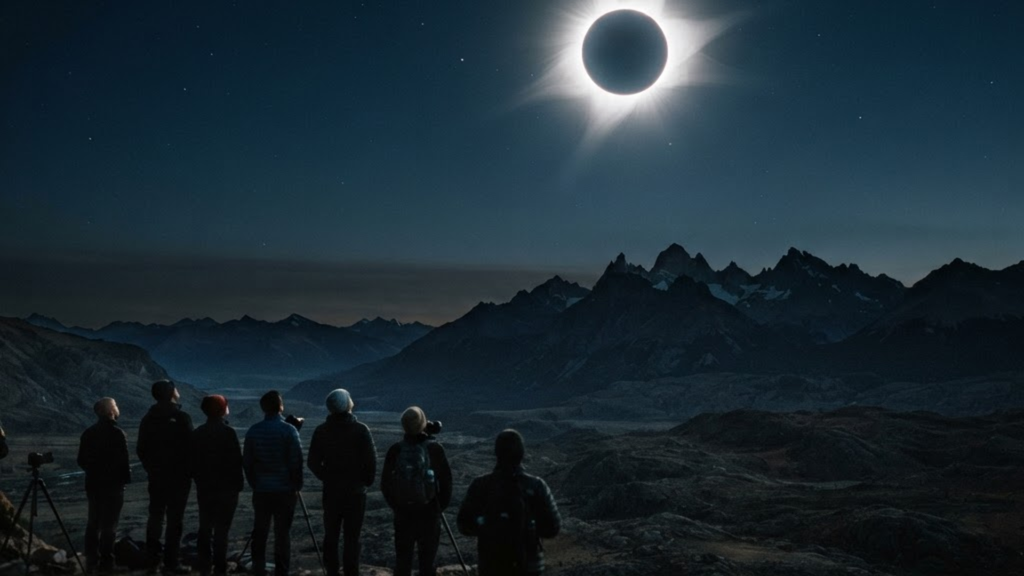
Those who saw it describe the same sequence. The light doesn’t dim — it shifts. Colors go silver, then strange. Birds stop singing. Not one by one, but all at once, like someone hit a switch. The temperature drops. And then the corona appears, this pale, fragile ring around nothing, and the sky becomes something that doesn’t have a name. Not night. Not dusk. Something older.
What the 2026 Solar Eclipse Did to People
Here’s what’s interesting. The stories coming out of the 2026 solar eclipse aren’t really about the eclipse. They’re about what happened to people while it was happening.
Couples who’d been arguing went quiet. Strangers shared eclipse glasses without being asked. Teenagers stopped filming and just looked. An old man in a park in Bilbao reportedly sat on his bench for ten minutes after it ended, not ready to go back to his day.
Phones came out afterward — but not for photos. People called their mothers. They texted family members. “Are you seeing this?” The urge wasn’t to capture the moment. It was to share it with someone.
And then there was the vulnerability. The way the darkness stripped everything away — the noise, the schedules, the performance — and left people standing in parks feeling raw and present and slightly embarrassed, like they’d forgotten they were capable of being that affected by something.
That’s the part nobody prepared for. Not the darkness. The feeling.
The Quiet After
Two minutes. That’s all totality lasted. Then the light crept back, the birds returned, and the world slowly became itself again.
But something lingered. In the hours and days after the 2026 solar eclipse, social media filled up — not with photos, but with attempts at describing something. “I didn’t expect to feel that.” “I wanted to call someone.” “I didn’t want it to end.” Everyone reaching for words that don’t quite exist.
Because what do you call it? That feeling of standing in the dark with people you’ve never met, looking at something you can’t control, can’t buy, and can’t scroll past. There’s no word for it. But everyone who was there knows exactly what it feels like.
Why This One Hit Different
Eclipses happen roughly every 18 months somewhere on Earth. They’re not rare in the grand scheme. But the 2026 solar eclipse came at a strange time. The world has been loud — pandemics, economic shifts, AI anxiety, political noise. Everything moves fast and nothing seems to pause.
Then the moon slid in front of the sun, and for two minutes, everything stopped. Not because someone told us to stop. Because nature did.
There’s something powerful about that. Something that has nothing to do with astronomy and everything to do with being human. The eclipse didn’t solve any problems. It didn’t change anything. It just reminded people that the world is bigger than their to-do list, more beautiful than their phone screen, and still capable of surprise.
Maybe that’s the real story of the 2026 solar eclipse. Not the science. Not the path of totality. Just a moment when millions of people looked up at the same time and felt the same thing — and realized they’d been starving for it without knowing.
What We’re Left With
Our honest read: the feeling won’t last. It never does. People go back to their routines, their feeds, their noise. The eclipse becomes a memory, then a photo, then a story they tell at dinner parties.
But something about it sticks. The curiosity — planetariums reported a flood of new visitors. The togetherness — strangers who shared those two minutes still talk about it. The perspective — a reminder that the universe is very large and most of what stresses us out is very small.
The next total solar eclipse is in August 2027, visible from parts of North Africa. If you caught this one, you’re already planning. If you didn’t — go. Not for the photo. Go because there’s something about standing in the dark with strangers that reminds people what it feels like to be human. And that’s worth traveling for.
If you’re the curious type, you might also enjoy our thoughts on how science is reshaping the way we think about the future.
This piece reflects the perspective of The Listening Market — not data, not research findings, just honest observations about what people felt when the sky went dark and nobody was ready for it.