
A perspective piece from The Listening Market
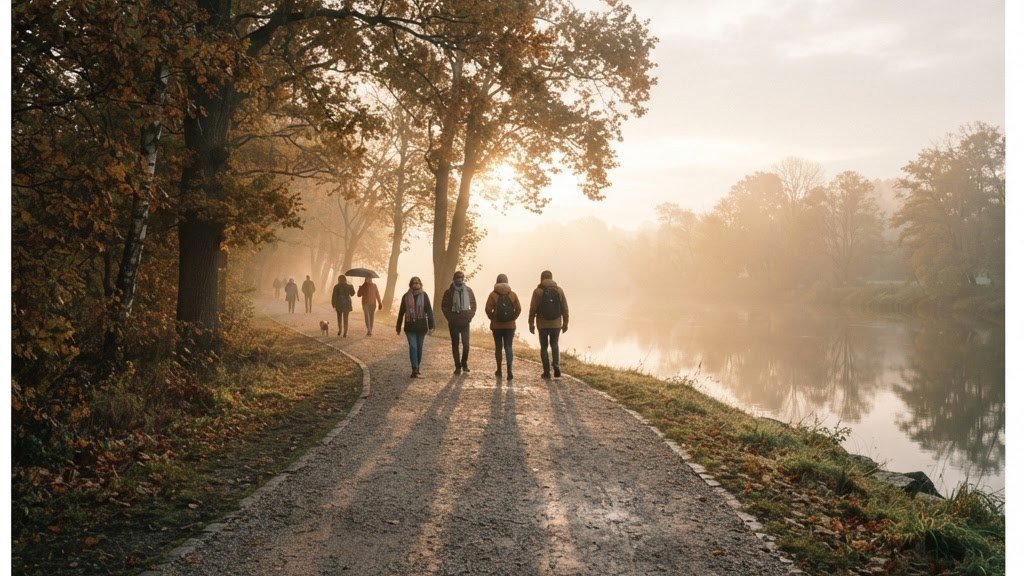
At six in the morning, the path along the river tells you everything the fitness industry spent a decade forgetting. There are no heart-rate monitors beeping, no coaches shouting through the final round, no leaderboards. There is a retired teacher moving at a pace that would shame no one, a young man listening to a podcast with the faint smile of someone whose mind has wandered somewhere pleasant, and a mother and daughter deep in a conversation they apparently could not have at home. All of them are walking. None of them would call it exercise. Every one of them will do it again tomorrow.
That quiet scene has become one of the defining health habits of the decade. After years in which fitness meant intensity, tracking and transformation, walking has staged a comeback that almost nobody in the industry saw coming, partly because it refuses to look like a comeback at all. It looks like people going for a walk. But underneath the ordinariness, something has genuinely shifted: the lowest-effort movement in the human repertoire has been quietly re-legitimised as one of the best things a person can do for their body, their mood and their mind.
From joke to recommendation
For a long time, walking was what exercise advice said to do when it assumed you could not manage anything harder. It was the consolation prize of physical activity, handed to beginners, older adults and the time-poor. The fitness economy had little commercial interest in it. A walk cannot be upsold, subscription-modelled or dramatically incremented. There is no gear you need, no studio you join, no protein powder that makes it work better. Its embarrassingly low barrier to entry was, from a marketing perspective, its fatal flaw.
Then the evidence kept accumulating, and it became harder to wave away. Large long-term studies found that brisk regular walking reduced the risk of cardiovascular disease, type-two diabetes, several cancers, dementia and depression by margins that rivalled far more punishing regimens, with a fraction of the injury risk. Researchers noted that walkers adhered to their habit at rates runners and gym-goers could only envy, precisely because walking asked so little. The most effective exercise, it turns out, is repeatedly revealed to be the one people actually keep doing. Somewhere along the way, the medical advice inverted: the question stopped being how to get people to work out harder and became simply how to get people to move more, for longer, across a whole lifetime.
The counterculture of going gently
The comeback has a cultural side, too, and it arrived as a reaction. The last decade of wellness was saturated with optimisation: fasting windows, cold plunges, sleep scores, wearable rings that graded every night. Optimisation produced real benefits for some, but it also produced a strange exhaustion, a sense that caring for a body had become a second job with performance reviews. Walking pushed back against all of it simply by being unoptimisable. You cannot sprint your way through a walk. You cannot gamify a stroll without ruining the stroll. Its entire value lies in its modest tempo, and that tempo became, almost accidentally, a form of protest.
Social media, ever quick to absorb a rebellion and resell it, turned walking into content anyway: the walking tutorial that is really a podcast, the video-meeting-taken-while-walking, the reverently filmed evening wander through a neighbourhood, coffee cup in hand. The aesthetic is pointedly unheroic. The message, repeated across millions of these clips, is not transformation. It is maintenance. Mood, ideas, digestion, patience, sanity: the walk is framed not as a route to a better body but as the cheapest available repair for a fraying mind. A generation raised on intensity has fallen for the gentlest intervention on the shelf, and there is something genuinely funny and rather hopeful about that.
The science of the wandering mind
Some of the strongest reasons to walk have nothing to do with the body. A respectable body of research now links moderate, repetitive movement with creativity, and every writer in history appears to have known it. Walking occupies just enough of the brain to quiet its louder loops while leaving the deeper associative machinery free to rummage around in the background. Ideas surface mid-stride that refuse to appear at a desk. The effect even has a reputation among problem-solvers: the issue that seemed immovable at three in the afternoon dissolves somewhere around the second park bench.
Psychologists point to the same mechanism for mood. A walk outdoors delivers layered doses of things a struggling mind tends to be short of: daylight, which regulates sleep and steadies mood; greenery and water, which measurably lower stress responses; and the peculiar social nutrient of low-stakes human proximity, the half-smiles of strangers who will never require anything of you. Perhaps most powerfully, walking gives an anxious mind a speed to match its own. It is essentially impossible to spiral comfortably at three kilometres an hour outdoors, which is why so many people finish a walk with a much better-behaved version of their problem in their head.
Why cities are starting to act like it matters
Where the habit goes, infrastructure eventually follows. Urban planners in several countries have spent recent years scrambling to make up for a century spent designing cities around cars. Fifteen-minute neighbourhoods, widened footpaths, traffic-calmed streets and riverside boardwalk renewals all quietly serve the pedestrian. The economic argument is being made in hard numbers as well: streets designed for walking consistently outperform streets designed for parking on almost every measure of local prosperity, from shop survival to public health costs.
The shift matters because walking has always been a habit shaped by environment more than willpower. Telling people to walk more in a place with no safe pleasant route is like telling people to swim in a city with no pools. The remarkable part of the current comeback is that it appears to have led policy rather than followed it: people started walking through their existing, imperfect neighbourhoods in such numbers that officials finally began treating pedestrians as serious infrastructure users, rather than an afterthought with a stopwatch.
Employers are catching on with their own corporate adjustments. Walking meetings, for years a quirk of managers who disliked boardrooms, have edged toward the mainstream, encouraged by research suggesting side-by-side movement loosens conversations that a formal table would stiffen. Lunchtime walking groups have appeared on office floors where the vending machine was once the only gathering point. None of this is strenuous. That, precisely, is why it survives contact with real working weeks in a way grander wellbeing programs rarely do.
The myth that needed retiring
No discussion of walking survives long without the number ten thousand. The famous daily step target has drifted from the marketing department of a 1960s Japanese pedometer into global public-health folklore. The reassuring finding of recent research is that most of walking’s benefits arrive with far less. Meaningful improvements in health outcomes appear to begin well below the folklore figure, with benefits continuing to accumulate for those who go further. In other words, the number was never the point. The point is regularity, and regularity is available to almost everyone, starting from wherever they currently are.
That forgiveness is central to walking’s renewed appeal. The habit does not punish a missed day, does not require a base level of fitness, does not demand money or youth or a particular body. It scales down to five gentle minutes around the block and up to a full day disappearing along a coastal track, and it is honest at both ends. Very few health behaviours can honestly say that.
Rebuilding a lost everyday motion
The deepest reason for the comeback may be the simplest. Human beings evolved as walkers, and a startlingly short stretch of modern history removed walking from daily life almost entirely. Cars took the commute, screens took the errands, convenience took the rest. The body did not stop needing the movement; it simply stopped getting it, and paid for the shortfall in energy, mood and sleep. The current trend, with all its podcasts and its unremarkable dawn footpaths, is best understood not as a fitness fad but as a correction. People are reopening a channel of ordinary movement that a couple of convenient decades quietly closed.
There is also something recognisably human in the way it has returned: not through discipline, but through pleasure. People are not walking because a guideline told them to. They are walking to hear the end of an episode, to take the phone call elsewhere, to see the season change on a familiar street, to feel like a person who lives somewhere rather than merely sleeps there. The health benefits arrive the way shadows arrive, as a side effect of something people have come to enjoy for its own sake.
That is the quiet genius of the comeback. Every generation rediscovers some ancient, obvious thing and briefly believes it has invented it. This generation’s rediscovery is going for a walk, and the sooner it stops being a trend and goes back to being simply what people do, the better off everyone will be. The river path at six in the morning, it should be said, has never needed the validation.




