
A perspective piece from The Listening Market.
The best food in any country is rarely found in the restaurant with the white tablecloths. It is found on the street. On a cart pushed by someone who has been making the same dish for thirty years. At a market stall where the queue is longer than the menu. On a corner where the smell hits you before the sight does, and you know — before you even see what is being cooked — that you want it.
Street food is not a budget option. It is a cuisine. It is the food that a culture feeds itself, day after day, without ceremony. And it tells you more about a place in one bite than a guidebook can in a chapter.
The Foods That Define Streets Around the World
Every street food culture has its icons — the dishes that locals grow up eating and travellers never forget. What follows is not an exhaustive list. It is a starting point. The dishes that, once tried, change what you think food can be.
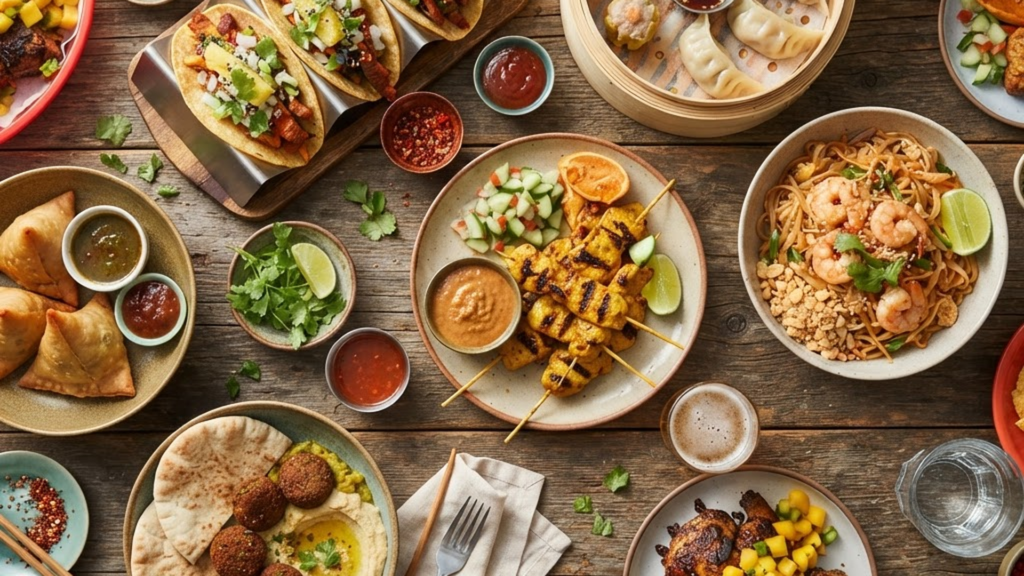
Bangkok’s pad Thai, made to order. Not the version from a restaurant kitchen. The one from a street cart, where the cook tosses noodles in a wok over flames so hot the metal glows. The prawns go in raw and come out curled. The egg crisps at the edges. The tamarind, fish sauce, and palm sugar hit a balance that no bottle can replicate. It is ready in ninety seconds and tastes like it took all day.
Mexico City’s tacos al pastor. Pork marinated in red chilies and pineapple, shaved from a vertical spit directly into a tortilla. A sprinkle of cilantro, a squeeze of lime, a spoonful of salsa from a bottle that has been on that counter for years and is better than anything you can buy in a jar. This is what a taco is supposed to taste like.
Delhi’s chaat. The word means “to lick” — and that is what the flavours make you do. Crispy fried dough, tangy tamarind chutney, cooling yoghurt, pomegranate seeds, chickpeas, and a dusting of spice that hits every part of the tongue at once. Chaat is not a single dish. It is a category of joy.
Istanbul’s simit and balık ekmek. A sesame-crusted bread ring eaten on the ferry across the Bosphorus, followed by a fish sandwich grilled on a boat anchored at the waterfront. The simplicity is the point. Fresh bread, fresh fish, the sea on both sides.
Hanoi’s banh mi. A French baguette filled with Vietnamese pâté, pickled daikon and carrot, fresh herbs, chilli, and whatever protein the stall is specialising in that day. It is the history of a country in a sandwich — colonial influence, local ingenuity, and the kind of flavour combination that should not work but absolutely does.
Marrakech’s harira and msemen. A rich tomato and lentil soup, served with flaky square pancakes dipped in honey and butter. Eaten at sunset during Ramadan or any evening at a stall in Jemaa el-Fnaa, surrounded by the sound of drums and the smoke of a hundred grills.
Tokyo’s yakitori. Chicken skewers grilled over binchotan charcoal, seasoned with nothing but salt or a glaze of soy and mirin. The chef controls the fire with a fan. The chicken is done when the fat just starts to render. It is minimalism on a stick, and it is perfect.
Jakarta’s satay. Skewers of marinated meat grilled over coconut husk coals, served with a peanut sauce that is sweet, smoky, and slightly spicy. The sauce is the soul of the dish, and every vendor guards their recipe.
What Street Food Teaches
There is something street food does that restaurant food rarely manages. It connects you to the person making it. You watch them cook. You see the fire, the hands, the speed. There is no kitchen door between you and the craft. The person serving you is the person who made it, and they have probably made it ten thousand times.
This connection matters because it reminds us what food is for. It is not just nourishment or art. It is communication. A dish on the street says: this is what we eat, this is how we make it, and we want to share it with you. Right now, for a few coins, standing up.
The Culture Worth Protecting
Street food cultures around the world are under pressure. Hygiene regulations, gentrification, and the disappearance of market spaces threaten the stalls and carts that have fed communities for generations. When a street food stall closes, it is not just a business loss. It is a cultural loss. A recipe, a technique, a tradition that may not survive the next generation.
The best thing any traveller can do is simple. Eat there. Often. Tell others. The economics of street food are fragile, and every purchase is a vote for the culture that produced it.
The world’s best meal might be waiting on a corner you have not walked past yet.