
A perspective piece from The Listening Market.
Most workspaces are designed by accident. A desk gets placed wherever it fits. A chair is chosen because it was on sale. The lighting is whatever the room came with. And then people wonder why they cannot focus, why their back hurts by noon, why they would rather be anywhere else.
The space where you work is not a container. It is a collaborator. It either works with you or against you, and in 2026, more people are starting to take that seriously. The question is no longer “where do I put my desk?” but “what kind of space makes me do my best work?”
Start With the Body, Not the Aesthetics
The biggest mistake people make when designing a workspace is leading with how it looks rather than how it feels. A beautiful desk means nothing if your shoulders creep up to your ears by hour two. An Instagram-worthy shelf is irrelevant if the lighting gives you a headache by afternoon.
The foundation of a good workspace is physical comfort. A chair that supports your lower back. A desk at the right height — not the height that looks good, the height that keeps your forearms parallel to the floor. A monitor at eye level so your neck does not spend eight hours tilted forward. These are not exciting choices, but they are the ones that determine whether you can actually stay in the space long enough to get something done.
Comfort is not the enemy of focus. It is the prerequisite.
Light: The Ingredient Everyone Underestimates
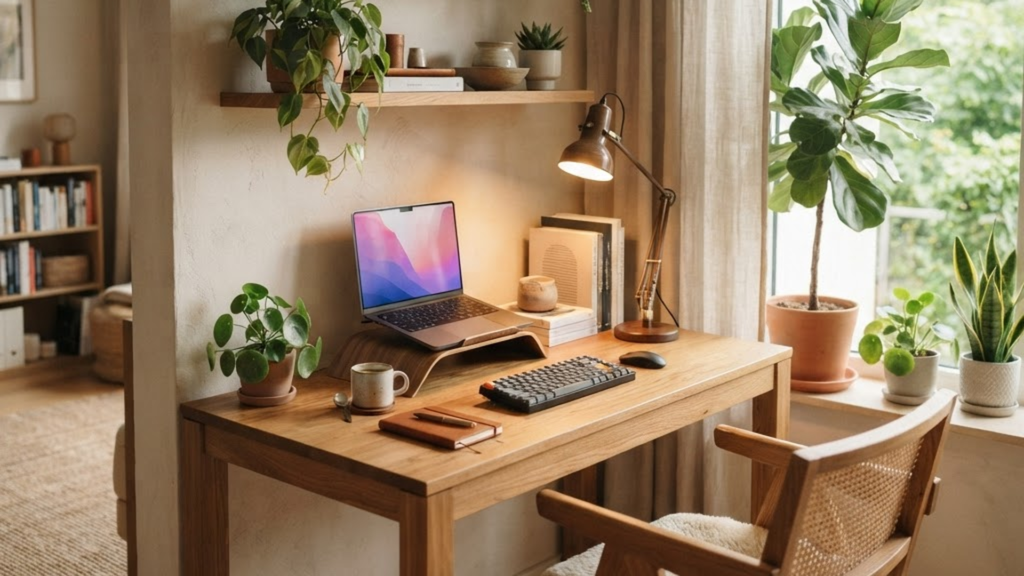
If there is one thing that transforms a workspace more than any other, it is light. Natural light is the gold standard, and the ideal setup places your desk perpendicular to a window — you get the benefit of daylight without the glare on your screen. When natural light is not available, the goal is to mimic its qualities as closely as possible: warm, diffused, and layered.
Layered lighting means multiple sources at different levels. A ceiling light for general visibility. A desk lamp for task work. Something ambient — a warm-toned bulb in a corner — to soften the harshness. The worst workspaces have a single overhead light casting flat, shadowless illumination that makes the room feel like a doctor’s office.
People spend hundreds on productivity apps and nothing on a lightbulb. The lightbulb will do more.
The Role of Nature and Texture
The research on plants in workspaces is consistent: they reduce stress, improve focus, and make people more productive. But the research is almost beside the point. A workspace with a plant feels different. There is something alive in the room. It changes the air, the humidity, the visual texture. It gives the eye a place to rest that is not a screen.
Beyond plants, texture matters more than people think. A wooden desk feels different from a laminate one. A corkboard on the wall absorbs sound and adds warmth. A wool rug underfoot softens the room acoustically and visually. These are not decorative choices. They are sensory ones. A workspace that feels good to occupy is one where you stay longer, not because you have to but because you want to.
The Discipline of Clutter Management
There is a myth that creative people thrive in chaos. Some do. Most do not. What looks like creative chaos is usually just disorganisation wearing a flattering label.
A workspace that makes you want to work has a system. Not a sterile, everything-in-its-place system, but a rhythm. Active projects within reach. Reference materials nearby but not in the way. A place for the coffee cup that is not on the desk. Cables managed, or at least hidden. The goal is not minimalism. The goal is frictionlessness — being able to reach for what you need without having to move three things first.
The Space You Want to Return To
The ultimate test of a workspace is simple. When you finish working for the day, do you want to come back tomorrow? Not out of obligation, but because the space itself draws you in. Because it is pleasant to sit there. Because it feels like a place where good work happens.
That feeling does not come from any single element. It comes from the combination. The right chair, the right light, a plant in the corner, a surface that is clear enough to think on. None of it is expensive. All of it is intentional.
The best workspace is not the one that impresses other people. It is the one that makes you sit down and forget you were ever reluctant to start.