
A perspective piece from The Listening Market.
We have more entertainment available to us than any generation in history. Films, series, music, games, podcasts — more than a lifetime’s worth, accessible instantly, for less than the cost of a cinema ticket per month. By every measure of supply, we should be the most entertained humans who have ever lived.
And yet, the thing people are valuing most in 2026 is the one thing that cannot be streamed: being there.
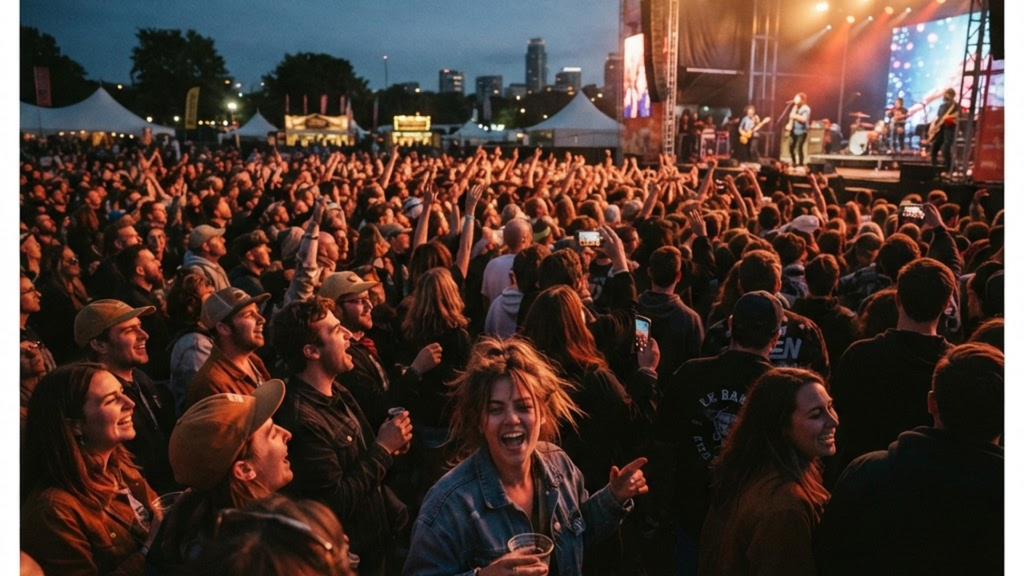
Live experiences — concerts, theatre, festivals, comedy, markets, sporting events — are surging in a way that seems to contradict everything the digital age promised. If everything is available on a screen, why are people paying more than ever to stand in a field and watch a band play? The answer reveals something important about what we actually want from entertainment.
The Scarcity That Changed Everything
Digital content is infinite. That is its great advantage and its hidden cost. When something is always available, it loses a particular kind of value — the value of occasion. You can watch the film tonight, or tomorrow, or never. There is no urgency. No moment. The content sits in a queue, and the queue grows longer, and the watching keeps getting deferred.
Live experiences cannot be deferred. They happen at a specific time, in a specific place, with specific people, and then they are gone. That scarcity — not manufactured scarcity, but genuine irreversibility — gives them a weight that no streaming algorithm can replicate. You were there or you were not. There is no “watch later” button for a live concert.
This is not nostalgia for a pre-digital world. It is a recognition that abundance and value are not the same thing, and that in an age of infinite content, the finite becomes precious.
The Shared Moment
There is something that happens in a crowd that cannot happen alone. A comedian’s joke lands differently when five hundred people laugh at the same time. A song’s chorus hits differently when ten thousand voices are singing it back. A goal feels different when the people around you leap to their feet and you leap with them.
This is collective emotion, and it is one of the few experiences that screens genuinely cannot replicate. A streamed concert captures the sound. It does not capture the press of the crowd, the vibration of the bass in your chest, the stranger who becomes a friend for three minutes during the encore. These are not peripheral details. They are the experience.
People are not paying for the performance. They are paying for the moment — the specific, unrepeatable, shared moment of being present while something happens.
The Economics of Presence
The numbers tell the story. Live event revenue has been climbing steadily, and 2026 is on track to set records. Ticket prices have risen, and people are paying them. Festivals are selling out faster. Small venues are reporting their best years. The appetite is not just holding — it is growing.
For artists, performers, and event organisers, this shift is significant. It means the live experience is no longer the promotional tour for the recorded product. In many cases, the recorded product is the promotional tool for the live experience. The album builds the audience. The tour is the business.
This inversion has been building for years, but 2026 feels like the year it became undeniable. The recorded version is the advertisement. The live version is the thing.
What This Means Going Forward
The rise of live experiences does not mean the decline of digital. They serve different purposes. Digital content is for consumption — convenient, personal, repeatable. Live experiences are for connection — communal, singular, irreversible. The future of entertainment is not one or the other. It is both, serving different human needs.
But the valuation has shifted. The thing that used to be the add-on — the live show, the in-person event, the physical gathering — has become the centrepiece. And the thing that used to be the main event — the album, the broadcast, the stream — has become the background.
There is a lesson in this that extends beyond entertainment. In a world where almost everything can be digitised, the things that cannot be digitised become more valuable. Presence. Proximity. Shared moments. The experiences that require you to be physically there are the ones that will increasingly command attention, money, and memory.
You can watch anything, anytime. But you can only be there once. And that is what makes it worth everything.