
A perspective piece from The Listening Market
It started with eggs. That’s what Marcus, a 34-year-old accountant in Brisbane, says when asked why he started cooking. Not a cookbook. Not a viral video. Just eggs — scrambled, one morning, in his own kitchen, with his own pan, on his own terms. He’d ordered takeout for dinner the night before, and something about the transaction left him feeling hollow in a way that had nothing to do with hunger.
So he cracked two eggs into a bowl the next morning. Added salt. Cooked them slowly. Ate them standing at the counter, looking out the window. And something clicked.
He’s not alone. Across kitchens in 2026, something is stirring. After years of food delivery apps, meal kit subscriptions, and the cultural gravitational pull of restaurants, people are coming back to the stove. Not with elaborate recipes or aspirational plating — just with simple food, made by hand, eaten at home.
The Fatigue of Convenience
Food delivery apps revolutionised dinner and then somehow ruined it. The friction was gone — no shopping, no chopping, no washing up — but so was the satisfaction. A meal that arrives in packaging, eaten from a container, produces a particular kind of emptiness. It’s efficient. It’s also joyless.
Research published in the National Library of Medicine has consistently shown that the act of cooking at home is associated with better dietary quality, lower rates of obesity, and improved psychological wellbeing. The benefits extend beyond nutrition — the process itself matters.
What people discovered, gradually, is that the thing they were paying to eliminate — the effort of cooking — was actually the part that made the meal meaningful. Convenience removed the chore and the reward simultaneously.
Simple Doesn’t Mean Basic
The home cooking renaissance of 2026 isn’t about complexity. Nobody is making their own pasta or curing their own olives — or if they are, they’re the exception. What’s happening is a return to foundational cooking. Pasta with butter and parmesan. A roast chicken on Sunday. Vegetables roasted with olive oil and salt. Rice and beans. Soup from whatever is in the fridge.
These are dishes that require no skill beyond following a few steps and paying attention. They’re the things our grandparents made without calling them recipes. And they taste better than almost anything that arrives in a delivery bag, not because of technique, but because of freshness and the simple fact that someone cared enough to make them.
The Ritual Element
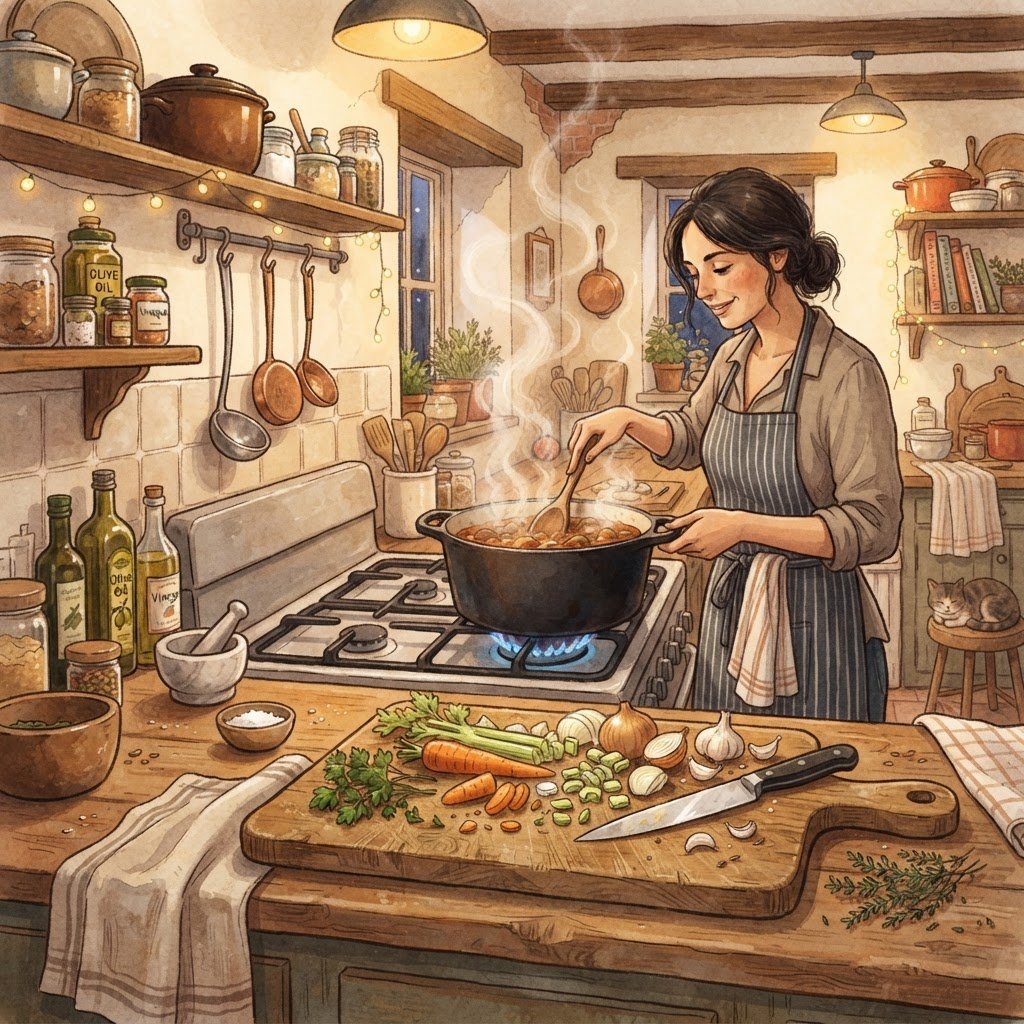
What people are finding is that cooking is less about the food and more about the ritual. The act of standing at a counter, slicing something, hearing oil sizzle in a pan — these are sensory experiences that ground a person in their body and their space. After a day of screens and notifications, cooking is analog. It requires hands. It produces something real.
The kitchen has become, for many, the one room in the house where phones are put away. Not because of a rule, but because chopping onions while scrolling is genuinely difficult and slightly dangerous. The activity demands presence, and presence has become the rarest commodity in modern life.
The Economics Are Hard to Ignore
There’s also the money. A meal cooked at home costs a fraction of its delivered equivalent. A whole chicken roasted with vegetables feeds four people for under fifteen dollars. The same meal ordered through an app, with delivery fees and tips, costs sixty or more. Over a week, the difference is staggering. Over a year, it’s the kind of saving that funds a holiday.
People aren’t cooking to save money — or if they are, they don’t lead with it. They lead with how the food tastes, how the kitchen smells, how sitting down to something they made feels different from opening a bag. But the economics make the habit sustainable in a way that good intentions alone never could.
Learning Without Intimidation
The barrier that kept people out of kitchens for years was intimidation. Cooking shows portrayed the act as theatrical. Social media made it competitive. A generation grew up believing that cooking required talent, equipment, and an audience.
What’s changed is the discovery that cooking doesn’t require any of those things. It requires a knife, a heat source, and the willingness to make something that tastes fine rather than perfect. The first few attempts might be underwhelming. The tenth will be good. The fiftieth will be something you look forward to.
As Harvard Health notes, the health benefits of home cooking compound over time — and so does the confidence. People who cook regularly report a growing sense of competence that spills into other areas of life. If you can feed yourself well, what else can you do?
The Return to the Table
Perhaps the most significant thing about the return to home cooking is what happens after the cooking is done. People sit down. At a table. Often with someone else. The meal becomes an event — not a grand one, but a real one. Fifteen minutes of eating without a screen, sharing food that someone made, talking about something other than work.
It’s not nostalgic. It’s not a rejection of modern life. It’s a recognition that some things were never improved by optimisation. Food made by hand, eaten at a table, shared with someone — that’s one of them. And in 2026, people are remembering it, one simple meal at a time.