A perspective piece from The Listening Market
The standing desk had a moment that felt almost religious. Somewhere around the mid-2010s, the health conversation shifted decisively against sitting. Articles compared prolonged sitting to smoking, a comparison that was simultaneously reductive and effective. People who had never thought about their desk heightsuddenly became connoisseurs of ergonomic design. Offices installed height-adjustable workstations, and the standing desk went from a quirky wellness accessory to a status symbol that signalled both health consciousness and corporate modernity.
A decade later, the story has become more interesting, and more honest. People are still switching to standing desks, but a growing number are switching back to sitting, or at least to a hybrid approach that involves far less standing than they initially intended. What happened in between is a useful lesson in how wellness trends evolve when they meet the complexity of real human bodies and real workdays.
The original case against sitting was not wrong, exactly, but it was incomplete. Research published by the Mayo Clinic and other institutions showed correlations between prolonged sedentary behaviour and a range of health problems, from cardiovascular disease to metabolic disorders. The key word is correlations. Sitting for eight hours a day, especially sitting that involves no movement whatsoever, is associated with negative health outcomes. But the causal chain is more tangled than the headlines suggested. People who sit all day often sit because their jobs are sedentary, and people with sedentary jobs often have less time for physical activity, and people with less time for physical activity are more likely to have diets that contribute to the very metabolic problems the studies identified. Sitting is part of a lifestyle pattern, not an isolated variable, and treating it as the sole culprit was always an oversimplification.
The standing desk entered this conversation as the obvious solution. If sitting was the problem, standing was the answer. And standing does have benefits. It engages the postural muscles, it encourages subtle shifts in weight and position that break up the stillness of sedentary time, and for some people, it genuinely improves focus and energy, particularly in the period right after lunch when the post-meal slump makes sitting feel like a slow-motion descent into a nap.
But standing has its own problems, and they became apparent only after people had spent months, not minutes, at their new desks. Standing for extended periods places load on the lower back, the knees, and the feet. Without proper footwear and a cushioned mat, the discomfort builds gradually and then suddenly. Varicose veins, which are associated with prolonged standing, became a complaint among people who had never previously thought about venous return. The same stillness that was the problem with sitting turned out to be a problem with standing too, because standing in one place is also a static posture, just a different one. The human body is designed for movement, not for any single fixed position held for hours.
This is where the narrative gets interesting, because the people who switched to standing desks and then switched back are not rejecting the idea that posture matters. They are rejecting the framing that the choice is binary. The most informed ergonomists and occupational health researchers now talk about postural variation, the idea that the best approach is not sitting or standing but moving between positions throughout the day. Sit for a while, stand for a while, walk to get water, stretch, change the desk height, do it again. The enemy is not a particular posture but the absence of change.
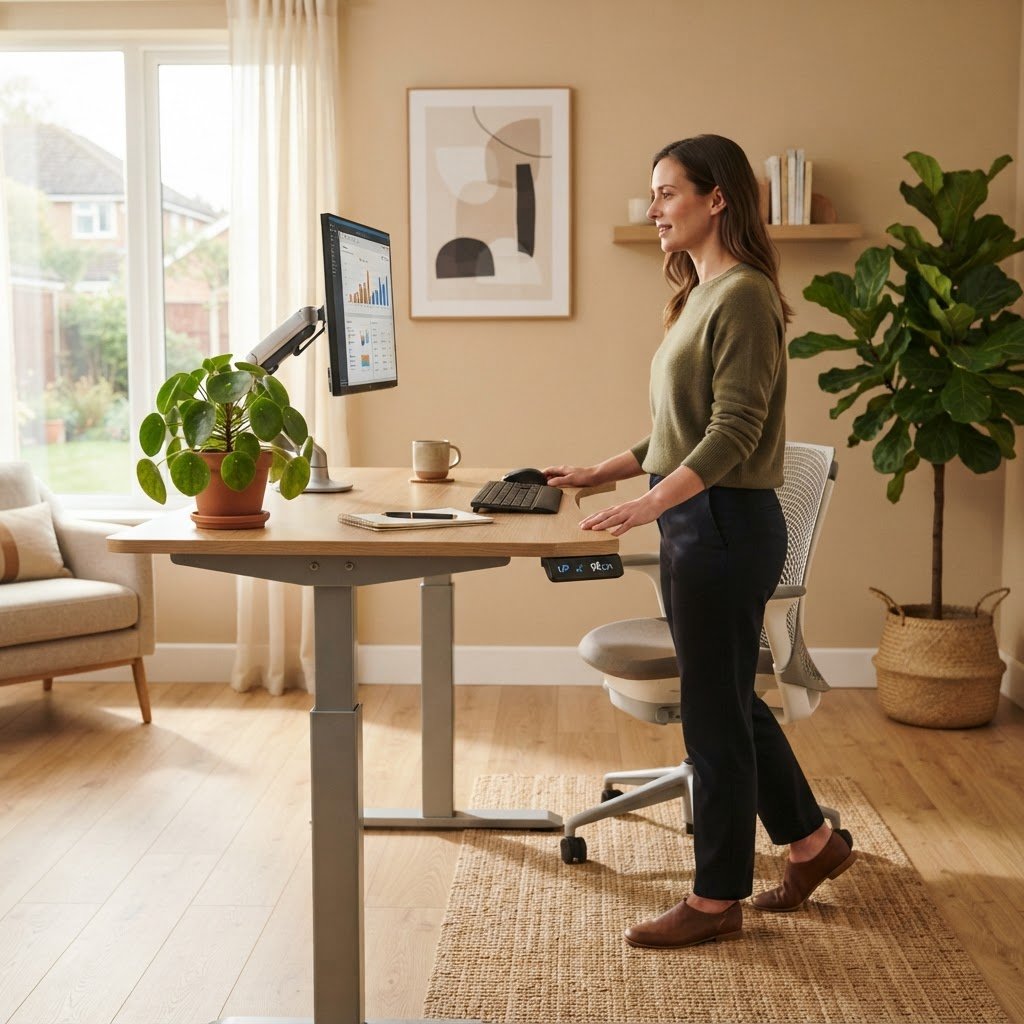
The products that have emerged to serve this philosophy are different from the first wave of standing desks. The early models were often fixed-height standing desks, which meant the user had to commit to standing or add a tall chair that was never quite comfortable. The current generation of height-adjustable desks, both manual and electric, is designed for frequent transitions. Some models recall preferred heights at the touch of a button, so switching between sitting and standing takes seconds rather than a deliberate effort. The desk is not a commitment to standing but a tool for variation.
There is also a quieter trend that sits alongside the standing desk conversation, and that is the walking pad. These slim treadmills, designed to be used under a desk at slow speeds, have gained a following among remote workers who found that neither sitting nor standing solved the fundamental problem of being motionless. Walking at two or three kilometres per hour while reading emails or participating in video calls is not exercise in any rigorous sense, but it keeps the body in motion, and motion, more than any specific posture, is what the body actually wants. The walking pad is not for everyone, and video calls while walking have their own awkwardness, but the impulse behind it, the desire to build movement into the workday rather than carving it out separately, is the most honest response to the sitting-versus-standing debate.
What the standing desk trend reveals, more broadly, is how wellness culture processes complexity. The initial enthusiasm was understandable. Sitting all day is not good for you, and a desk that lets you stand seems like a straightforward fix. But the body is not a machine that has an optimal operating position, and any single solution that assumes it does will eventually disappoint. The people who have stuck with standing desks tend to be the ones who discovered postural variation on their own, who learned that standing for three hours and sitting for five is better than either one for eight. The ones who switched back are not failures of the trend but evidence that the trend was always more complicated than it was sold.
The lesson is not that standing desks are bad or that sitting is fine. The lesson is that health advice which reduces a complex problem to a single binary choice is almost always incomplete. The sitting-versus-standing question is really a question about movement, variety, and the fact that the body evolved to change position frequently, not to hold any one position all day. The best desk is not the one that lets you stand or the one that lets you sit. It is the one that lets you do both, and the best habit is not standing more or sitting less but never staying in either for too long.