A perspective piece from The Listening Market
For the better part of two decades, the narrative around long-distance travel wassimple and predictable. Flying was the future, and trains were the past. Budget airlines stripped away every comfort and made flying cheap enough to be routine, and the high-speed rail boom in Europe and Asia was framed as a practical alternative for short corridors, not as something anyone would choose for the experience itself. Train travel was efficient in the right geography, but nobody was calling it luxurious.
Something has shifted. Not gradually, but with a noticeable acceleration in recent years, train travel has been reinvented as a premium category, and the people driving the trend are not the budget-conscious travellers one might expect. They are the ones who can afford to fly business class, the ones who have spent enough time in airport lounges to feel the particular exhaustion that air travel now generates. They are choosing trains not because they are cheaper but because they are better, and the travel industry is paying attention.
The causes are layered, but the most obvious one is the deterioration of the flying experience. Airports have become more crowded, security lines have become more unpredictable, and the space allotted to each passenger has shrunk to the point where a three-hour flight can feel like an endurance event. The romance of air travel, always more myth than reality, has been thoroughly extinguished by the realities of modern aviation. Delays, cancellations, and the increasingly common spectacle of passengers being removed from overbooked flights have made flying something to be endured rather than enjoyed. For short and medium-distance journeys, the train is competitive on total travel time once the airport is factored in, and the experience of travelling is not merely better but categorically different.
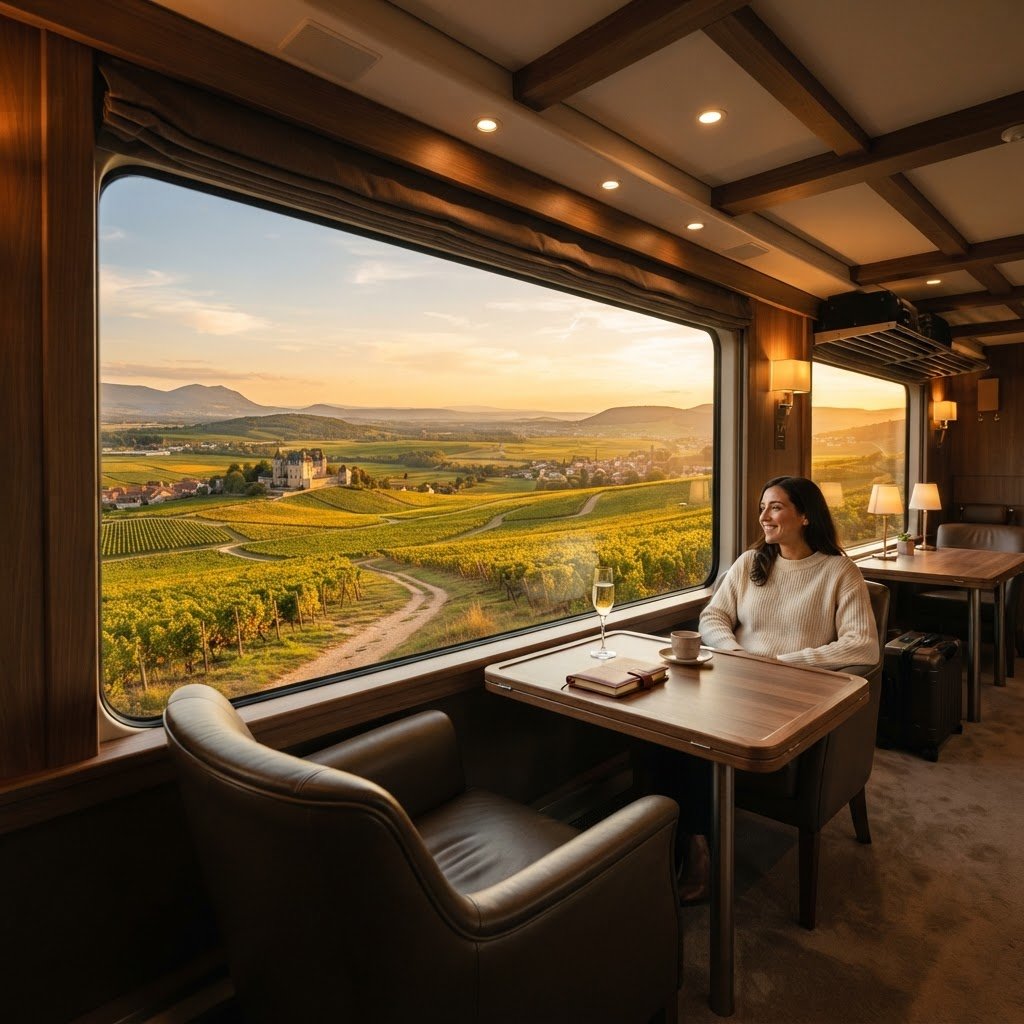
What makes train travel feel luxurious is not always the amenities, though those have improved. It is the pace. A train moves at a speed that the human mind can accommodate. The landscape scrolls past at a rate that invites contemplation rather than the blurring anonymity of a jet at altitude. There is a window, a real window, through which the world is visible, and that visibility changes the psychological texture of the journey. Flying is a teleportation, a suspension between two points with the space between them erased. Train travel is a journey in the older sense, a continuous passage through places that exist, and that continuity has a calming effect that no amount of airport lounge access can replicate.
The product itself has evolved to meet the new demand. New sleeper trains have launched across Europe, connecting cities like Brussels, Vienna, and Stockholm with overnight routes that were abandoned decades ago and have now returned with a fundamentally different design language. The new sleeper compartments are not the cramped couchettes of the 1980s. They are private rooms with real beds, thoughtful lighting, and design sensibilities borrowed from boutique hotels. The Austrian Federal Railways’ Nightjet service has become the standard-bearer, offering routes that turn travel time into rest time, arriving in the morning city centre having slept through the night without the disruption of an airport departure at dawn.
Daytime premium trains have also raised the bar. The Eurostar, connecting London with Paris, Brussels, and Amsterdam, has positioned itself unambiguously as a premium experience, with new trains that feature more spacious seating, better onboard service, and a station experience that avoids the worst indignities of airport terminals. In Japan, the Shinkansen has maintained a standard of punctuality and comfort that no airline has matched, and the cultural expectation of the journey itself as something to be valued rather than endured has kept train travel at the centre of Japanese intercity transport. In Australia, the revival of interest in long-distance rail journeys like The Ghan and the Indian Pacific reflects a similar impulse, the desire to experience the journey as a destination in its own right rather than an inconvenience to be compressed.
The dining experience on trains has become a significant part of the appeal. The dining car, once a functional space for reheated meals, has been reimagined by operators who understand that food and travel have always been linked. Regional menus that reflect the landscape the train is passing through, wines from the regions alongside the tracks, and the simple pleasure of eating at a table while the countryside moves past the window, these are experiences that air travel cannot replicate and that road travel cannot match because the driver, by definition, cannot relax with a glass of wine and a three-course meal.
There is also an environmental dimension that has become part of the luxury narrative. Train travel produces significantly lower carbon emissions per passenger than flying, and for a growing segment of travellers, the ability to move across a continent without the environmental guilt of air travel adds a moral dimension to the luxury. This is a relatively new phenomenon, the idea that a premium experience can also be a virtuous one, and it has proven remarkably powerful. The traveller who chooses a sleeper train over a short-haul flight is making a statement about values as well as preferences, and the train operators have been savvy about leaning into this positioning.
The limitation, of course, is geography and time. A train from Sydney to Perth is a journey of days, and most people do not have that kind of time. For journeys under six hours, the train is often the superior choice even on pure convenience grounds. For journeys longer than that, the train becomes an experience rather than a transport option, something chosen for pleasure rather than efficiency, and that repositioning is where the luxury market lives.
What the rise of train travel as a premium category suggests is that the definition of luxury in travel is changing. Luxury used to mean faster, higher, more exclusive. It is starting to mean slower, more connected, more human. The private jet and the first-class cabin still exist and still have their market, but the most interesting growth is happening at ground level, on rails, where the journey has been restored to its rightful place as part of the travel experience rather than the tax one pays to reach a destination. The train was supposed to be the past of travel. It is turning out to be, in a way nobody quite predicted, part of its future.