
A perspective piece from The Listening Market
The average attention span of a goldfish is approximately nine seconds. This statistic, repeated so often it has taken on the quality of folklore, has been used to explain everything from the decline of reading to the rise of TikTok. Whether or not the comparison to goldfish holds up to scientific scrutiny is beside the point. What matters is that the comparison resonates because it captures something real about how entertainment has changed. The most popular content in the world today is not a film, a novel, or even a television series. It is a video that lasts between fifteen and sixty seconds.
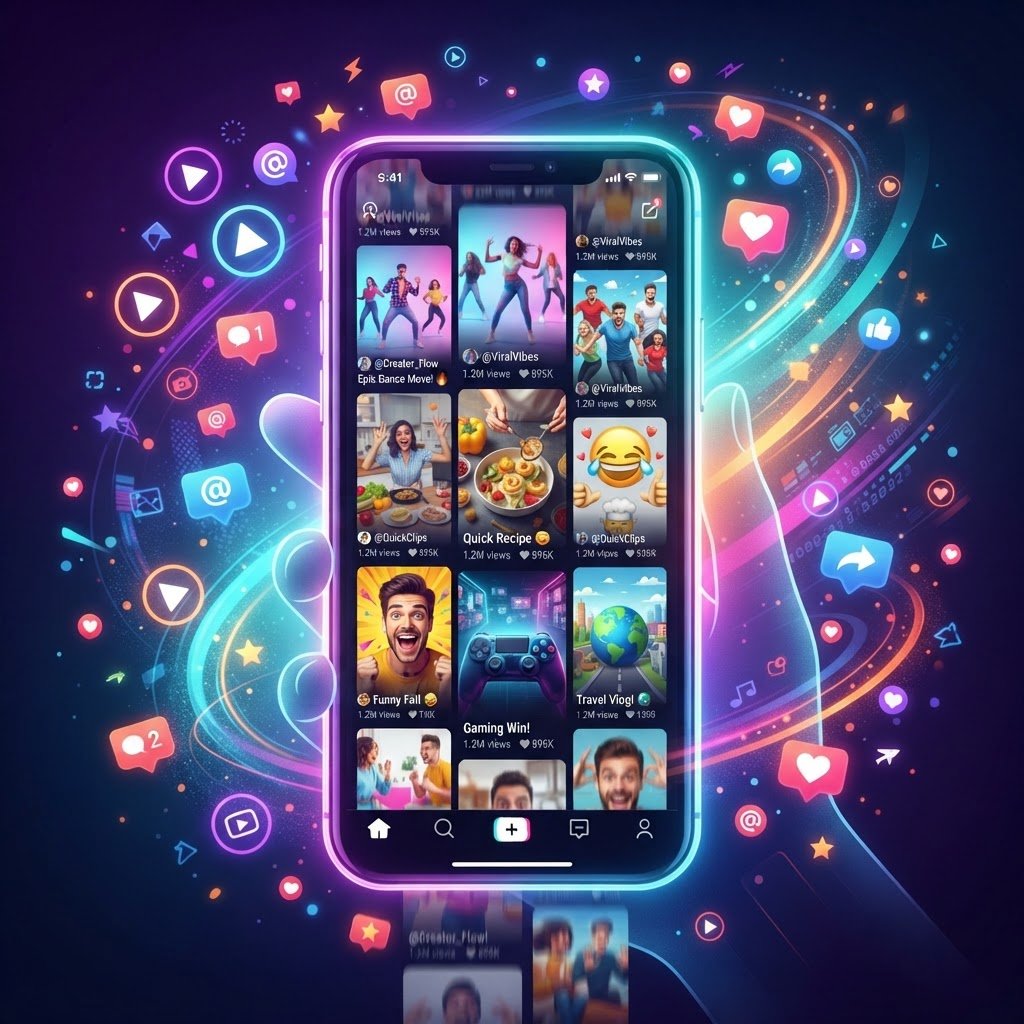
The rise of short-form entertainment has been one of the most rapid cultural shifts in recent memory. Platforms built on the principle of brevity have accrued billions of users in a fraction of the time it took their predecessors to reach similar scale. The format has colonised not just its native territory but older platforms as well, with established social networks hastily adding short video feeds to avoid being left behind. What began as a niche format for lip-syncing clips has become the dominant mode of entertainment for an entire generation, and its influence is now spreading outward into every corner of media.
Understanding why this happened requires looking beyond the technology to the psychology. Short-form content is engineered to exploit the brain’s reward system with remarkable efficiency. Each video delivers a concentrated burst of novelty, humour, beauty, or outrage, and before the brain can process or tire of it, the next one arrives. The swipe is the mechanism, but dopamine is the engine. The format is not just short by design but infinite in supply, and the combination of brevity and endlessness creates a loop that is difficult to break out of once entered.
This is not a moral failing on the part of the user. The platforms have been built by some of the most sophisticated engineering teams in the world, and their algorithms are designed to learn, with extraordinary precision, what keeps each individual person watching. The swipe-and-scroll interface removes even the minimal friction of clicking, making the decision to continue virtually automatic. It is, from a product design perspective, a masterwork. It is also, from an attention economy perspective, a system of extraordinary extraction.
The content itself has evolved to meet the constraints of the format. Creators have developed a grammar of short-form video that is distinct from anything that came before. The first second is non-negotiable: if the hook does not land immediately, the viewer is gone. Text appears on screen because many viewers watch without sound. Cuts are rapid, sometimes several per second, to prevent the eye from wandering. There is no build, no setup, no patience. Everything is payoff, and the payoff must arrive before the thumb decides to move.
What is lost in this compression? Detractors point to several things. Narrative complexity is impossible when the entire story must unfold in under a minute. Emotional depth requires time to build, and the format does not allow for it. Critical thinking is undermined because there is no space for nuance or counterargument. And the sheer volume of content means that even the best clips are quickly replaced by the next thing, making it difficult for any single piece to linger in the mind. The experience is broad but shallow, a river that is miles wide and an inch deep.
There is also concern about what happens to creators in this ecosystem. The pressure to produce constantly, to chase trends, and to optimise for an algorithm that rewards volume and novelty creates a treadmill that is exhausting to maintain. The shelf life of a viral clip is measured in days, sometimes hours, and the demand for fresh content is relentless. For every creator who builds a sustainable career, many more burn out, their work consumed and forgotten in the same breath.
Yet it would be a mistake to dismiss short-form entertainment entirely. The format has democratised content creation in ways that previous media never did. A person with a phone and an idea can reach millions without a production budget, a distributor, or a gatekeeper. Voices that were historically excluded from mainstream media have found audiences on these platforms, and the result is a broader, more diverse range of perspectives than traditional entertainment ever offered. The flattening of the creative landscape is real, even if the content it produces is uneven.
The format has also proven surprisingly versatile. Educational creators use short clips to teach everything from history to physics, distilling complex topics into bite-sized explanations that can spark curiosity and send viewers down rabbit holes of further learning. Cooks share recipes in sixty seconds. Crafters demonstrate techniques in real time. The constraint of brevity, rather than always being a limitation, can function as a forcing function for clarity. When there is no room for padding, every second has to earn its place.
The cultural conversation around short-form entertainment has largely framed it as a problem to be solved, something to be moderated, limited, or resisted. Screen time controls, app timers, and digital wellbeing features are the technological responses. But cultural responses are harder to engineer because the appeal of the format is not irrational. People are not being tricked into watching. They are choosing it, again and again, because it delivers something they want: entertainment that is immediate, portable, endlessly varied, and perfectly suited to the in-between moments of modern life.
The deeper question is what happens to the capacity for sustained attention when the default mode of entertainment trains the brain to expect constant novelty in short bursts. Research on this is still emerging, and the picture is not straightforward. Some studies suggest that heavy users of short-form content do show reduced ability to focus on longer tasks, but causation is hard to establish. People who already struggle with attention may simply be drawn to the format that suits them. Others argue that the brain is more adaptable than the doom-laden narratives suggest, and that humans have always adjusted to new media formats without losing the ability to engage with old ones.
What seems clear is that short-form entertainment is not going away. It has become too embedded in daily life, too profitable for the platforms that host it, and too compelling for the audiences that consume it. The more productive question is not whether to engage but how, and what place this format should occupy in a balanced media diet alongside the slower, deeper forms of entertainment that have always existed.
There may yet be a backlash. The same cultural pendulum that swung from long-form toward short-form may eventually swing back, at least partially, as people seek depth to compensate for all the breadth. We may see a revival of the essay, the long podcast, the unhurried film. But even if that happens, the short form will remain. It has earned its place in the ecosystem, not by replacing what came before but by adding something new. The goldfish comparison, whatever its scientific merit, captures the spirit of the age: a world in which the most valuable resource is not information but attention, and the competition for it has never been fiercer.




