
A perspective piece from The Listening Market
There is something primal about eating food from a cart on a street corner. The sizzle of a hot plate, the smoke curling upward into the evening air, the cook who has made the same dish thousands of times and moves with the effortless precision of someone performing a well-rehearsed routine. No reservations, no dress code, no tasting menu. Just food, made quickly, served simply, and eaten standing up or perched on a plastic stool. Street food is the opposite of fine dining, and yet in many ways it represents cooking at its most honest. It is food stripped of pretension, designed to nourish, delight, and be accessible to anyone with a few coins in their pocket.
Every culture has its version. The specifics change from country to country, city to city, even neighbourhood to neighbourhood, but the underlying principle is the same. Take what is local, what is abundant, what is cheap, and transform it through technique and tradition into something that tastes like it belongs nowhere else. Street food is not just food eaten outdoors. It is food that could not exist in any other form, tied to its place so completely that attempting to recreate it elsewhere always leaves something missing. The water, the climate, the particular variety of chilli grown in that region, the way the dough responds to humidity. All of it matters.
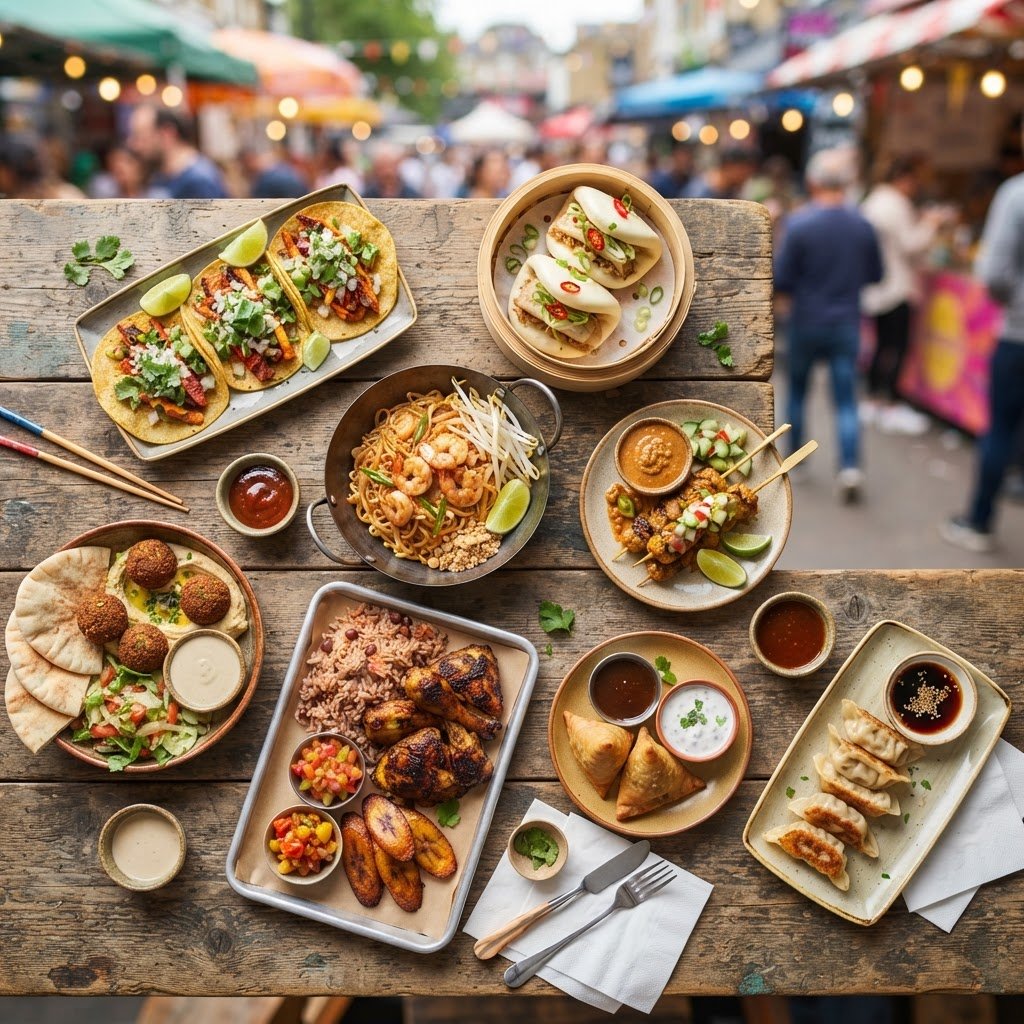
Tacos are perhaps the most globally recognised street food, and for good reason. A good taco is a masterclass in balance. The tortilla, ideally pressed fresh from masa, provides a warm, slightly chewy foundation. The filling, whether carnitas slowly braised until tender, al pastor shaved from a vertical spit with pineapple, or simple grilled fish with cabbage slaw, brings protein and fat. The salsa adds heat and acidity. The final squeeze of lime and sprinkle of cilantro brightens everything. It is a complete dish in a handheld package, and when it is done right, there is nothing better to eat.
Dumplings tell a different story. Across China, dumplings vary enormously by region, from the delicate pleated folds of Shanghai xiaolongbao, filled with pork and a molten broth, to the thick-skinned, hearty jiaozi of the north, eaten boiled or pan-fried. Each variation carries the fingerprints of its origin. The folding technique passed down through generations. The specific ratio of meat to vegetable in the filling. The dipping sauce, which might be black vinegar and ginger in one place and soy and chilli oil in another. A dumpling is not just a dumpling. It is a specific dumpling from a specific place, made by specific hands.
Satay skewers, grilled over open coals across Southeast Asia, offer another kind of pleasure. Thin strips of meat, usually chicken or beef, marinated in a blend of turmeric, coriander, lemongrass, and coconut milk, threaded onto bamboo sticks and charred until smoky at the edges. They are served with a peanut sauce that is sweet, salty, and faintly spicy, the kind of sauce that makes you want to lick the plate. In Malaysia, Indonesia, and Thailand, satay is evening food, market food, food eaten with a crowd, the smoke from the grill drawing people in from across the street.
Falafel, found across the Middle East and now throughout the world, represents the genius of simplicity. Chickpeas or fava beans, soaked and ground with herbs and spices, formed into balls and deep-fried until crisp and golden. Inside, the texture is soft and almost creamy, the flavour herbaceous and warm. Wrapped in flatbread with pickled vegetables, tahini sauce, and a scatter of sumac, falafel is a complete meal that costs very little and satisfies deeply. It is also a reminder that some of the best food in the world is accidentally vegan, born not from dietary trends but from making the most of what is available.
Bao buns, the soft, pillowy steamed bread from Taiwan and southern China, have travelled far beyond their origins. Filled with braised pork belly, pickled mustard greens, crushed peanuts, and cilantro, a good gua bao is a study in contrasts. The yielding softness of the bun against the rich, melting fat of the pork. The tang of the pickle cutting through the sweetness of the glaze. The crunch of peanuts adding texture. It is a small package that contains an entire conversation between flavours, and eating one is never quite enough.
Jerk chicken from Jamaica brings fire to the conversation. The meat is marinated in a paste made from scotch bonnet peppers, allspice, thyme, garlic, ginger, and spring onions, then cooked slowly over pimento wood until the skin is blackened and the meat is deeply perfumed with smoke and spice. The heat is real, the kind that builds with each bite and makes you reach for something cold to drink. But beneath the fire is a complex sweetness and warmth from the allspice, a flavour that is impossible to replicate without the right wood and the right climate.
Pad thai, the stir-fried noodle dish that has become synonymous with Thai street food, is everywhere for a reason. Rice noodles tossed in a wok over fierce heat with tamarind paste, fish sauce, palm sugar, dried shrimp, tofu, and egg, finished with crushed peanuts, lime, and chilli flakes. The dish is a tightrope walk between sweet, sour, salty, and umami, and when the balance is right, every bite tastes slightly different depending on which ingredient your chopsticks have gathered. It is food that demands to be eaten immediately, while the noodles are still hot and the textures are at their peak.
Samosas, the triangular pastries of the Indian subcontinent, are proof that a simple shape can carry extraordinary flavour. A crisp, blistered pastry shell gives way to a filling of spiced potatoes, peas, and sometimes lentils or meat. The spices, cumin, coriander, turmeric, and garam masala, bloom in the heat of frying and fill the air with a smell that stops people mid-stride. Eaten with tamarind chutney or mint sauce, a samosa is a complete experience in a few bites, the kind of food that turns a quick snack into a moment worth savouring.
The beauty of street food is not just in the dishes themselves but in the context. Eating banh mi on a low plastic stool in Hanoi while motorbikes stream past. Buying a hot dog from a cart on a New York sidewalk and eating it while leaning against a building. Grabbing churros from a stand in Madrid and burning your fingers on the first one because you could not wait. These experiences cannot be separated from the food. The setting is part of the flavour, part of the memory, part of the reason people travel halfway across the world to eat something they could approximate at home.
There is also an economic story here. Street food is a livelihood. The woman flipping crepes on a Parisian corner, the man rolling injera in Addis Ababa, the family running a noodle stall in Bangkok for three generations. These are small businesses, often invisible to formal economies, that feed cities. They operate on thin margins and high volume, and their survival depends on consistency and reputation. A street food vendor does not have marketing campaigns or loyalty programs. They have returning customers, and that is enough.
The globalisation of street food has created both opportunities and tensions. On one hand, dishes that were once hyper-local are now available in cities far from their origins, introducing new audiences to flavours they might never have encountered. On the other hand, there is a risk of dilution, of dishes being simplified or altered to suit palates that are unfamiliar with the original. The best street food, wherever it is found, remains stubbornly authentic, made by people who learned from people who learned from people, the recipe carrying the weight of its own history.
What ties all of these foods together is not a single ingredient or technique. It is a philosophy. Good food does not require a formal setting. It does not require a long preparation time or an expensive ingredient list. It requires knowledge, care, and the willingness to serve it simply, at the moment it is ready, to whoever is there to eat it. Street food is the most democratic form of cooking, and its global popularity is a reminder that the best meals are often the most unassuming.
For anyone who has never stood at a cart and eaten something extraordinary on a paper plate, the experience is worth seeking out. Not because it will change your life, but because it will remind you what food is for. It is for pleasure, for connection, for energy, and for memory. And sometimes, the meal that stays with you longest is not the one served on fine china but the one handed to you in a folded leaf, still hot, eaten standing in the street, tasting exactly like where you are.




