
A perspective piece from The Listening Market
The first co-working spaces were born out of necessity. A few freelancers and startup founders, tired of working from kitchen tables and cafe corners, pooled resources to rent a shared room with reliable internet and decent coffee. It was a practical solution to a practical problem. Nobody called it a movement. Nobody wrote think pieces about the future of work. It was simply a room where people could sit and work alongside other people without the isolation of home or the noise of a public space. From that modest beginning, co-working grew into a global industry, and now it is evolving again, reshaping itself to meet work habits that look nothing like they did even five years ago.
The original co-working model was built around a simple proposition. Rent a large open-plan space, fill it with desks and comfortable chairs, offer unlimited coffee and fast internet, and charge a monthly fee for access. The appeal was straightforward. Freelancers got a professional environment without the cost of a private office. Startups got flexibility, able to scale up or down without signing a multi-year lease. Everyone got community, the chance to sit near other working adults and occasionally share a conversation over the coffee machine. It worked because it solved a real problem at a time when remote work was still the exception rather than the rule.
Then the world changed. Remote work went from perk to default almost overnight, and the co-working industry found itself in a strange position. On one hand, more people than ever were working outside traditional offices and needed somewhere to go. On the other hand, the reasons they needed somewhere to go had shifted. It was no longer about having a desk and internet. Most people had those at home. It was about something else, a need for boundaries between work and life, for professional surroundings that signalled productivity, for human proximity without the obligation of interaction. Co-working spaces had to adapt, and the ones that survived did so by rethinking what they offered.
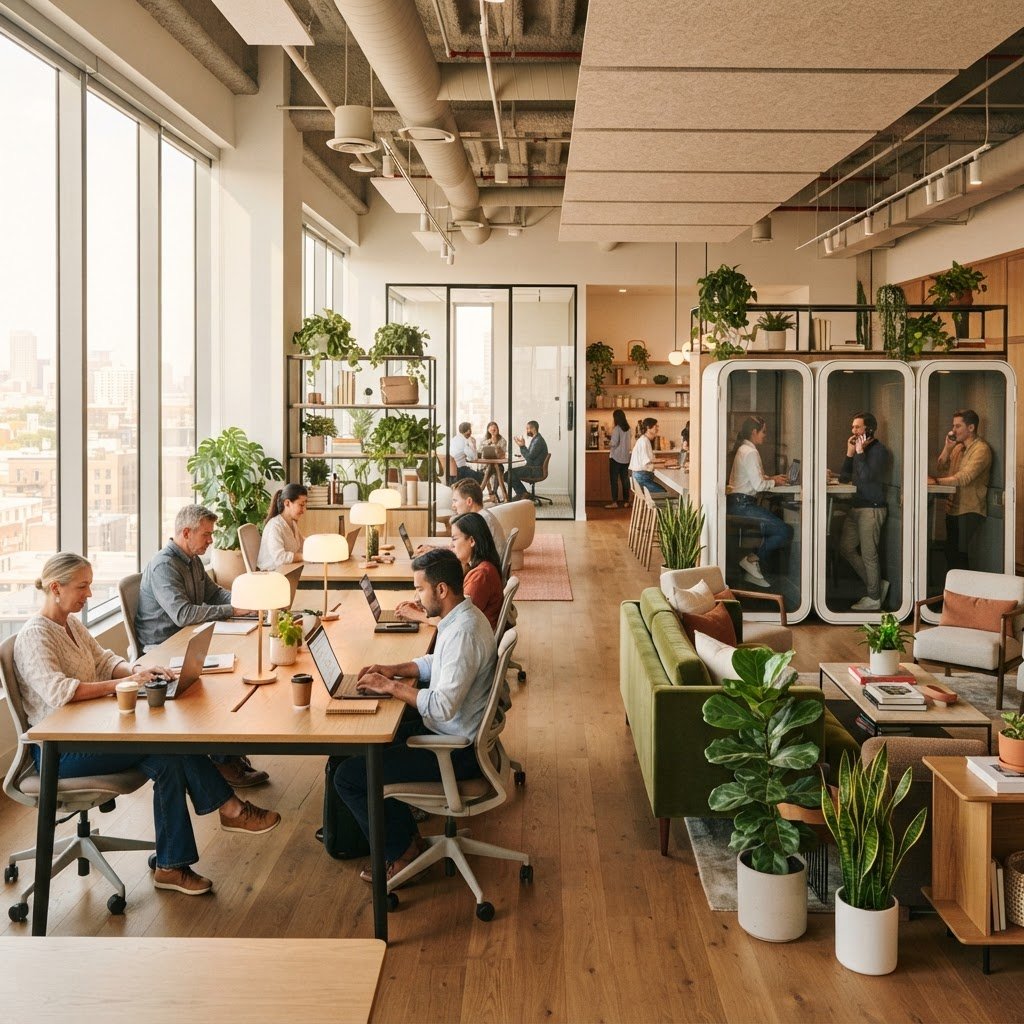
The open-plan desk farm is giving way to something more nuanced. The new co-working spaces are being designed around the recognition that work is not a single activity but a range of activities, each requiring a different environment. Focused deep work demands quiet and isolation. Collaborative work needs whiteboards and open space. Phone calls require privacy. Meetings need rooms with screens and acoustics. Breaks need comfort and a change of scene. The best modern co-working spaces offer all of these in a single membership, allowing members to move between zones depending on what the day demands.
Private phone booths have become a standard feature, a direct response to the reality that open-plan spaces made phone calls awkward for everyone. These small, soundproofed rooms are not glamorous, but they address a genuine need. The freelancer taking a client call, the remote employee joining a video meeting, the entrepreneur pitching an investor. All of them need a space where they can speak freely without worrying about being overheard or disturbing others. The phone booth is a small innovation with a large impact on daily usability.
Lounges and break areas have evolved from afterthoughts to centrepieces. Where early co-working spaces treated breaks as something that happened at the coffee machine, newer spaces design dedicated areas for rest and informal socialising. Comfortable seating, magazines, plants, sometimes a ping-pong table or a piano. These spaces serve a dual purpose. They give members a place to decompress, which matters more than it sounds, and they create the conditions for the serendipitous encounters that were always part of co-working’s promise. The person you chat with in the lounge might become a collaborator, a client, or simply a friendly face that makes the workday more pleasant.
The role of location has shifted too. Early co-working spaces clustered in city centres, near transport hubs and business districts. That made sense when members were commuting from homes in the suburbs and wanted a central, accessible location. The new geography of work is more dispersed. With remote work entrenched, people are less willing to commute long distances to reach a desk. Co-working spaces are opening in residential neighbourhoods, suburban town centres, and smaller cities, offering members a professional environment closer to where they actually live. The neighbourhood co-working space, a small facility with maybe twenty desks and a couple of meeting rooms, is becoming a common sight.
The membership model is also changing. The original all-you-can-eat monthly pass is still available, but it now sits alongside a menu of more flexible options. Day passes for those who need a desk occasionally. Part-time memberships for people who split their week between home and office. Meeting room credits for teams that need a place to gather periodically but not a permanent base. This flexibility reflects the reality that work patterns are no longer uniform. Some people want a desk five days a week. Others want a room for two hours every second Thursday. The spaces that can serve both are the ones thriving.
Corporate clients have entered the picture in a way that would have seemed unlikely a decade ago. Large companies, grappling with the cost and complexity of maintaining traditional offices, are turning to co-working spaces as part of a distributed work strategy. Rather than leasing a floor in a city centre, they book a block of desks in several locations, giving employees a choice of where to work. This hybrid approach reduces overhead, improves employee satisfaction, and provides flexibility to adjust as headcounts change. Co-working operators have responded with enterprise plans, dedicated suites, and custom branding options.
The community aspect, always the hardest element to engineer, is being approached with more intention. Early co-working spaces assumed that proximity would naturally produce connection. Put people in a room together and they would talk, collaborate, and form bonds. Sometimes that happened. Often it did not. People sat at their desks, put on headphones, and worked in silence, surrounded by others but essentially alone. The new generation of co-working spaces is more proactive. Organised events, workshops, member directories, interest-based groups. The goal is to create structured opportunities for interaction rather than leaving it to chance.
Technology is playing a larger role in the experience. App-based booking systems allow members to reserve desks, meeting rooms, and phone booths from their phones. Digital check-in replaces reception desks. Access logs provide data on usage patterns, helping operators optimise layouts and capacity. Some spaces are experimenting with smart environment controls, adjusting lighting and temperature based on occupancy and time of day. The physical space is increasingly augmented by a digital layer that makes it easier to use and easier to manage.
Sustainability has entered the conversation as well. Newer co-working spaces are being designed with environmental considerations in mind. Energy-efficient lighting and climate systems. Recycling and composting programs. Furniture made from recycled or sustainable materials. Some operators are pursuing green building certifications as a point of differentiation. This reflects both genuine concern and market demand, as members increasingly prefer spaces that align with their values.
The co-working industry has been through a turbulent period. Rapid expansion followed by contraction, high-profile closures, and questions about profitability. But the underlying need that co-working addresses has not gone away. If anything, it has intensified. More people are working independently than ever before, and the appetite for flexible, professional, community-oriented workspaces continues to grow. What is changing is the form. The generic open-plan office with unlimited coffee is no longer enough. The spaces that succeed are the ones that understand what people actually need from a workspace in this era: not just a desk, but an environment that supports the full range of how work happens now. Focus and collaboration, solitude and community, flexibility and routine. The best co-working spaces are learning to hold all of these at once, and in doing so, they are becoming something more interesting than what they started as.




