A perspective piece from The Listening Market
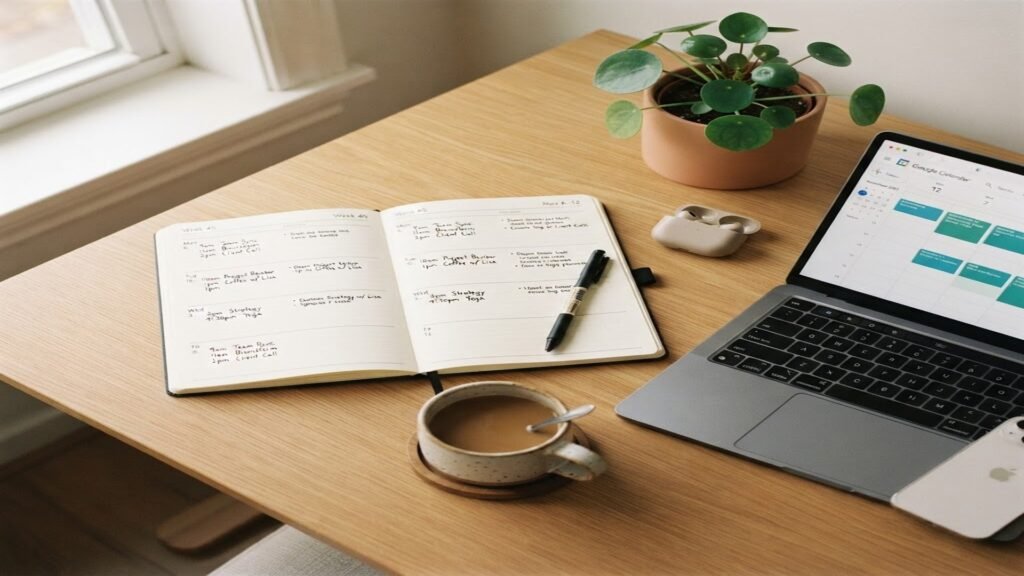
Sunday evening used to belong to the notebook. A quiet ritual: review the week gone, list the week coming, assign days to tasks, close the planner feeling briefly organised. That ritual works until the week arrives and dismantles the plan by Tuesday. Meetings multiply, surprises arrive, the carefully drawn columns surrender. The problem was never the pen. It was that a static plan has no answer when reality politely disagrees with it.
This is precisely where the new crop of AI tools earns its keep, not as a replacement for planning, but as a thinking partner that never runs out of patience. People who use AI to plan their weeks are not outsourcing their judgement. They are outsourcing the tedious mechanics of planning, the sorting, the estimating, the reshuffling, so their own attention lands on the decisions that actually matter. Here is how to build that practice from the ground up.
Start with a brain dump, not a schedule
The biggest mistake people make is asking an AI assistant for a schedule before giving it anything worth scheduling. The first move is a full brain dump: every open loop, commitment, worry, idea and half-remembered obligation, poured out in whatever messy form it arrives. Voice memo dictated on a walk, paragraphs typed in a rush, fragmentary sentences. Nothing curated. The point is to get everything out of working memory and onto the table, because unfinished tasks are known to occupy the mind precisely because they are unfinished.
A dump given to an AI assistant then becomes raw material. Ask the assistant to extract every task, sort them into work, personal, admin and someday categories, and flag anything that looks like a deadline or has been mentioned more than once. Vague anxieties, the thing that has been nagging without a clear next step, can be converted into concrete one-line actions: ask the assistant what the very next step would be for each hovering worry. A surprising number dissolve on the spot once they are reduced to a single sentence.
Let the assistant do the triage
Once the week’s raw material exists, the real work begins: deciding what deserves a place. This is where an AI tool shines as an interrogator. Paste the full task list and ask a simple, ruthless question: if only three of these get done this week, which three would make the week a success? The assistant will reason through dependencies, flag items that keep getting deferred while quietly carrying consequences, and identify tasks that belong to someone else’s priorities rather than the plan owner’s.
It helps to share context along with the list. State the week’s fixed commitments, energy patterns (mornings deep, afternoons shallow, or the reverse), and any hard deadlines. The more honestly the assistant knows the week, the more useful its sorting becomes. People who would never admit to a colleague that Wednesday is a write-off can admit it to a chat window, and the plan gets better for it.
Match tasks to real energy, not ideal energy
Static planners assign tasks to days. Efficient planners assign tasks to energy. The difference is everything. A week is not five identical days in a row; it is a landscape of peaks and troughs, and most planning failures come from matching deep work to a trough and administrative busywork to a peak.
Describe the shape of a typical week to an AI assistant, the fixed meetings, the school run, the afternoon slump, and ask it to slot the task list accordingly: deep, generative work into protected pockets, shallow tasks into low-energy windows, and nothing demanding into the hour after the worst weekly meeting. Then ask it to build in recovery. A plan with no slack is a plan that fails on schedule; the assistant can be instructed to leave one afternoon deliberately unscheduled as overflow, and that buffer is what keeps Tuesday’s surprise from destroying Thursday.
Turn the plan into a conversation that survives the week
Where weekly AI planning decisively beats the paper planner is midweek. Wednesday rearranges everything, and instead of redrawing the whole week, the plan can simply be told what happened: two urgent things landed, Thursday morning is now gone, the report got pushed. Then one request, rework the rest of the week around what actually happened. In seconds the assistant redistributes the surviving tasks, moves what can move, and says plainly what will have to slip.
This re-planning step is the habit that separates people who feel organised from people who are organised. A plan that gets abandoned the first time it is contradicted was only ever a ritual. A plan that adapts is a system. The weekly conversation can be brief, five minutes on Wednesday evening, checking what slipped and adjusting before the backlog calcifies.
Delegate the pre-work, not just the plan
Planning well also depends on material that arrives in decent shape, and AI can lighten that load too. Before a planning session, ask the assistant to summarise the week’s emails and messages into a short list of decisions pending and responses owed, so the Sunday dump starts from evidence rather than memory. Meeting agendas can be drafted in seconds from a one-line intention, sent ahead, and turned afterward into two clear action items rather than a vague sense of discussion. Reports that other people need can be outlined first, then filled, halving the dread that makes tasks slide.
This pre-work is where most hidden hours live. Inboxes, agendas and updates are the connective tissue of a week, dull enough to postpone and important enough to resent. Handing their first drafts to an assistant converts them from obstacles into checklist items, and the weekly plan benefits because every slot is then filled with work that has already been started.
Prompts that pull their weight
A few well-shaped requests cover most of a planning week. Try: extract every task from this dump, group them by theme, and tell me which ones look urgent, which look important, and which look like noise. Or: here is my task list and calendar, protect two deep-work blocks of ninety minutes and fit the rest around them. Or, the midweek reset: this happened today, rework the remaining days and tell me honestly what is no longer realistic.
The quality of the output tracks the honesty of the input. Assistants respond well to candour about capacity. Telling a planning tool that the week is already heavy before adding anything produces better schedules than pretending the calendar is empty. The tool has no ego about a Monday that accomplishes one thing.
Keep the human hands on the wheel
Two cautions keep the practice honest. First, AI is enthusiastic, and enthusiasm invents plans that flatter rather than fit. A generated week that schedules nine hours of focused output is fantasy; the correction is to ask the assistant to plan for about sixty percent of available time and let reality finish the rest. Second, the plan must stay connected to a review. A weekly glance backwards, what got done, what kept slipping and why, teaches the assistant far more than any prompt could. Patterns emerge: the recurring task that never happens is usually either mis-sized or secretly dreaded.
Second, boundaries matter. Planning conversations involve real details of a real life, and the whole point of the ritual is that it is private. The right approach is simple: use tools that keep conversations contained, and let good enough be good enough when it comes to chasing marginal features. A weekly plan is a kitchen-table tool, not a mission-control system.
A weekly ritual that finally sticks
Pull it together and the ritual looks like this. Sunday evening, ten minutes of brain dump. Three more minutes asking the assistant to sort, flag and question it. Two minutes to approve a draft week with energy slots and one empty buffer. Wednesday, five minutes to repair the week after reality has had its say. Next Sunday, close the loop before starting again.
Twenty minutes a week, in exchange for a plan that survives contact with actual life. The notebook on the desk does not become obsolete; many people keep a paper view of the week precisely because glancing at paper feels calmer than opening an app. But the thinking underneath the week, the sorting, the sequencing, the honest redistribution when things break, can now happen in conversation, quickly and without drama.
That is the quiet upgrade. Planning used to be a monologue performed alone, full of hope and undone by breakfast. Done with AI, it becomes a dialogue that keeps going all week, adjusting, trimming, and honest about what fits. The best week is not the fullest one. It is the one where everything in it was chosen on purpose.