A perspective piece from The Listening Market
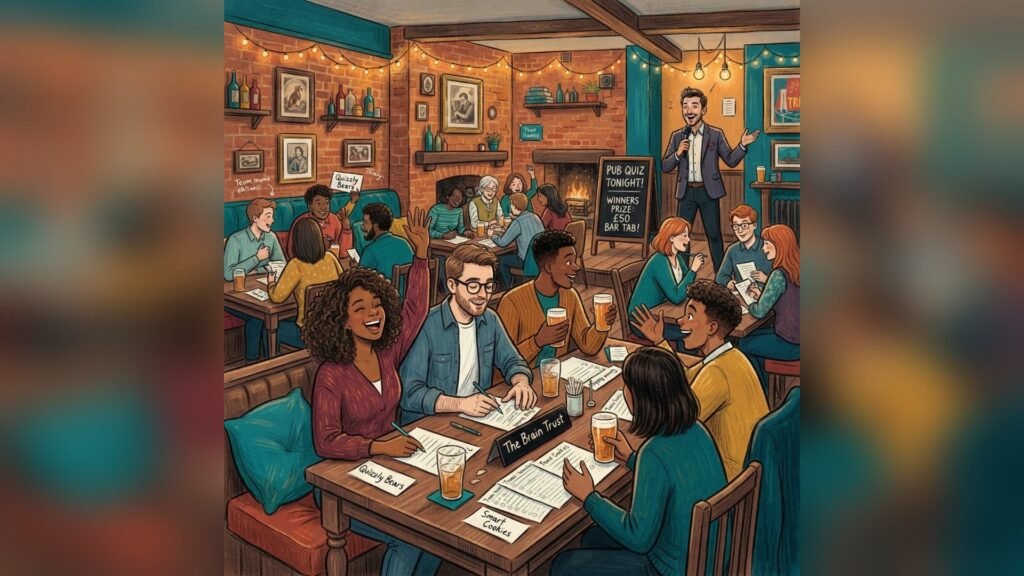
By half past seven on a Wednesday night, the back room of an ordinary suburban pub has filled past capacity, and nobody in it is looking at a phone. Sixty people sit in huddles of four to six around tables littered with pens, answer sheets, debateable opinions and someonesomeone’sunfinished#8217;s unfinished cider. A quizmaster with a microphone and no patience reads out a question about river deltas to a room of accountants, nurses, schoolteachers, and one table of regulars who have won nine times and are hated accordingly. When the leaderboard is read out, the room roars — at right answers, at wrong ones, and mostly at itself.
Pub trivia, written off for dead somewhere in the streaming decade, is in the middle of a full-blooded revival. And the reasons it is back say considerably more about the present moment than about the questions.
The rise of the scheduled social occasion
The revival arrives at the end of a long drift. For years the default model of social life moved steadily toward the private and the informal: the group chat, the streaming night, the “we should catch up” that both parties sincerely meant and neither ever scheduled. The pandemic compressed that drift into its final form — social life fully mediated by screens — and then produced its own correction. People came out of those years with a realised appetite for something the feed could not synthesise: a place, with other people in it, that happens whether or not anyone feels like organising it.
This is the first secret of trivia’s return. It is a standing appointment with society. A group that struggles to agree on a restaurant can agree, without effort or negotiation, on being at the pub at seven on Wednesday — because the event exists already, recurrently, requiring only attendance. The organisational friction that quietly killed so much of adult friendship is outsourced to the venue and the quizmaster. All a friendship has to do is show up.
Venue owners noticed the shift before anyone wrote about it. A pub midweek was once dead commercial space; now trivia night fills a room that would otherwise hold four regulars, sells food for three solid hours, and does it without a cover charge — the draw is the format itself. Turn up anywhere in most cities on a Tuesday or Wednesday and the evidence is audible before it is visible: a room laughing on a schedule, one question at a time.
A game perfectly shaped for the moment
The format, at forty-plus years old, turns out to be almost perfectly engineered for the current cultural moment. Trivia demands a team, which calls it social; but the team competes seated, around a table, with food, which makes it social in the way most adults actually prefer — conversation with something to do. No one needs to be good at anything. Knowledge is pooled, meaning the retired teacher, the teenager and the tradesman all contribute, and the person who knows 1980s football is exactly as valuable as the person who knows capital cities. There is no athletic requirement, no equipment, no practice, and no way to be embarrassed alone.
Then there is the phone-shaped hole in the middle of the room, which is the game’s quietest feature and loudest selling point. Trivia is one of the last social activities that enforces device abstinence without ever announcing it — a phone under the table is both pointless and socially unacceptable, since every answer is eventually knowable and every table is watching its own. For a few hours, a room full of people who spend their days in notifications holds sustained attention on one thing, together, and the relief of it is palpable. Venue staff describe the same observable: the room is loud, but every face is up.
The knowledge itself has changed with the audience, too. The classic quizmaster question — kings, wars, flags — still anchors a round, but modern trivia kits lean on memes, song intros, picture rounds, “guess the decade of this ad” and deliberately absurd lateral puzzles whose answers matter less than the arguments had on the way to them. Quizmasters have become a job description and, in the upper brackets, a performance art. Good ones read the room like a comedian in slow motion, and the best ones are known by name and followed between venues, which is a sentence few would have predicted a decade ago.
More than a night out
What keeps people coming back, though, is the thing that is harder to advertise: the table. Regular teams describe a loyalty to their night that outlasts jobs, house-shares and relationships. Births are announced at trivia tables. Teams have names that have been funny for eleven years. When a regular dies, whole leagues observe a round of silence — a tradition nobody designed that exists because the table became the place those friendships actually lived.
Sociologists have a term for spaces like this — the third place, the ground between work and home where community forms — and have spent years documenting its decline as the traditional venues of casual belonging (leagues, clubs, church halls, the corner pub of legend) hollowed out. Trivia night has become one of the last surviving third places with a recurring population, and possibly the most accessible one, since membership costs a sense of humour and the venue supplies everything else. Councils and mental-health bodies have begun quietly funding trivia programs in libraries and community centres for exactly this reason: it is social prescribing in its most permissive form, community instrumentalised as fun.
The workplace has noticed too. Corporate team-building, having exhausted rope courses, has stumbled on the obvious: the pub quiz is team building that adults voluntarily repeat. Recruitment now sometimes happens at tables rather than desks — one team’s accountant met a colleague at the unavoidable moment of submitting a tiebreaker, and the friendship transferred to the office with them.
What the revival has not done — and this is part of its charm — is professionalise past recognition. There are leagues, and there are regional championships whose prestige is entirely self-declared, but the heart of the format remains the neighbourhood fixture: the weekly night at the familiar venue, priced around a burger and a jug, where the stakes are vouchers and the glory is universally understood to be a joke. That stubborn modesty has protected the format from the cycle that consumed so many other social trends — discovered, monetised, tournamented, and abandoned once it stopped feeling like play. Trivia resisted being turned into content partly because its product cannot leave the room. The recordings that do circulate — a viral clip of a quizmaster, an impossible question that divided the internet — function as advertising rather than substitute, sending new tables to the pub rather than replacing it.
The economics behind the boom deserve a final note, because the pub quiz may be the only live entertainment whose price has gone down in real terms. A night of hosted, scheduled, competitive entertainment still costs roughly what it did years ago — the price of the meal the table would have ordered anyway — and in a decade when concerts, cinema and dinner out have all surged beyond casual reach, the trivia table has quietly become one of the last affordable nights out that still feels like an occasion. Cheap, recurring, communal and unrecordable: the entire format is a bet against the entertainment industry’s last ten years of instincts, and the rooms full of midweek roaring suggest the bet is winning hand over fist.
Not nostalgia, something sturdier
It is tempting to file the revival under nostalgia, the same drawer as vinyl records and film cameras. The filing is wrong, or at least incomplete. Nostalgia explains the first visit — the ironic team name, the retro picture round — but not the tenth. People do not return weekly to a feeling about the past; they return because the evening reliably delivers something the present has grown short of: unstructured company, mild competition, one shared object of attention, and a schedule that holds the friendship in place without anyone having to hold it.
There is also something quietly defiant in the format’s refusal to scale. Trivia cannot be streamed, algorithmically recommended or completed alone. Its pleasure is bound to a specific time, room and group of people — the precise qualities the rest of the entertainment economy has spent two decades removing from everything else. In an industry endlessly trying to make content frictionless, trivia’s stubborn friction (a British pub argument, a walk to the venue, a pencil) turns out to be the product.
The room roars
Back in the suburban back room, the final round ends and the leaderboard hushes. The hateful table of nine-time winners comes second — a fact greeted with an ovation louder than any victory — and a team of nervous first-timers stumbles into the prize vouchers with a spreadsheet they later discover contains a wrong answer nobody else caught either. The quizmaster takes the microphone. Too late for this week, he observes, but there is always next Wednesday. There is always next Wednesday. A whole form of modern belonging — phone-down, table-round, weekly — is sitting inside that single confident sentence.