
A perspective piece from The Listening Market
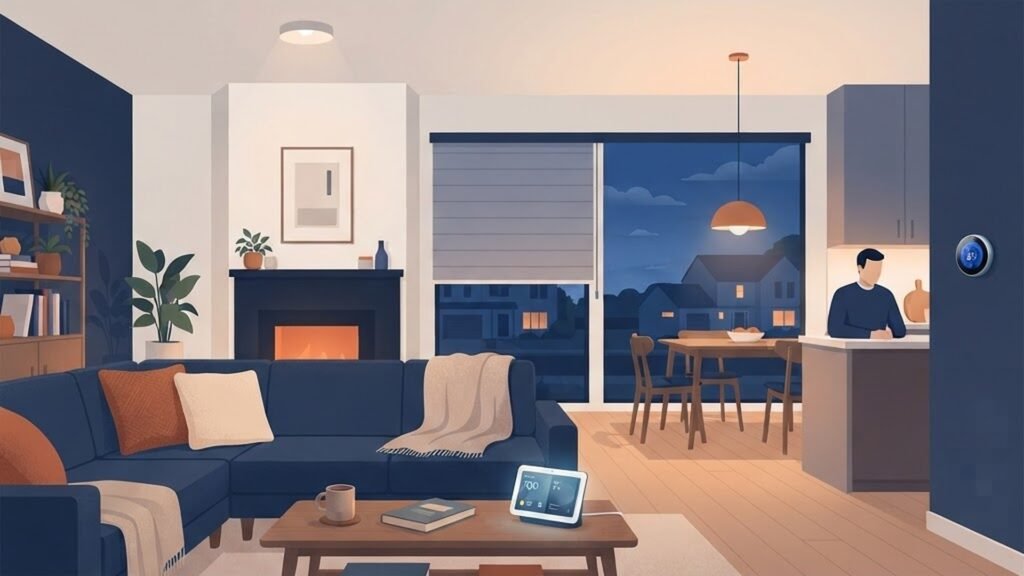
On a winter evening in a suburban home in Melbourne’s west, the lights warm gradually as the sky darkens, the heating has already brought the living room to temperature and the robot vacuum finishes its rounds and slides back under the couch. Nobody touched a switch. Nobody gave a command. The house simply behaved the way a house should, and its occupants barely noticed, which is precisely the point.
The death of the gimmick
The smart home had an awkward adolescence. For the better part of a decade it consisted of expensive gadgets that demanded attention rather than deserving it: lightbulbs that needed an app and a network reset, speakers that misunderstood simple requests, door locks that worked brilliantly until the wifi dropped out. Enthusiasts loved it. Everyone else found it exhausting.
The change in recent years has been less about any single device and more about a growing maturity across the ecosystem. Devices now talk to each other through shared standards rather than competing walled gardens, setup takes minutes instead of weekends, and the design philosophy has moved from look what it can do to notice how little you have to do. The smart home of 2026 is defined less by what it contains than by what it no longer requires from the people living in it.
Interoperability finally grew up
The quiet hero of this story is interoperability. For years, buying a smart home device meant committing to a brand ecosystem, and mixing brands produced a house of conflicting apps and invisible walls. The response of the industry, gradually and imperfectly, was the emergence of a common connective standard adopted by virtually every major manufacturer.
The practical result is that a thermostat from one company, lights from another, blinds from a third and a television from a fourth can now be choreographed into single routines. A goodnight command locks the doors, dims the kitchen, drops the blinds, adjusts the heating and silences announcements downstairs, regardless of whose logo is on each box. This sounds mundane. It is the reason smart homes finally work.
Energy becomes the killer app
Perhaps the most consequential development is that the smart home has found its true purpose, and it is not voice commands for party tricks. It is energy. With electricity prices climbing across Australia and much of the world, households have discovered that automation is a financial instrument as much as a convenience.
Homes with solar panels now routinely automate the choreography of sunshine: running dishwashers, pool pumps and washing machines during peak solar generation, heating water during off-peak windows and feeding surplus back to the grid at the most lucrative times. Smart batteries learn household patterns and decide, without being asked, when to store and when to sell. Some households report cutting energy bills by remarkable margins without changing their behaviour at all, only their home’s timing.
Security you can actually trust
The security side of the smart home has also crossed a threshold. Video doorbells and outdoor cameras have become mainstream consumer products rather than hobbyist gear, and the newer generations combine local storage with familiar interfaces that grandparents can operate. Package theft investigations, evidence for insurance claims after storms and simple reassurance while travelling have made these devices among the most consistently appreciated of any smart product.
At the same time, the industry has slowly responded to years of criticism about surveillance and data handling. Local processing, where video and voice never leave the house, has moved from niche feature to marketing priority. There is still a long way to go, and privacy remains the single most common reason thoughtful people decline to participate at all. But the direction of travel is, for the first time, broadly encouraging.
The house as caregiver
The most quietly moving chapter of the smart home story is unfolding among elderly Australians and their families. Voice-first devices with screens have become video-call terminals for people who could never manage a smartphone. Fall detection, smart pill dispensers, stove shut-off systems and sensors that notice a deviation from normal routines are keeping people in their own homes for years longer than would once have been possible.
The technology’s real function here is not surveillance but independence, both for the older person and for the adult children who would otherwise be tearing themselves apart with worry. Families describe the shift as transformative, turning a daily phone call built on anxiety into a conversation between people who both already know everyone is all right.
Kitchens that lend a hand
The kitchen has become the quiet laboratory of domestic AI. Fridge cameras, smart ovens and app-driven appliances have had mixed reputations, but the current generation has found its stride in subtler roles. Ovens now sense when a roast is actually done rather than when the timer says so. Range hoods switch themselves on when they detect smoke. Dishwashers negotiate with the household’s solar production to run when electricity is free. It is less Jetsons than people once imagined, and considerably more useful.
Meanwhile, a different kind of intelligence has taken residence at the bench. Home cooks now routinely photograph the contents of the fridge and ask an assistant what can be made from them, request a meal plan built around a family’s budget and a fussy child’s preferences, or convert a vague craving into a reliable recipe with quantities scaled to the number of plates on the table. This is not automation that impresses guests. It is automation that gets dinner made, which most nights is the more valuable miracle.
What the entry price looks like
A persistent misconception is that a genuinely smart home requires a renovation budget. The reality of 2026 is closer to a ladder. People typically begin with a single useful purchase, often a video doorbell, a smart speaker or a set of bulbs in the two rooms that matter most, and discover that one working routine blossoms into a curiosity for more. Each rung is cheap, and returns come quickly in comfort and, with energy-aware devices, in bills that visibly shrink.
The economics improve further when households count the invisible savings alongside the visible purchases: the heater that no longer warms an empty house for hours, the batteries that sell power at peak prices, the camera that settles a border dispute with a neighbour without a single lawyer’s letter. Judged as a pure gadget purchase, the smart home can look indulgent. Judged as household infrastructure, it increasingly resembles insulation or double glazing: invisible while it works, and expensive only in its absence.
What still does not work
Honesty requires acknowledging what remains broken. Subscription creep is real, with some manufacturers now hiding basic features, such as recording history or even responsive alerts, behind ongoing monthly payments for hardware that was already expensive. Some categories remain stubbornly disappointing, with smart curtains and irrigation systems still requiring more patience than most people possess. And any system that depends on the internet is hostage to outages, which is why the immutable rule of good smart home design is that every automated function must still work manually.
Weather, heat and a house that adapts
In a country where summer heatwaves are intensifying, the adaptive home has taken on a role that is frankly protective. Modern systems pull down blinds automatically to block morning sun, pre-cool the house in the cheap hours before a hot afternoon, and circulate air strategically through the evening. During heat events, smart air conditioning can shift a household’s entire peak grid contribution, easing pressure on infrastructure that, on the worst days, runs at the edge of its tolerance.
Water management has followed a similar arc in drought-prone regions, with tanks, pumps and irrigation schedules responding to forecasts rather than fixed clocks. The house has effectively gained a kind of weather sense, reacting to conditions rather than to commands, and households have discovered that comfort on a forty-degree day is now a matter of preparation that happens without them waking up to do it.
Living inside a computer, comfortably
Stepping back, what has happened to the household over the past few years resembles what happened to the car a generation ago. Features that began as curiosities, central locking, keyless start, reversing cameras, became so ordinary that their absence now feels like a defect. The house is going through the same journey at higher speed.
The deeper effect is on expectations. A generation is growing up for whom a house that does nothing, where lights answer only to fingers on switches and heating is a dial on a wall, feels faintly broken. That generational shift, more than any product launch, is what will carry the smart home from trend to default. The devices have stopped shouting for attention and started doing their work quietly in the background, and in doing so they have finally earned their place in ordinary homes. The glow of a house that prepares itself for the people inside it is no longer a glimpse of the future. It is Thursday evening.




