A perspective piece from The Listening Market
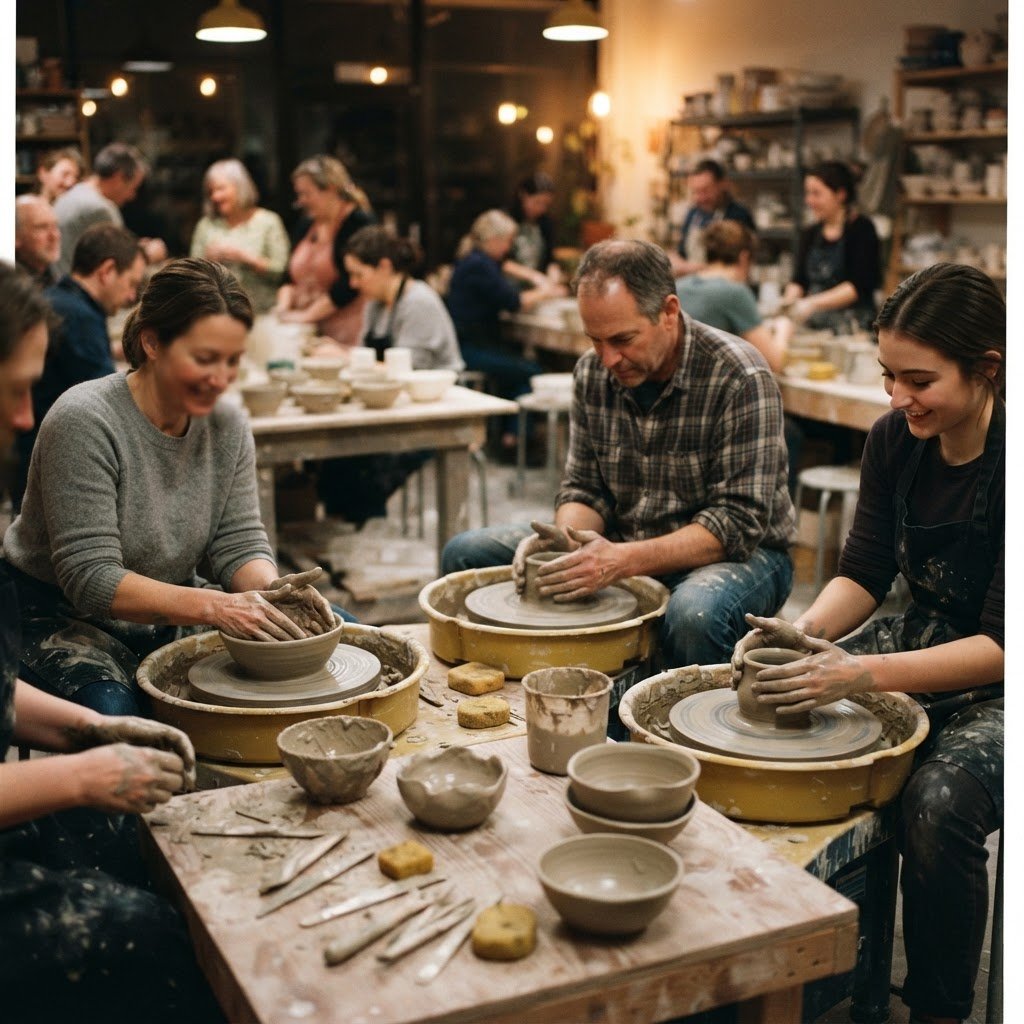
A woman in her fifties stands in a community pottery studio on a weeknight, sleeves rolled, guiding a lump of clay that refuses to centre on the wheel. Beside her, a man in his twenties is on his fourth attempt at the same simple bowl, and both of them are failing with visible delight. Nobody in the room is producing anything worth keeping. By the older rules of hobby and craft, the evening should feel like a waste of time. Instead, the class has a waiting list of several weeks, and studios like it have been opening steadily over recent years. The common thread, according to the instructors at such classes, is that a striking proportion of adults are showing up precisely to be bad at something.
For most of adult life, the acceptable roles are experienced, capable and informed. Beginnings get concentrated early: taught to read, taught to swim, taught to drive, sent into the workforce, and then quietly expected to specialise. Somewhere along the way, many people stop starting things altogether. Then, at some point in the past several years, a noticeable share of them decided to start again, badly and on purpose. Pottery, watercolour, chess, pickleball, bread baking, learning an instrument in middle age, joining a choir without being able to read music: the list of things adults are publicly, cheerfully bad at is expanding, and the pleasure they take in the lowliness of their skill is the entire point.
A reaction to lives of competence
The explanation begins with what modern working life asks of people. Professional existence rewards the appearance of mastery, and digital life frays the edges of it further. Social platforms present everyone else’s finished, edited output, carefully hiding the wobbling beginnings behind it, which trains a habit of comparison that makes every personal beginning feel unusually exposed. After a decade of managing that pressure, many adults have concluded that the skill they most want to practice, more than pottery itself, is the ability to be visibly, unremarkably mediocre.
Learning something new as an adult delivers several things at once, and most of them are about leaving the performance economy briefly behind. A beginner’s mistakes are expected, even charming, which makes a beginner’s practice one of the few remaining social spaces where improvement rather than achievement is the celebrated outcome. Poor early results in a hobby carry no professional consequence whatsoever, which frees the brain from the stakes that shadow every task at work. Time spent being bad at something is time spent not competing, and there is a particular calm to it that gets harder to find as life gets more organised.
There is also the satisfaction of visible progress. Adults learning a physical skill improve on a satisfying curve: the first month of pottery produces more visible progress than the first month of a management course ever will. Progress curves like this act as evidence, refreshing to the adult mind, that a person is still capable of change. And this evidence accumulates in the body itself, in muscle memory, calluses on hands, and small physical competencies that exist nowhere on a résumé but are felt daily.
The dynamics that made it possible
Practical forces have also made adult beginning easier than it used to be, and they explain why this era is particularly suited to the trend. Communal studios, low-obligation classes and drop-in sessions have spread across cities, replacing the old commitment-heavy evening-course model with formats designed for people with unpredictable schedules and cautious confidence. Online video tutorials have removed the intimidation from private practice, since a person can fail alone at home before ever failing in company. And the changing norms of adult social life have helped too: joining a class of strangers has become a socially acceptable way to meet people, at a time when ordinary adult life offers fewer and fewer settings with any real chance of new friendship.
The economic aftermath of recent years may have contributed something as well. When life plans get disrupted at scale, the question of what a person is besides their job sharpens, and hobbies are the traditional answer. The adults taking up skills they will never monetise, never display and never be identified with are, in a quiet way, safeguarding something against the possibility of their work devaluing them.
The evidence in the sign-up sheets
The scale of the beginner boom is easiest to read in the mundane paperwork of the leisure economy. Community education programmes in several countries report waitlists for pottery, watercolour and bread-making classes that have stretched from days into weeks, with some popular courses filling within hours of opening. Trade in entry-level musical instruments, beginner art supplies and table tennis equipment has outgrown the market for professional gear in the same categories. Chess has enjoyed a prestigious explosion of new adult players, and racket sports courts built for casual evening play are booked weeks ahead in cities that could barely fill them a decade ago. None of these observed facts proves anything on its own, but together they describe a genuine demographic movement, not a social-media pose, into being newly, voluntarily unskilled.
The demographics of the sign-up sheets carry their own quiet story. The adults filling these classes are precisely the people conventional leisure marketing expected to be hardest to reach: mid-career professionals with no apparent shortage of demands on their time. Surveys of participants in such classes return strikingly consistent reasons, dominated not by the hope of becoming good but by the wish to spend regular hours doing something with no professional stakes attached. Instructors describe the same motivation in plainer terms, reporting that their adult students ask, more than any technical question, whether it is normal not to be improving quickly, and brighten visibly on being told that it is not only normal but the entire experience. What the classes are really selling, several of them say, is permission, and permission, unlike talent, is something a class can genuinely provide.
The economics of it deserve a final note, since a beginner’s hobby is among the last inexpensive pleasures the modern city offers. A weekly class, a set of watercolours, a second-hand chess set: the whole undertaking costs less than a single household utility bill, and the return, measured in one evening per week that belongs to no goal, is difficult to buy elsewhere at any price. In a culture engineered around monetising attention, an hour spent awkwardly, enjoyably failing at a wheel, a board or a keyboard remains stubbornly unprofitable, which increasingly reads as the very definition of what makes it worthwhile.
What carrying a beginner’s mind does
A recurring note from instructors of adult beginners is that the students with the least talent often enjoy it most. Talent, as it happens, is beside the point. What these learners are buying with their weeknight hours is not the output, but the mental position: the learner’s posture, which has to do with curiosity, patience and being at ease with imperfection. Psychologists have long observed that adults learn differently from children, often more slowly but with far better strategies, and that self-consciousness, not aptitude, is the main obstacle in the way. The growing cultural approval of adult beginnerhood removes that obstacle a little more each year.
There is something quietly radical in a culture that finds room to celebrate the unskilled, since almost all modern culture is a tournament of the excellent. The amateur revival redefines success in a hobby as continued participation rather than display, which suits a population that no longer has energy to spare for a second career’s worth of striving. The pleasure of the potter’s wheel, the chessboard and the piano bench is a real and renewable resource: the discovery that a grown person can still start from zero and find the early part of the climb the best of it.
Back in the studio, the woman in her fifties pulls her clay into something that will crack in the kiln, and the man next to her laughs openly at his fourth failed bowl, planning to come back next week to fail at a fifth. Both leave lighter than they arrived, carrying nothing. In a world where results are the usual currency, a pleasant evening spent buying none may be the most reasonable purchase an adult can make.