A perspective piece from The Listening Market
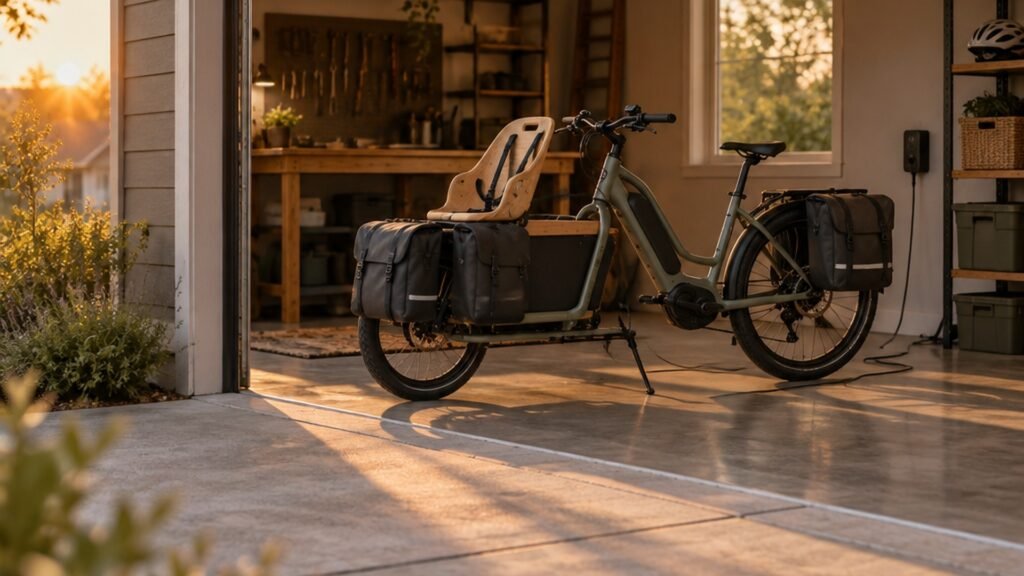
There is a moment familiar to anyone who has watched a friend convert from sceptic to evangelist. It usually happens in a car park, or at the end of a dinner party, when the conversation turns to the odd-looking bicycle leaning against the wall. “It has a motor,” the friend admits, slightly embarrassed, as though confessing to a mild form of cheating. Six months later, that same friend has sold the second car. The garage, once home to a hatchback that did little except depreciate, now stores a bicycle, a charger, and a set of panniers. The family budget, meanwhile, has quietly rerouted itself.
Stories like this used to belong to a particular kind of enthusiast, the sort who wore hi-vis vests on weekends and measured their rides in centuries. But over the past few years the demographic has broadened to the point of becoming unremarkable. School runs happen on cargo bikes. Commutes that were once thirty minutes of traffic are now twenty minutes of fresh air. Older riders who had given up on hills have discovered that sixty-five is not too late to feel the wind again. Somewhere between a pandemic that emptied the roads and a cost-of-living squeeze that emptied wallets, electric bikes stopped being a toy for early adopters and started doing something far more interesting: replacing the second car.
The economics nobody argues with
The case for the second car was never a romantic one. It existed because someone in the household needed to be somewhere at the same time as everyone else, and public transport could not always bridge the gap. It was a machine for solving scheduling conflicts, purchased at a startling price for the privilege.
That price is worth dwelling on. A second car costs, conservatively, several thousand dollars a year to keep on the road once insurance, registration, fuel, servicing, and the slow bleed of depreciation are added together. Many of those costs exist whether the car moves or not. An electric bike, by contrast, consumes electricity at a rate that rounds to approximately nothing, requires servicing roughly as often as a decent conventional bicycle, and loses value slowly enough that the maths never really becomes frightening.
The comparison is not subtle, which is perhaps why it has begun to appear in household conversations that have nothing to do with cycling. When the second car’s registration notice arrives, it is no longer unthinkable to ask the obvious question: what does this machine actually do for us, and could something else do it for a tenth of the cost?
Built for errands, not for racing
What changed the electric bike from a curiosity into a car replacement was not primarily the motor. It was the shape of the things around the motor. The cargo bike, with its long wheelbase and its box for carrying children, groceries, or a small dog, turned the school run into something that could be done without a parking spot. The step-through frame did away with the awkwardness of a high top tube. Racks, mudguards, lights, and integrated locks arrived as standard rather than as aftermarket projects.
The result is a category of vehicle that answers the questions people actually ask. Can it carry a week’s shopping? Yes. Can it handle a child and a backpack? Yes. Can it be ridden in ordinary clothes, without arriving at work needing a shower? Increasingly, yes, because the whole point of the assistance is to take the sweat out of the equation. The motor is not there to make anyone faster. It is there to make the errand possible.
There is a distinction here that matters. A racing bicycle is optimised for performance, and performance is a language most people do not speak. An electric bike with a basket and a comfortable saddle is optimised for usefulness, and usefulness is a language everyone understands. The second car was always a utility vehicle. It has simply been replaced by a better one.
The hills that used to decide everything
Ask anyone why they stopped cycling, and geography is usually the answer. The hill between home and work. The headwind that arrives at five o’clock as if scheduled. The distance that is fine in the morning and intolerable on the way home at the end of a long day. Traditional bicycles demanded a negotiation with terrain that many people were happy to lose.
Electric assistance ended the negotiation. The rider still pedals, still steers, still does the work of staying upright, but the gradient stops being the deciding factor in whether a journey is possible. This is the quiet revolution at the heart of the machine. It does not make cycling effortless. It makes cycling fair. The sixty-year-old and the twenty-five-year-old can now take the same route to the same office and arrive with the same composure.
That fairness has consequences beyond the commute. It means a parent can carry two children up a hill without a car. It means a tradesperson can tow a trailer of tools across a city. It means the circle of places a person can reach under their own power has expanded outward, in some cases by entire suburbs.
Cities are catching up, in their own ungainly way
None of this happens in a vacuum, and cities have slowly, imperfectly, begun to respond. Protected bike lanes that were once dismissed as vanity projects now appear in transport plans with dull, bureaucratic names like “corridor upgrades”. The reasoning has moved equally from health to economics: a person on a bike takes up a fifth of the road space of a person in a car, and costs the public purse essentially nothing in wear.
The change is not consistent. For every city building separated lanes as though its future depended on it, there is another where riding remains an act of faith. But the direction is unmistakable. The more people who arrive on electric bikes, the more pressure there is on cities to treat them as transport rather than as a nuisance, and the easier it becomes for the next household to make the same calculation.
There is also the quiet matter of what cities are for. A street full of cars is a street people pass through. A street full of bicycles and cargo boxes and children waving from the front of family bikes is, unmistakably, a street people live in. Not every planner would phrase it that way, but the effect shows up in the data all the same.
An honest account of the trade-offs
None of this is to say the electric bike is a perfect machine or that the transition is without friction. Batteries have finite lives and replacement costs that are worth knowing about in advance. Range anxiety, in a milder form, exists. Rain still exists. The rider still arrives responsible for their own safety, and in cities that have not caught up on infrastructure, that responsibility can feel heavy.
There is also the price of entry, which remains the honest objection. A good electric cargo bike can cost as much as a very old second car, and while the running costs invert the comparison quickly, the upfront sum is real. It is one of the reasons the change has happened household by household rather than all at once.
But the direction of travel is clear enough. Every year the bikes get better, the batteries get cheaper, the lanes get longer, and the anecdote about the friend who sold the second car becomes less of an anecdote and more of a pattern.
The garage, reconsidered
Perhaps the most interesting part of the shift is what it reveals about the second car itself. For decades it sat in garages across the suburbs, barely questioned, a fixed star in the constellation of modern life. It was purchased for freedom, used mostly for short errands, and paid for in the background of every household budget.
The electric bike has not defeated the automobile, and it does not need to. What it has done is something smaller and more concrete: it has made the second car optional. It has offered a different answer to the question of how a household moves its people and its shopping around, an answer that is cheaper, often faster across a congested city, and, in the words of every convert, quietly joyful in a way that no hatchback ever managed.
The friend in the car park is no longer an outlier. The garage has a bicycle in it, and nobody misses the hatchback. Somewhere between the registration notice and the school run, the calculation changed, and it is not changing back.