A perspective piece from The Listening Market
There used to be a simple, universal answer to the question of when to take a holiday, and the answer was summer. Schools closed, offices thinned out, prices rose, and everyone who could went anyway, arriving at the same beaches at the same time to stand in the same queues. The peak season was not so much a decision as a default, inherited from a century of habits and reinforced by every brochure that ever put a price on sunshine.
That default is quietly dissolving. Ask around among serious travellers, or watch what happens to flight prices in the shoulder months either side of the rush, and a pattern emerges: the crowds are thinning in August and thickening in May and October. The shoulder season, those in-between months when the weather is mild, the crowds are smaller, and the prices drop, has stopped being the consolation prize and started being the main event. In some places it has already overtaken the traditional peak.
How the shoulder season won
The shift has several parents, and the first is economic. Peak-season pricing was a tax on school-holiday families, and everyone else was paying it out of pure convention. As budgets tightened across a decade, travellers began running the numbers, discovering that the same apartment in the same town, a few weeks either side of the rush, costs a third to half less, and comes with a better chance of actually being available.
The second parent is overcrowding itself. The world’s most beloved places spent the 2010s being loved to the point of dysfunction. Venice, Barcelona, Santorini, Dubrovnik, Kyoto: each spent its summers processing more bodies than its streets could gracefully hold. Locals pushed back. Cities experimented with entry fees, cruise-ship caps, and booking systems. Somewhere in the collective memory, a link formed between peak season and misery, between August and the exact kind of stress a holiday was supposed to cure.
The third parent, quieter and less often named, is the slow loosening of the school-year stranglehold. Remote and flexible work decoupled some families from strict term dates, and travelling retirees were never bound to them at all. With the school calendar’s grip loosening on one portion of the market, the annual surge loses part of its engine.
And the fourth parent is the climate itself. Peak seasons were set decades ago around ideal weather, and ideal weather has moved. In much of the Mediterranean, August has become a furnace, a season of heat advisories rather than beach bliss. The months either side of it, warm seas, gentle sun, bearable afternoons, now offer something closer to the original promise.
What the in-between months actually deliver
The practical case is easy to make because the in-between months are, in most destinations, genuinely better places to be.
The weather is the pleasant surprise. The Mediterranean in late May or early October delivers mid-twenties days and sea that has been warming all summer, which many swimmers prefer to June’s bracing shallows. In the tropics, the shoulder months skirt the worst of both wet and dry extremes. In the wine regions, autumn is harvest, and the vineyards are at their most beautiful and most sociable. In Japan, the shoulder months hold the maples in autumn or the blossom in spring, which are the two weeks the entire year is famous for.
The price difference is not a rounding error. Flights, rooms, and rentals in shoulder season routinely run thirty to fifty percent below their August equivalents, and unlike peak-season bargains, which tend to be bargains for a reason, the in-between discount comes with an upgrade: the same hotel, less strained, with a room that faces the right way and a staff with time to talk.
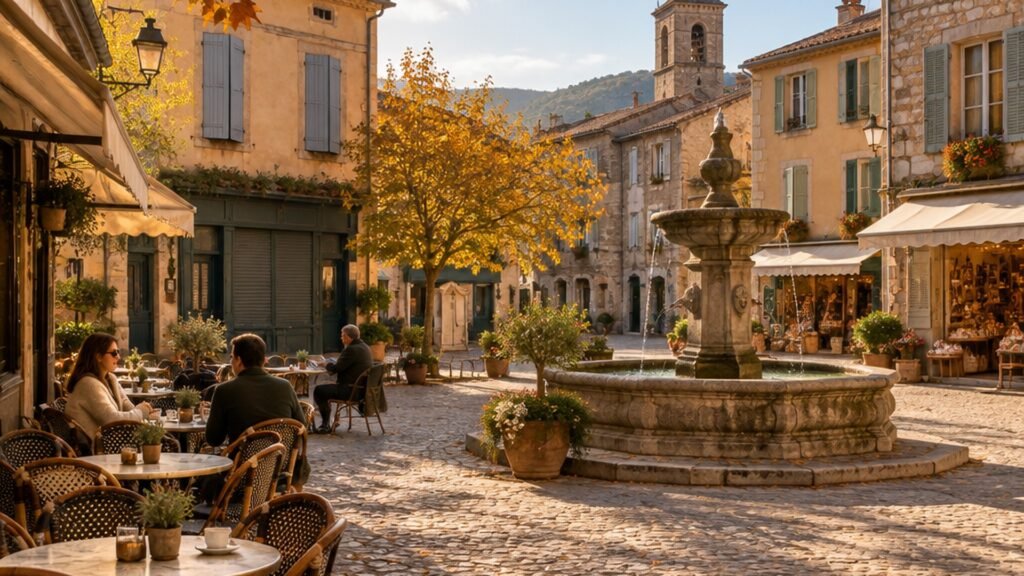
The crowds, or their absence, change the character of a place. A Roman piazza in October is a place where Romans still sit. A Greek island taverna in May has seats free at sunset, a kitchen that is not drowning in covers, and an owner who has time to ask where the evening’s visitors are from. Travellers who have done both seasons describe the difference in a word that travel marketing never uses but every traveller understands: dignity. Peak season treats a place as a product. The shoulder months allow it to be a place.
The catch, stated honestly
None of this makes the shoulder season a free lunch, and an honest account needs its caveats lined up. The weather is milder, but milder also means less certain: an October week on the Aegean can still turn grey and cool, and a May fortnight in the Alps can still hold a last snowfall. The sea is warm in autumn and cold in spring, which cuts both ways. Opening hours shrink: in some towns, a third of restaurants and half the boutiques close between seasons, and a beloved hotel may be shuttered entirely for its October repainting. In places whose season is short and sharp, the shoulder months are not a discount version of the peak but a genuinely different destination, sleepier, stranger, occasionally shuttered, and requiring a different kind of appetite from the visitor.
There is also the family arithmetic, which no amount of economics dissolves. For households bound to school terms, the true shoulder is a narrow corridor, and the term-date premium remains a fact of life. The rise of the shoulder season is partly a story of who travels when: the retired, the flexible, the remote, the child-free, quietly rearranging the calendar while the bound majority still surge in August.
How to plan one
The practicalities are friendlier than they look. The first rule is that shoulder season is not one set of dates but a local fact: the in-between months of the northern hemisphere’s Mediterranean are May and October, while ski towns breathe easiest in January and late March, and tropical coasts have their own calculus of wet and dry. The question is not “when is shoulder season” but “when is this place’s in-between”, and the answer is usually visible in the price calendar itself: the weeks where rates fall by a third and availability opens up are the weeks being described.
The second rule is to book the things that close. The hotels and restaurants most worth visiting, the small ones with soul, are also the ones likeliest to take their own holidays in the off-peak. A ten-minute check of opening dates before booking flights turns the shoulder’s main disappointment into a non-event. Travellers who do this early get the best of both worlds: the calm of the in-between and the doors of the fully open.
The third is to pack for a range rather than a season. The in-between months reward layers, a light rain jacket, and a willingness to sit outside at lunch and inside at dinner. It is a smaller wardrobe than the peak demands, and a fair price for the pleasure of walking through a famous city at the pace of the people who live there.
Why it feels like more than a booking trick
Yet something larger than savings is going on. The shift to the shoulder months is part of a broader, slower change in what people want a holiday to be. The old model was peak or nothing: maximum sunshine, maximum season, maximum event, concentrated into a fortnight and paid for in crowds. The new mood is more distributed, calmer, and slightly less certain of itself: a week away when the air is good, a city in its ordinary working clothes, a place met on its own terms rather than dressed for the parade.
The travel industry, always the last to know and the fastest to act, has begun selling exactly this: “shoulder season escapes”, “the new sweet spot”, the marketing of in-between-ness, arriving just as the thing itself was becoming scarce. But the underlying change is real, and it belongs to travellers, not to brochures. It is the slow discovery that the best weeks in most of the world’s loveliest places have been sitting either side of the rush all along: warm enough, open enough, quiet enough, cheap enough, and blessedly, blessedly, less full.
August, as ever, will survive. But its monopoly is over, and anyone who has stood in an empty October square in a famous city, with the light low and the tables free, already knows which side of the calendar the future is drifting toward.