
A perspective piece from The Listening Market
There was a long era in corporate life when productivity was measured in physical keystrokes, filled rows on a spreadsheet, and the disciplined triage of a crowded inbox at sunrise. Software was a passive instrument—a sharper pencil, a faster calculator, a digital filing cabinet with instant search. The worker remained the primary operator, physically nudging every piece of information from one application to the next, bridging the wide gaps between software systems through sheer manual effort and cognitive endurance.
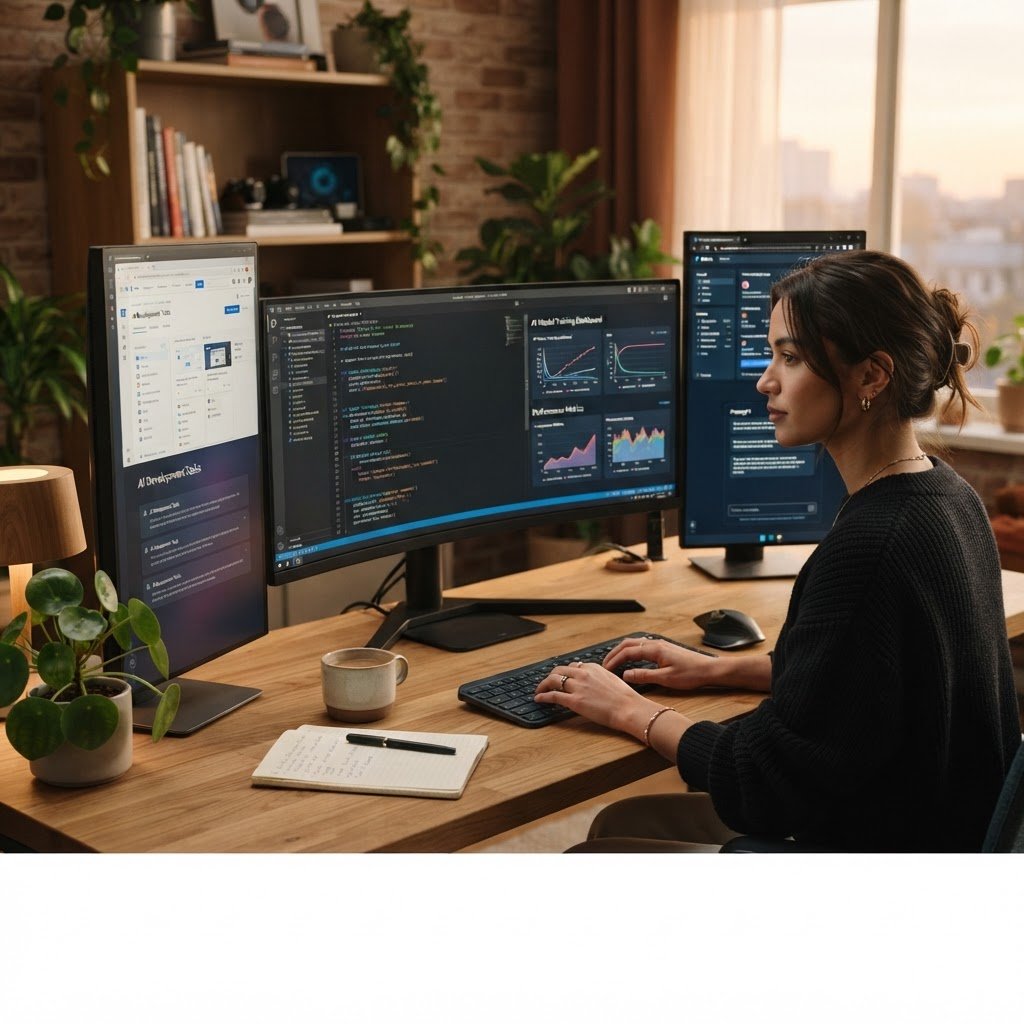
That paradigm has dissolved. Over the past few years, the nature of workplace software underwent a fundamental mutation. The digital tools resting on modern desktops are no longer passive instruments waiting for manual commands. They have evolved into active collaborators—ambient intelligence layers capable of reading organizational context, anticipating operational needs, and executing complex, multi-step workflows with minimal friction. Across global enterprises and agile startups alike, modern AI productivity tools are quietly dismantling the legacy architecture of knowledge work, shifting the human role from manual execution to strategic direction.
This transformation is not merely about writing emails slightly faster or summarizing lengthy documents in seconds. It represents a deeper structural realignment of how time, attention, and human intellect are allocated across the modern working day. As these capabilities mature throughout 2026, the traditional distinction between software that stores information and intelligence that processes it has vanished, creating a corporate environment where the background noise of administrative friction is systematically erased.
The Shift From Task Execution to Cognitive Orchestration
For decades, the average knowledge worker spent a startling percentage of the working day engaging in what organizational researchers call high-friction context switching. A typical project required toggling between a communication platform, a project management board, a cloud storage repository, an enterprise resource planning system, and a dedicated document editor. Every single transfer of data required human intervention: copying a customer request from chat, pasting it into a task manager, drafting a response in a separate document, and manually updating a status column for project stakeholders.
Modern AI productivity tools have radically simplified this fragmented landscape through cognitive orchestration. Rather than waiting for explicit instructions at every micro-step, contemporary workflow platforms operate with persistent contextual awareness. When a critical customer inquiry arrives, artificial intelligence systems instantly pull relevant contract details from cloud storage, analyze historical interaction logs across CRM platforms, evaluate current service capacity, and present the manager with a fully drafted, contextualized resolution ready for review.
In this emerging environment, professionals spend far less time managing the mechanical plumbing of office communication and significantly more time making nuanced judgment calls. The administrative connective tissue that once consumed hours of cognitive energy is now handled invisibly in the background. The worker functions less like an assembly-line technician shuttling digital files across screens and more like an orchestra conductor, refining outputs, evaluating strategy, and guiding automated processes toward high-value business outcomes. The operational emphasis shifts entirely from manual speed to strategic discernment.
Context-Aware Intelligence and the Death of the Search Bar
One of the most persistent bottlenecks in enterprise productivity has historically been the retrieval of institutional knowledge. Millions of hours were lost annually to the quiet frustration of searching for buried files, tracking down archived messaging threads, or hunting for the definitive version of a project brief saved somewhere in an expansive cloud directory. The traditional search bar, relying on rigid keyword matches, frequently returned either hundreds of irrelevant documents or nothing at all, creating deep organizational blind spots.
The integration of neural search and vector retrieval models has fundamentally altered how organizations interact with their own institutional memory. Next-generation AI productivity tools function as living enterprise knowledge networks, continuously ingesting and indexing every document, conversation, code commit, customer interaction, and recorded meeting created across a company. Because these models understand semantic meaning rather than mere keyword overlap, workers can query organizational knowledge in natural, conversational language.
A marketing strategist preparing a regional campaign can ask a workspace assistant to identify every initiative over the past three years that addressed European data privacy compliance, extract the core lessons learned, and compare those historical outcomes against current market proposals. Within seconds, the system synthesizes data across disparate departments, citing specific internal documents and past meeting transcripts with exact references. The result is an organizational brain that never forgets, eliminating redundant work and allowing distributed teams to build directly upon institutional knowledge rather than continuously reinventing the wheel.
Autonomous Agents in the Daily Workflow
The evolution of artificial intelligence in the workplace has moved rapidly beyond simple prompt-and-response text interfaces. While early generative applications required continuous human prompting for every single action, modern agentic systems are capable of autonomous execution across complex, goal-oriented business processes.
Today, AI productivity tools deploy specialized digital agents designed to carry out multi-step operations across diverse software ecosystems. When assigned a broad objective—such as preparing a comprehensive competitive analysis report for an upcoming product launch—an autonomous agent can independently research market benchmarks, retrieve internal sales statistics, generate structured data visualizations, draft an analytical narrative, and format the final deck according to corporate style guidelines.
These specialized agents operate under structured human-in-the-loop oversight, flagging potential anomalies or strategic forks for executive decision-making while completing routine execution tasks autonomously. In financial analysis, legal research, software engineering, and supply chain management, agentic workflows are compressing multi-day analytical processes into a matter of minutes. By assuming responsibility for structural drafting, data aggregation, and initial code generation, these tools allow human specialists to focus their energy on high-level validation, creative differentiation, and strategic risk management.
Meeting Intelligence and Ambient Collaboration
Few aspects of corporate life have inspired as much exhaustion as the endless cycle of status meetings, sync calls, and post-meeting documentation. For decades, professionals wrestled with the dual burden of participating actively in strategic conversations while simultaneously taking frantic notes, attempting to capture action items, key decisions, and technical commitments without losing the thread of the discussion.
The arrival of ambient meeting intelligence has transformed video calls and collaborative spaces from passive communication channels into active centers of structured synthesis. Contemporary AI productivity tools sit silently in virtual meeting rooms, analyzing dialogue in real time, differentiating between speakers, recognizing emotional tone, and capturing technical nuance that human note-takers often miss.
Immediately following a discussion, these intelligent systems generate precise executive summaries, categorize key decisions, assign tagged action items directly to team members’ task management systems, and update relevant project roadmaps across the organization. Furthermore, for team members operating across international time zones or managing conflicting priorities, ambient summaries allow workers to stay fully informed without attending every meeting in person. The result is a dramatic reduction in administrative fatigue and a return to genuine presence during collaborative discussions, as participants are freed from the keyboard to focus entirely on human interaction and strategic problem-solving.
Reclaiming Deep Work and Managing Cognitive Fatigue
While the proliferation of digital communication promised greater efficiency, it also unleashed an unprecedented wave of cognitive fragmentation. The continuous barrage of instant messages, email alerts, and task notifications created a workplace culture of perpetual urgency, where attention was constantly chopped into tiny, unfocused fragments. Deep work—the ability to focus without distraction on demanding cognitive tasks—became increasingly rare across modern corporate environments.
Ironically, artificial intelligence is now becoming the primary defense against the very digital noise that previous generations of software created. Advanced focus management platforms powered by AI productivity tools act as intelligent filters between workers and the relentless firehose of corporate communication. These systems evaluate incoming messages for true urgency, batching non-critical updates into structured morning and afternoon digests, while automatically shielding calendar blocks reserved for deep strategic work.
By analyzing individual work patterns and cognitive energy cycles, these tools recommend optimal schedules for complex problem-solving, draft quick response options for routine inquiries, and summarize sprawling messaging threads into three-bullet briefings. By taking control of the digital gatekeeping process, intelligent software is restoring the psychological boundaries required for deep, contemplative thought, helping organizations reduce operational burnout and cultivate higher standards of intellectual output across every team.
The Future of Human Craft in an Automated Age
As AI productivity tools become standard infrastructure across industries, the fundamental definition of professional value is undergoing a profound recalibration. When routine drafting, initial research, basic coding, data aggregation, and complex scheduling are handled effortlessly by machine intelligence, the competitive advantage of an individual or an enterprise shifts toward distinctly human capabilities.
Technical proficiency in operating legacy software is giving way to conceptual clarity, critical reasoning, original synthesis, and empathetic leadership. The most successful organizations in 2026 are not those that simply use artificial intelligence to churn out vast volumes of generic content or automated emails, but those that leverage saved time to deepen strategic thinking, elevate client relationships, and foster genuine innovation.
The ultimate promise of AI productivity tools lies not in turning human beings into hyper-efficient processors of administrative data, but in liberating them from that burden entirely. By shifting mundane execution to ambient intelligence, software is returning to its highest potential: an amplifier for human imagination, enabling professionals to spend their days doing the thoughtful, creative, and meaningful work that technology can never replicate.