
A perspective piece from The Listening Market
On a rainy Friday evening in 1997, the journey toward finding a movie began with an ignition key and a jacket zipped against the damp chill. The destination was a fluorescent-lit storefront smelling faintly of synthetic carpet and buttered popcorn. Walking down long, narrow aisles bounded by plastic VHS cases, a viewer relied on a complex interplay of sensory cues: the glossy artwork on a box, the handwritten staff recommendation card tucked beneath a cult classic, or the sheer serendipity of finding a single remaining copy resting behind its shelf marker. Discovery was tactile, deliberate, and undeniably social. It required movement, patience, and a willingness to gamble two hours of an evening on a film chosen almost entirely by instinct.
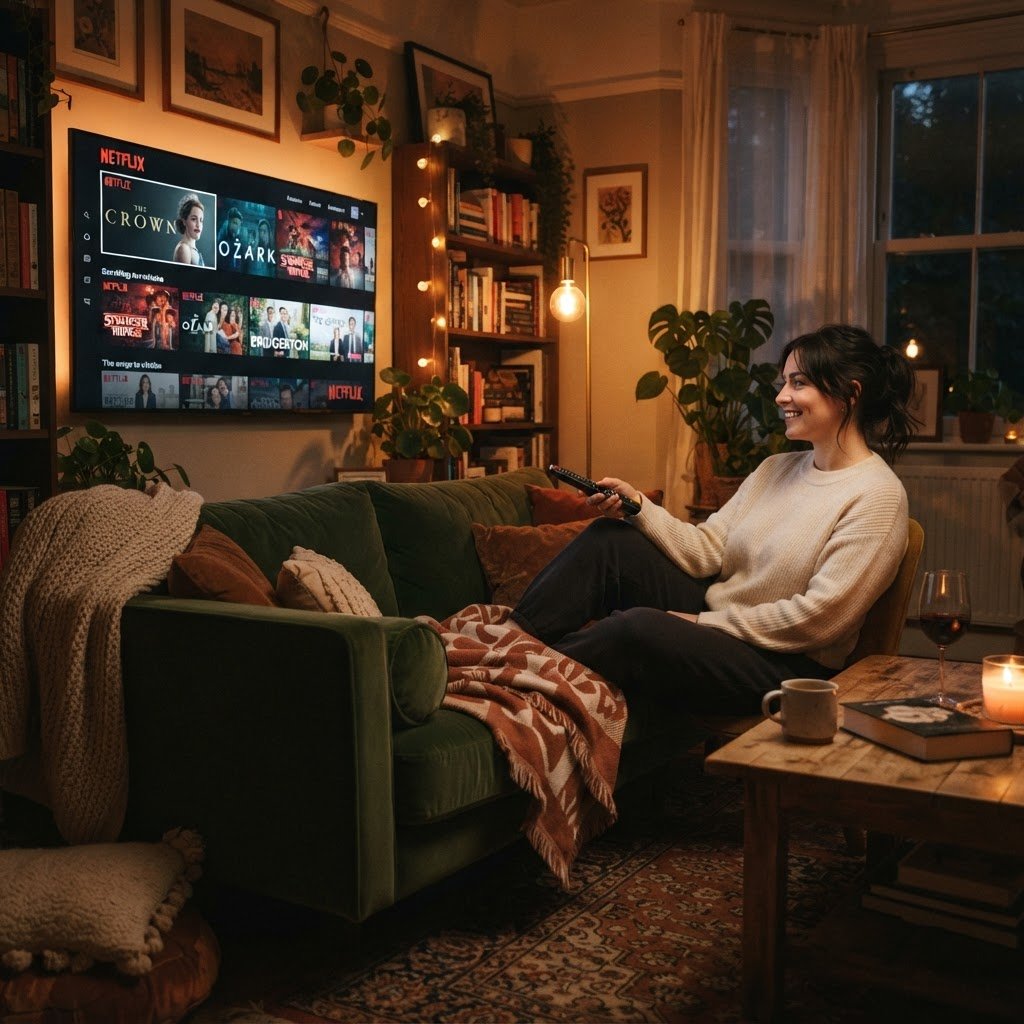
Fast forward to the present day, and the mechanics of cinematic exploration bear almost no resemblance to that nostalgic ritual. The physical journey has collapsed into the space between a sofa cushion and a thumb resting on a remote control. Inside millions of living rooms worldwide, the search for evening entertainment begins not with a walk through an aisle, but with the quiet illumination of an ultra-high-definition television screen displaying a sleek digital interface. Row after row of high-contrast thumbnails slide past in silent succession, accompanied by auto-playing video teasers and personalized match percentages calculated to the second decimal point.
Yet, despite the unspooling abundance of tens of thousands of titles available at the touch of a button, a curious phenomenon frequently unfolds. Viewers spend twenty, thirty, or forty minutes scrolling endlessly through digital catalogs, paralyzed by the sheer volume of options, only to land on a comfort series they have already watched three times. This modern impasse reveals a fundamental truth about contemporary media consumption: streaming didn’t just change where entertainment is consumed—it fundamentally transformed the psychological, social, and structural pathways of how stories are found. Understanding how streaming changed movie discovery requires examining the retreat of serendipity, the rise of predictive algorithms, and the profound shift in how human culture engages with visual storytelling.
The death of the video store aisle
To appreciate the magnitude of this shift, one must consider what was lost when physical distribution gave way to cloud-based streaming platforms. In the era of brick-and-mortar video stores, independent cinema houses, and scheduled television broadcasts, discovery was defined by inherent friction. That friction was not merely an inconvenience; it served as a vital incubator for curiosity. When choosing a film involved driving to a store, paying a non-refundable rental fee, and returning home, the viewer was emotionally invested in the choice. Even a flawed or bizarre film was given a full viewing because the effort required to acquire it demanded a return on investment.
Moreover, the curation of physical spaces was fundamentally human. Video store clerks, independent theater programmers, and television broadcast schedules acted as cultural gatekeepers whose eccentric tastes and personal enthusiasms introduced audiences to unexpected gems. A clerk’s passionate endorsement could transform an obscure foreign thriller or an underfunded indie drama into a neighborhood sensation. The physical layout of the store encouraged cross-pollination; a customer searching for a mainstream blockbuster might wander into the foreign film section simply because it occupied the adjacent wall.
When platforms like Netflix, Hulu, and Prime Video disrupted this model, they replaced physical spatial friction with frictionless digital access. In doing so, how streaming changed movie discovery became a story of hyper-efficiency. The physical storefront was replaced by an infinite scroll, and the human clerk was superseded by mathematical algorithms engineered to maximize user engagement. While the total volume of accessible cinema expanded exponentially, the organic, unpredictable nature of browsing suffered a quiet extinction.
The mechanics of the recommendation engine
Behind the polished interface of every major streaming platform lies a complex architecture designed not necessarily to broaden a viewer’s artistic horizons, but to keep eyes anchored to the screen. At the heart of this system are collaborative filtering algorithms and machine learning models that analyze astronomical volumes of behavioral data. Every pause, fast-forward, completion rate, time-of-day selection, and search query is logged and categorized to construct a granular psychological profile of the consumer.
One of the most subtle ways streaming changed movie discovery is through dynamic artwork optimization. Platforms no longer present the same poster image to every subscriber. If a viewer frequently watches romantic comedies, the thumbnail for an action film might feature a quiet moment between the lead actors. If a viewer shows a preference for gritty thrillers, the exact same film might be represented by a dark, intense close-up of the antagonist. The artwork transforms dynamically to match individual psychological triggers, steering selection through personalized visual persuasion.
Furthermore, digital catalogs are organized into hyper-specific micro-genres. Rather than broad categories like “Drama” or “Sci-Fi,” viewers are greeted with tailored shelves such as “Visually Striking Scandinavian Crime Series” or “Witty Independent Movies Featuring Strong Female Leads.” While this level of granularity offers unprecedented precision, it also creates an algorithmic feedback loop. By continually feeding viewers content that closely mirrors past behavior, recommendation engines inadvertently build taste silos. The unexpected encounter with a film outside one’s comfort zone grows increasingly rare, replaced by a curated reflection of pre-existing habits.
The paradox of choice and decision fatigue
In 2004, psychologist Barry Schwartz published *The Paradox of Choice*, arguing that while a baseline of choice is essential for human well-being, an overabundance of options leads to anxiety, decision fatigue, and ultimately, dissatisfaction. Nowhere is this paradox more evident today than on the modern streaming home screen.
When a viewer stood in a physical video store, the selection was finite—constrained by square footage and current inventory. Choosing among fifty available action titles felt manageable. Today, a subscriber facing a library of thousands of titles across multiple active subscriptions experiences cognitive overload. The brain struggles to evaluate endless possibilities without a clear, bounded framework. As a result, the process of finding something to watch frequently transforms from an exciting prelude into an exhausting chore.
This decision fatigue explains the widespread reliance on ambient television and background viewing. Exhausted after a long workday, many consumers lack the cognitive bandwidth to evaluate complex algorithmic options or risk ninety minutes on an unfamiliar title. Consequently, streaming platforms have observed a dramatic rise in background viewership, where audiences repeatedly stream familiar sitcoms or predictable procedural dramas while scrolling on secondary screens. The irony is stark: in an era of unprecedented cinematic availability, actual exploration is frequently abandoned in favor of passive comfort.
The vanishing shared screen
Beyond individual psychology, the transformation of media discovery has reshaped collective culture. For decades, film and television discovery was a shared social ritual governed by synchronized schedules. Broadcast networks dictated when shows aired, creating national “watercooler moments.” Millions of households tuned into the same episode at the same hour, ensuring that the following morning’s conversations across offices, schools, and coffee shops were united by a common narrative thread.
Streaming shattered this synchronized clock. By introducing on-demand availability and popularized binge-dropping—releasing entire seasons simultaneously—platforms decentralized the communal watching experience. Today, two people living in the same home may possess completely different digital homepages, exposed to entirely separate promotional campaigns and algorithmic recommendations. The concept of a universal hit film or television series has become increasingly rare.
When a show does manage to break through the noise to achieve global ubiquity—such as *Squid Game* or *Stranger Things*—its discovery trajectory follows a distinct modern pattern. Virality is no longer driven by traditional film criticism or network marketing campaigns; instead, it spreads through social media algorithms, short-form video edits, and meme culture. A series becomes a cultural phenomenon almost overnight, dominates online discourse for two weeks, and then evaporates just as quickly as new content drops into the digital pipeline. The life cycle of cultural discovery has accelerated dramatically, compressing months of sustained conversation into brief, intense bursts of fleeting attention.
Global access and the rise of the niche
While the algorithmic model has unquestionably fragmented mass culture, it would be incomplete to view this transformation solely through a lens of loss. How streaming changed movie discovery also encompasses one of the greatest democratizing shifts in cinematic history: the total collapse of geographical and linguistic barriers to entry.
Prior to the streaming era, international cinema and subtitled television faced immense distribution hurdles in Western markets. Outside of major metropolitan art-house theaters and specialized video stores, global titles were virtually impossible for mainstream audiences to locate. Streaming platforms, operating on global infrastructure, changed that reality permanently. By embedding high-quality dubbing, multilingual subtitling, and global placement directly into standardized user interfaces, platforms exposed millions of viewers to non-English storytelling for the first time.
Spanish thrillers, Korean dramas, German sci-fi, and Japanese animation now routinely climb to the top of worldwide viewing charts. Audiences who might never have manually sought out a foreign film discover incredible stories simply because an algorithm recognized a structural similarity to a domestic title they enjoyed. In this sense, digital recommendation engines have expanded global cultural literacy, proving that compelling narrative design transcends language barriers when distribution friction is removed.
Simultaneously, streaming has provided a lifeline for hyper-specialized niche genres. Documentaries, micro-budget horror, classic film restorations, and avant-garde animation that would have struggled to secure theatrical release now find dedicated global micro-audiences. Platforms specializing in curated cinema, such as Criterion Channel, MUBI, and Shudder, demonstrate that algorithmically assisted discovery can coexist with deep human editorial passion, offering alternative havens for discerning cinephiles.
Reclaiming human curation in a digital age
As the streaming ecosystem reaches maturity, a subtle counter-revolution is taking shape among audiences seeking to escape algorithmic echo chambers. A growing movement of viewers is actively looking for ways to reintroduce human curation, texture, and surprise into their watching habits.
This desire has fueled the explosive growth of social film platforms like Letterboxd, where cinephiles log diary entries, create custom lists, and share written reviews with friends and global film lovers. On platforms like Reddit, Discord, and TikTok, organic communities dedicated to niche cinema recommendations have flourished. Viewers are increasingly turning away from platform homepages and relying instead on trusted human curators, podcast hosts, film club newsletters, and independent critics to tell them what is genuinely worth their time.
At the same time, physical media is experiencing a notable renaissance. Vinyl records proved that music lovers craved tactile connection in a streaming world, and a similar resurgence is occurring with 4K Ultra HD Blu-rays and boutique video releases. Collecting physical discs is no longer just about owning a piece of plastic; it is a conscious rejection of digital library volatility, algorithmic surveillance, and automated curation. Holding a tangible physical edition, complete with essay booklets and director commentaries, restores a sense of intentionality to the movie-watching experience.
Ultimately, how streaming changed movie discovery is a narrative of profound transformation that remains ongoing. The move from physical store aisles to digital recommendation grids brought unmatched convenience, global access, and vast choice to the screen. Yet it also revealed that discovery is not merely about access—it is about connection, serendipity, and human perspective. As viewers navigate the endless digital landscape of 2026 and beyond, the most valuable guides may not be the algorithms running silently in data centers, but the shared human voices reminding audiences why stories mattered in the first place.