
A perspective piece from The Listening Market
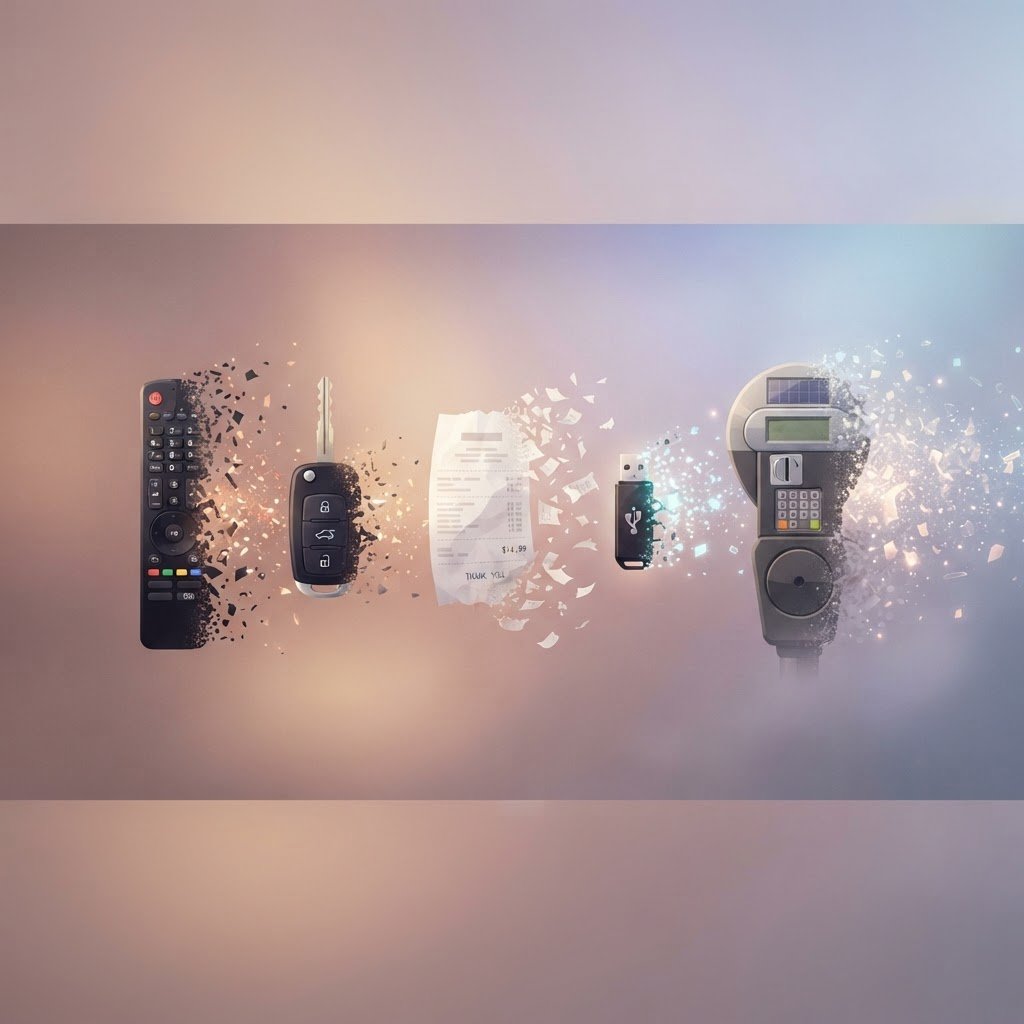
There is a particular kind of object that has lived in every kitchen drawer for the last twenty years. A small plastic rectangle with buttons, the universal remote that promised to control everything and, in practice, controlled almost nothing without a thirty-second struggle. It is the kind of item that gets purchased, used grudgingly, and then quietly forgotten about. In 2026, that remote is beginning to feel like a relic. Not because it broke, but because the world moved past it. Voice commands replaced buttons. Apps replaced infrared beams. The remote did not fail. It simply became unnecessary.
This is how technologies tend to disappear. Not with a dramatic announcement or a ceremonial retirement, but with a slow, quiet fading. People stop reaching for the thing that used to be essential, and one day they realise they have not touched it in months. The object is still there, gathering dust in a drawer, but it no longer matters. At some point, it gets thrown out or donated, and nobody misses it. The disappearance is so gradual that it barely registers as a loss.
Looking ahead to 2040, there are several technologies currently embedded in daily life that are on a similar trajectory. Not the obvious ones, not the things that get headlines about disruption and revolution. The technologies most likely to vanish are the ones that have already become slightly annoying, slightly redundant, or slightly less convenient than their newer alternatives. They are the middle children of innovation, caught between the analogue world they replaced and the digital world that is replacing them.
Take the physical key. For most of human history, locking a door required a piece of metal cut to a specific shape. That metal had to be carried, could be lost, and could be copied by anyone with the right tools. Smart locks have already made significant inroads, and the infrastructure is catching up. Hotels largely moved to card systems years ago. Office buildings use badge access. New apartment developments increasingly include keyless entry as a standard feature. By 2040, carrying a physical metal key may feel as quaint as carrying a pocket watch. The key is not being abolished; it is being absorbed into the phone, the watch, the biometric sensor. The function remains. The form vanishes.
Then there is the parking meter, or more broadly, the physical payment machine for short-term services. These machines have been mildly infuriating for years. They require coins in an increasingly cashless world. Their screens are often unreadable in sunlight. Their card readers work intermittently. The information they display, rates and time limits, could just as easily live on a phone screen. Many cities have already begun replacing them with app-based parking payments, but the physical meters remain standing, taking up pavement space, their coin slots gradually clogging. They are a solution to a problem that no longer exists in the same form. Within a decade or so, the remaining meters will likely be removed, and people will walk past the spots where they once stood without noticing anything is missing.
The USB stick occupies a similar position. It was once a genuine lifesaver, the easiest way to move files between computers. But cloud storage has made it largely redundant, and the increasing integration of phones and laptops has reduced the number of times anyone actually needs to physically transfer a file. USB sticks still sell, but mostly to people who need them for a specific task that they could probably accomplish another way. They are in the phase of slow decline where the object still exists because it still sells, but the underlying need it satisfies is shrinking. Eventually, the market shrinks enough that the object disappears from the shelves.
Receipts are another candidate for disappearance. The paper receipt is a strange artefact when considered carefully. A thin strip of thermal paper printed with details of a transaction, often illegible within weeks as the ink fades, useful only if a return is needed or an expense is claimed. Digital receipts are already common, and the infrastructure to make them universal is nearly in place. The main obstacle is habit. People still reach for the receipt out of reflex. But habits fade when the alternative is genuinely better, and a receipt that lives permanently in an email inbox, searchable and unlosable, is genuinely better than a scrap of paper that fades and gets lost. The paper receipt will likely cling on for a while longer than it should, because it is cheap and familiar, but its days are numbered.
Beyond these specific examples, there is a broader pattern worth noticing. The technologies that disappear first are the ones that occupy a narrow niche, the ones that do one thing that something else can also do. The remote controlled the television, but the phone controls the television and a hundred other things. The key opened one door, but the phone opens all doors. The USB stick moved files, but the cloud moves files without being carried. When a technology serves a single function that a more versatile technology can also serve, the single-function device eventually loses.
This does not mean every single-purpose device is doomed. Books have not disappeared despite e-readers. Vinyl has not disappeared despite streaming. There is a category of objects that survive because they offer something beyond pure function, a tactile quality, a ritual, an aesthetic pleasure that the digital alternative cannot replicate. The technologies that vanish are the ones whose only value was their function. When the function moves elsewhere, the object has nothing left to offer.
There is also the question of infrastructure. A technology disappears when the systems around it stop supporting it. Physical keys require locks with keyholes. Parking meters require pavement space and maintenance. USB sticks require ports. Receipts require thermal printers. As each of these support systems gets swapped out or upgraded, the technology they serve becomes harder to use even for those who want to keep using it. This is why the disappearance is gradual rather than sudden. The old systems do not get deliberately removed; they simply do not get replaced when they break. A building is renovated, and the new doors do not have keyholes. A street is repaved, and the parking meter is not reinstalled. A new laptop is shipped, and it has fewer ports than the last one.
The emotional response to these disappearances is usually mild. People feel a brief pang of nostalgia, acknowledge that the thing was not that great anyway, and move on. There is no campaign to save the parking meter. No movement to preserve the USB stick. The technologies that inspire passionate defence are the ones with cultural meaning, the record player, the film camera, the book. The ones that vanish quietly are the ones that were always just tools, and when a better tool arrives, the old one is put down without ceremony.
Looking toward 2040, the pace of these quiet disappearances is likely to accelerate. Not because innovation is speeding up in any dramatic way, but because the replacement infrastructure is now digital and networked, meaning it can be rolled out and updated far more quickly than physical systems. A city can switch its parking system from meters to an app in a matter of months. A hotel chain can replace every physical key with digital access over a single quarter. The friction of transition is lower when the replacement is software rather than hardware.
What remains is the question of what happens to the objects themselves. There is an environmental cost to producing billions of devices and then discarding them, a cost that is starting to be acknowledged but not yet fully reckoned with. The technologies that disappear do not simply vanish. They end up in landfills, in drawers, in the backs of cupboards. They linger physically even after they have become functionally obsolete. The cleanup of the analogue age will be its own quiet project, extending well beyond 2040.
For now, the process continues. A thing that was once essential becomes optional, then unusual, then unfamiliar. Someone born in 2030 may never encounter a parking meter or a paper receipt and will not know what they are looking at if they see one. The technologies do not announce their departure. They simply stop being part of the story, and the story moves on without them.




