
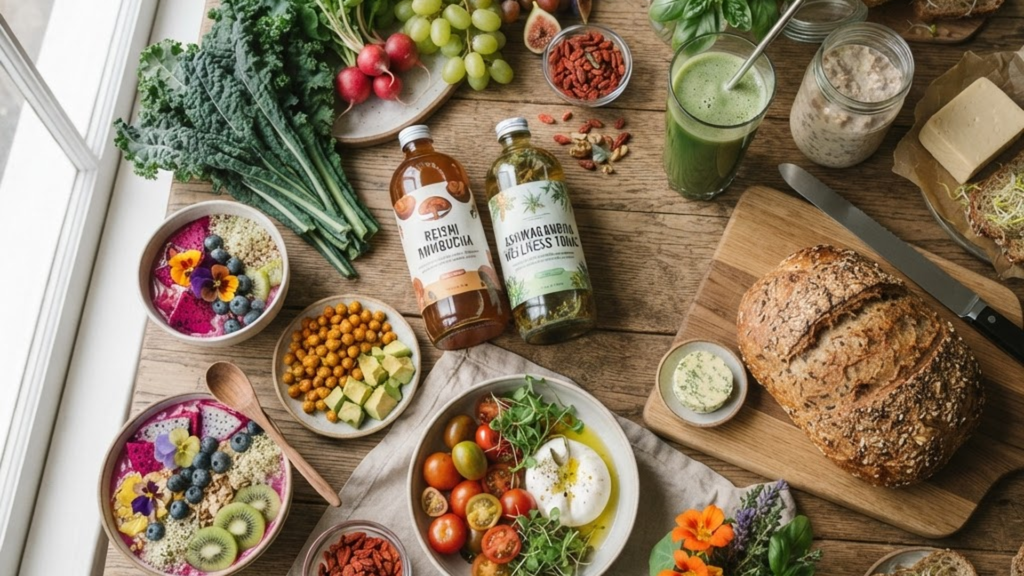
A perspective piece from The Listening Market
There is something quietly thrilling about standing in a grocery aisle and realising the shelves have changed. Not all at once, but enough. A row of prebiotic sodas where there used to be cola. A jar of beef tallow between the olive oils. A frozen meal that looks, improbably, like something from a restaurant kitchen. The food trends 2026 is bringing into kitchens and cafés are not arriving with fanfare. They are settling in — the way a new habit does, gradually, until suddenly it feels obvious that it was always heading this way.
What follows is not a checklist. It is a reading of the year — the currents running beneath the things people are buying, cooking, and sharing. Some of these shifts have been building for a decade. Others arrived faster than anyone expected. All of them say something about what people are hungry for right now, and it is not always food.
The Functional Beverage Has Become a Way of Life
Once upon a time, a drink was something that quenched thirst. Now it is expected to do more. According to the National Restaurant Association’s 2026 “What’s Hot” forecast, functional beverages — drinks formulated for energy, gut health, hydration, and mental clarity — are among the most requested items in food service (National Restaurant Association, “What’s Hot in 2026: Healthier, Functional Beverages”). SIAL Paris, the international food trade show, echoes this in its beverage trends report, pointing to fermented drinks, adaptogen-infused teas, and alcohol-free alternatives as defining the category in 2026 (SIAL Paris, “Beverage Trends 2026: Functional & Mindful Drinks”).
But the story beneath the numbers is more interesting than the numbers themselves. People are tired, literally. The functional beverage boom — which a Forbes analysis frames as part wellness movement and part marketing machine — is a response to a culture that runs on depleted reserves (Forbes, Noel Burgess, “The Functional Beverage Boom in 2026 — Health Trend or Hype?,” April 2026). Whether the electrolyte powder at the bottom of a water bottle is genuinely restorative or simply a ritual that feels like self-care is almost beside the point. The point is that people are reaching for it. The point is that the gesture itself — the deliberate decision to drink something because it does something — has become ordinary.
And when a behaviour becomes ordinary, the market notices. Flavorman’s 2026 beverage trends report, cited by Culinary Culture, highlights cascara-infused drinks, yerba mate, and functional tea blends as rising coffee alternatives — signalling that even caffeine is being reimagined through a wellness lens (Culinary Culture, “What Makes a Functional Beverage Actually Work,” citing Flavorman’s 2026 Beverage Trends Report).
The Kitchen Has Become a Café
There was a time when making coffee at home meant a spoonful of instant granules and a kettle. That time is over. The rise of at-home specialty coffee is one of the defining food trends 2026 has produced, and it is driven by economics as much as enthusiasm. According to the U.S. Chamber of Commerce, as of January 2026 American coffee prices had risen 18.3% compared with a year earlier (U.S. Chamber of Commerce, “How At-Home Specialty Coffee Is Powering a New Growth Market”). When the café becomes expensive, the kitchen counter steps in — but people are not settling for less. They are buying pour-over kits, cold brew towers, and oat-milk frothers. The Coffee Dispatch, a Substack publication tracking café culture, noted that 2026 might be the most interesting year yet for the sector, pointing to an expanding palate that now includes Robusta, dessert coffees, and matcha lattes alongside the familiar flat white (The Coffee Dispatch, “Why 2026 Might Be the Most Interesting Year for Cafés Yet”).
Whole Foods Market’s Trends Council captured this domestic drift perfectly with its “Kitchen Couture” prediction for 2026 — a trend toward eye-catching packaging and bold design for everyday staples, what the retailer called “dopamine décor” for the kitchen counter (Whole Foods Market, “The Next Big Things: Our Top Food Trend Predictions for 2026”). The implication is telling. The kitchen is no longer a place where mess is hidden. It is a stage. People want their olive oil bottles and their tinned fish to look as good as they taste, because the kitchen is where the gathering now happens.
Fibre Is the New Protein
Protein has been the star of the wellness world for years now, and it is not exactly going away. But in 2026, fibre is quietly stealing the conversation. Whole Foods identified a “Focus on Fibre” as one of its top predictions, noting that brands are increasingly adding fibre to pastas, breads, crackers, and bars, while prebiotic beverages made from ingredients like cassava and chicory root are becoming regulars on shelves (Whole Foods Market, “The Next Big Things: Our Top Food Trend Predictions for 2026”).
The reasons are layered. Gut health has moved from the fringe to the mainstream of personal wellness, and fibre is the nutrient most directly tied to it. But there is also something more primal at work — the desire to feel full without feeling heavy, to eat in a way that satisfies the body without dragging it down. Fibre delivers on that promise in a way that another protein bar simply cannot. And as the conversation around digestion, satiety, and the microbiome continues to deepen, expect to see fibre showing up in places where it was never advertised before — in juice, in yoghurt, in the fine print of snack packaging, quietly becoming a selling point rather than an afterthought.
Regional Indian Cuisine Is Having Its Moment
For a long time, “Indian food” in Western restaurant culture has meant a narrow selection of dishes from the north — butter chicken, rogan josh, naan. That is beginning to change. Penn State Extension’s food trends report for 2026 identified regional Indian cuisines as a major new trend driver, joining the continued momentum behind Korean cuisine and fermented foods that the programme has tracked in previous years (Penn State Extension, “Food Trends 2026”).
The shift matters because it reflects a broader appetite for specificity. Diners are no longer satisfied with broad cultural categories. They want to know which coast, which spice market, which grandmother’s recipe. And as more chefs from across India’s vast regional landscape open restaurants and publish cookbooks, the picture of what “Indian food” means in the global imagination is expanding — not flattening — to include the sour tamarind notes of Chettinad, the vegetarian sophistication of Gujarat, the seafood traditions of Kerala’s backwaters. This is not fusion for its own sake. It is recognition.
Fermentation, With Intention
Fermented foods have been trending for years, but 2026 brings a noticeable change in tone. What was once a wellness buzzword is now being treated as a craft. The James Beard Foundation asked ten of its award-recognised chefs about the food trends 2026 will be defined by, and “intentional fermentation” came up repeatedly — not as a health gimmick, but as a technique for preserving abundance, reducing waste, and expressing a sense of place and time (James Beard Foundation, “Flavor Forecast: Top Restaurant Food Trends for 2026”). Sayat Ozyilmaz, co-chef and co-owner of San Francisco’s Dalida, told the Foundation that he stocks his pantry with fruit vinegars made from kitchen trim and cultured chilli pastes from seasonal gluts, describing fermentation as a way for a cook to “express time, place, and scarcity all at once.”
This reframing — fermentation as stewardship rather than supplement — sits comfortably beside the rise of what Whole Foods called the “Very Vinegar” trend, pointing to a renaissance of premium, small-batch, and fruit-infused vinegars that add both depth and probiotic-like benefits to home cooking (Whole Foods Market, “The Next Big Things: Our Top Food Trend Predictions for 2026”). What is happening is the old becoming new again, not because of nostalgia, but because the logic of preservation still works — and now it tastes better than ever.
The Return of Ancestral Fats
Among the more surprising food trends 2026 has surfaced is the comeback of beef tallow. Whole Foods led its predictions with what it called the “Tallow Takeover,” noting that the fat — prized for its high smoke point and rich flavour, and long a staple of traditional cooking — is being rediscovered by consumers interested in ancestral ingredients and alternatives to seed oils (Whole Foods Market, “The Next Big Things: Our Top Food Trend Predictions for 2026”). Restaurants have begun trading conventional frying oils for tallow to elevate everything from chips to pastries, and social media has amplified the trend with the kind of fervour usually reserved for skincare routines.
What is interesting here is not the tallow itself, which is simply a fat that never really went away, but what its return signals — a questioning of the industrial food logic that declared certain fats good and others bad, and a willingness to look backward for answers that the present has failed to provide. It is a small thing, a jar of fat on a counter. But it represents a broader instinct toward reclaiming the kitchen, toward trusting tradition over marketing, and toward cooking with ingredients that carry a story.
Grazing, Smaller Menus, and the Value of Enough
Kroger, one of the largest grocery retailers in the United States, predicted that “grazing will go mainstream” in 2026, with one-bite snacks and mini meals leading the way as customers seek portion control and personalisation (Kroger, “Kroger Reveals Food Trend Predictions of 2026”). This dovetails with what the James Beard Foundation’s chefs described happening in restaurants: shrinking menus built around fewer things done well, and a rise in larger-format entrées for diners who are tired of sharing small plates they cannot afford to fill up on (James Beard Foundation, “Flavor Forecast: Top Restaurant Food Trends for 2026”).
Both trends point to the same underlying shift — a recalibration of what “value” means. It is no longer about volume alone. It is about intention. A smaller menu that changes with the season. A single snack that is genuinely satisfying rather than a handful of forgettable ones. An entrée that feeds the soul, as one chef put it, rather than a parade of bites that leaves a person reaching for toast at midnight.
Why These Trends Stick
The food trends 2026 has brought to the surface do not share a single ingredient list. They span from beef tallow to yerba mate, from frozen arancini to regional Indian seafood. But they do share something — a common emotional architecture. Each one represents a small act of reclamation. Reclaiming the kitchen as a place of beauty. Reclaiming the drink as something with purpose. Reclaiming the food of a specific region rather than a generic cuisine. Reclaiming the old techniques — fermentation, preservation, the use of the whole animal — not as novelties, but as living knowledge.
Trends, at their best, are not predictions. They are observations of what is already happening, seen clearly enough to be named. And what is happening in 2026, in kitchens and cafés and grocery aisles around the world, is a slow turning toward something more honest. Not more expensive, not more complicated, not more performative. Just more intentional. More rooted. More awake to the idea that what people eat and how they eat it says something about who they are choosing to be.
That, in the end, is why these trends will stick. Because they are not really about food. They are about the way food makes people feel — cared for, connected, curious, alive — and in a year that continues to ask a great deal of everyone, that feeling is something people are not willing to give up.