
A perspective piece from The Listening Market
There was a time when a desk was just a desk. A surface, a chair, perhaps a lamp if you were lucky. The relationship between a person and their workspace was largely transactional: sit down, do the work, leave. But somewhere between the sudden shift to remote work and the slow rethinking of what a working life should feel like, that relationship changed. The desk stopped being a place to tolerate and became a place to design.
The idea that a workspace should make someone genuinely want to sit down and begin is no longer a luxury reserved for tech startups with ping-pong tables and bean bags. It has become a practical question that more people are asking of their own homes, their own corners, their own small stretches of square footage. What does it take to build a space that pulls you in rather than pushes you away?
The Shift From Function to Feeling
For decades, office design was driven by efficiency. Rows of identical desks, fluorescent lighting, beige walls. The assumption was that work happened because it had to, not because the space invited it. Home workspaces inherited the same logic: a spare bedroom or a corner of the dining table, whatever was available, dressed up with a laptop and a charger cable.
What changed was not the furniture but the understanding. People began to notice that where they worked affected how they worked, and more subtly, whether they wanted to. A space that feels deliberately created carries a different psychological weight than one that feels like an afterthought. The difference is not about money or square footage. It is about intention.
A workspace that makes you want to work is one that has been thought about. Not necessarily expensively designed, but considered. The light, the texture, the sound, the temperature, the view. These are not decorative concerns. They are the quiet conditions under which focus becomes easier and resistance fades.
Light Is the First Question
Ask any architect what makes a room feel good and the answer will almost always involve light. Natural light, in particular, does something that no desk lamp or screen can replicate. It regulates the body’s circadian rhythm, signals wakefulness, and shifts mood in ways that are difficult to measure but easy to feel.
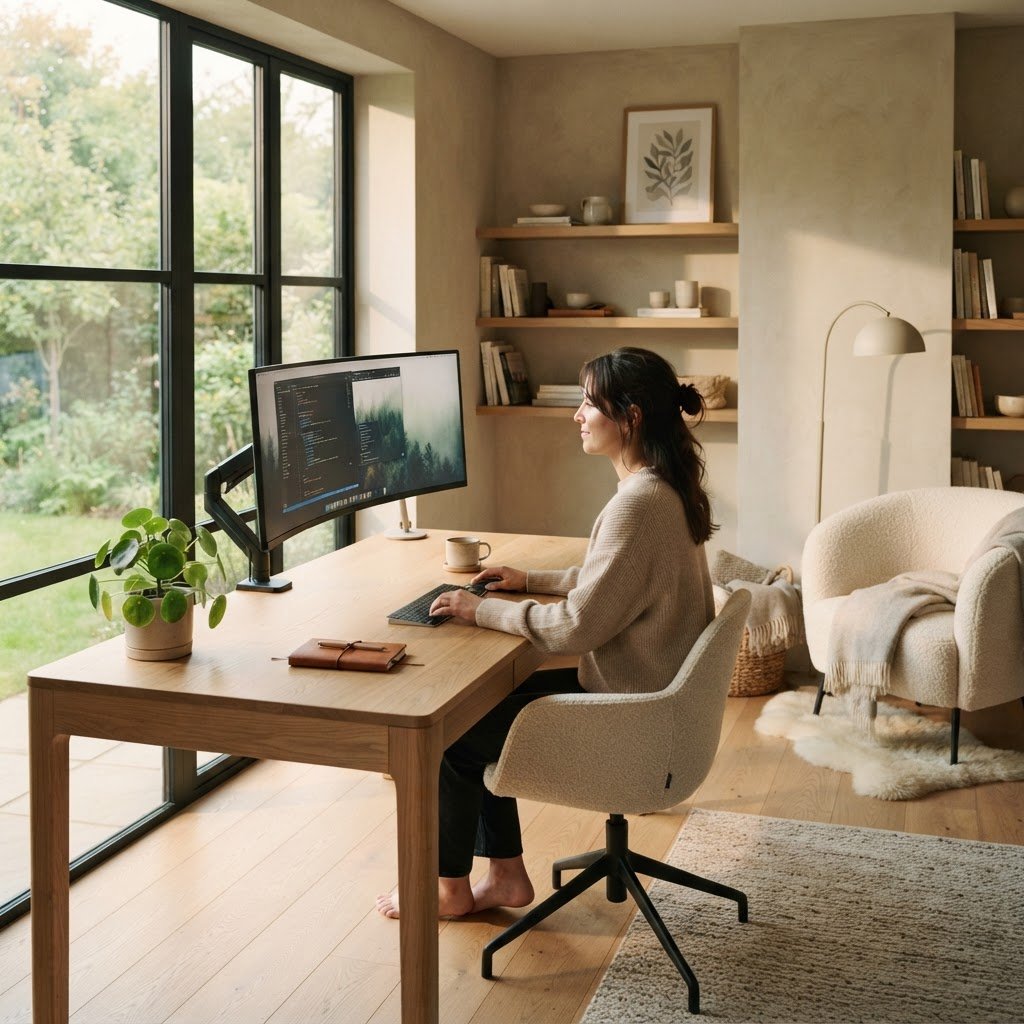
A workspace positioned near a window, where daylight can reach the desk without causing glare on a screen, is already ahead of most. For those who do not have that option, the choice of artificial light matters more than people realise. Warm light for comfort, cooler light for alertness, and a layered approach that lets the atmosphere shift as the day moves from morning focus to afternoon slog to evening wind-down.
The mistake most people make is treating light as an afterthought, something to be dealt with once the desk and chair are in place. In reality, light should come first. It shapes everything else. A beautiful desk in a dim corner will always feel oppressive. A modest desk in a well-lit room will always feel inviting.
The Surprising Power of Texture
There is a reason that the most appealing workspaces photographed for design magazines tend to share certain qualities: wood surfaces, soft fabrics, a plant or two, perhaps a ceramic mug. These are not random aesthetic choices. They are textures that the body responds to at a level beneath conscious thought.
Smooth, cold, synthetic surfaces, the kind found in many traditional offices, tend to feel sterile. They do not invite touch or lingering. Natural materials, wood, linen, stone, wool, carry warmth. They make a space feel lived in rather than assembled. A desk made of warm wood, a chair with a fabric seat, a wool throw draped over the back, a small ceramic pot holding a fern. These details are not frivolous. They tell the nervous system that this is a safe, comfortable place to spend time.
The psychology is simple. People are more likely to return to places that feel good to be in. A workspace that feels warm and tactile creates a gentle pull. It says: come back, settle in, stay a while.
Sound and the Architecture of Focus
Light and texture are visible. Sound is the invisible element that shapes a workspace more than most people account for. A beautiful room with terrible acoustics, echoing voices, the hum of traffic, the buzz of a refrigerator three rooms away, can make deep work nearly impossible.
Sound treatment does not require a recording studio budget. Soft furnishings absorb sound. A rug under the desk, curtains on the windows, a corkboard on the wall, all of these reduce echo and create a sense of acoustic intimacy. Some people work best in silence. Others need ambient sound, a café recording, rainfall, instrumental music, to create a buffer against distraction. The point is not that one is better than the other but that the choice should be deliberate rather than accidental.
The most productive workspaces give their occupants control over sound. Noise-cancelling headphones for the loud moments. A quiet corner for the deep ones. The ability to shape the sonic environment, even crudely, gives a sense of agency that translates directly into focus.
The Boundary Between Work and Everything Else
One of the most consistent findings from the remote work era is that people struggle to stop working when their workspace is always visible. A desk in the corner of the bedroom, a laptop on the kitchen table, these arrangements blur the line between on and off. The work is always there, always waiting, never fully out of sight.
A well-designed workspace has a boundary. This does not require a separate room with a door that locks. It can be as simple as a screen that blocks the desk from view at the end of the day, a ritual of closing the laptop and placing it in a drawer, or a physical shift, moving to a different chair in the evening. The brain needs a signal that work has ended. Without it, the workspace becomes a source of low-grade stress rather than a place of productivity.
The most effective boundary is psychological. When a workspace is designed with intention, it carries a clear identity. This is where work happens. The rest of the home is where it does not. That clarity, more than any physical barrier, is what allows people to fully engage during work hours and fully disengage after them.
Plants, Views, and the Outside World
The presence of living things in a workspace is not a trend. It is a response to a deep human need for connection to the natural world. Studies have repeatedly shown that plants in work environments reduce stress, improve air quality, and increase productivity. But beyond the research, there is something simpler at work: a living thing in a room changes how that room feels.
A plant on a desk is a small daily reminder that the world continues outside the screen. It grows, it needs water, it shifts with the light. It is a quiet companion that asks for nothing but attention and gives back a sense of life. For those without a view of greenery outside the window, a few well-placed plants can serve the same purpose.
The view matters too. A workspace with a window that looks onto a street, a garden, even a brick wall with changing light, gives the eyes somewhere to rest. Staring at a screen all day without a distant focal point causes eye strain and mental fatigue. A view, even an unremarkable one, offers the occasional micro-break that the brain needs to reset.
Designing for the Body
All the aesthetic considerations in the world will not save a workspace that is physically uncomfortable. The chair, the desk height, the screen position, these are the structural foundations. A chair that causes back pain after an hour is not a chair that belongs in a workspace, regardless of how it looks.
Ergonomics has a reputation for being clinical, but at its core it is simply the practice of designing for the human body. A desk at the right height. A chair that supports the lower back. A screen at eye level to prevent the slow forward slump that turns into neck pain. A keyboard positioned so the wrists remain neutral. These are not luxuries. They are the minimum conditions for sustained work without physical cost.
The good news is that ergonomic does not mean ugly. The market has responded to the demand for workspace furniture that is both comfortable and attractive. A well-designed chair in a warm fabric, a sit-stand desk with a natural wood top, a monitor arm that clears desk space. These choices serve the body and the eye at the same time.
The Personal Element
A workspace that makes you want to work is, in the end, one that reflects who you are. Not a copy of a photograph from a design website, but a collection of choices that feel right. A favourite book on the shelf. A print from a gallery visited on holiday. A mug that means something. These personal details are not distractions from work. They are the reason the space feels like it belongs to someone rather than to a company.
The most inviting workspaces are not the most expensive or the most curated. They are the ones that have been shaped by the person who uses them. Over time, through small adjustments and gradual refinement, a desk and a chair and a lamp become something more. They become a place that feels like home within a home. A place where work does not feel like an imposition but like a natural part of life.
That is the goal, in the end. Not a workspace that looks impressive to others, but one that feels right to the person who sits at it every day. The best measure of a well-designed workspace is simple: when the work is done, the space still feels good to be in. And when morning comes, there is a small, quiet pull toward the desk. Not obligation, but invitation.




