A perspective piece from The Listening Market
Almost everyone has met the fantasy version of journaling. It involves a linen-bound notebook, a quiet desk by a window, an hour of reflection before a nourishing breakfast, and prose that reads like a young poet’s. It is a lovely fantasy, and it is precisely what stops most attempts within a week. The gap between that imagined ritual and the actual texture of a busy life is where good intentions go to die: the morning turns chaotic, the desk is covered in laundry, and by the time the evening arrives, writing anything feels like a performance nobody has the energy to give. The five-minute journal is the opposite bet. It asks for almost nothing, and in exchange it quietly returns a practice that can hold together for years.
The mathematics of the approach are deliberately unimpressive, which is its strength. Five minutes is short enough to survive a bad day, short enough to begin while the kettle boils, short enough that skipping it feels more ridiculous than doing it. Where the fantasy journal demands an appointment with life, the five-minute version asks for a pocket of time that already exists: the minutes before the laptop opens, the pause on the train, the moment after the door closes and the house settles. People who study habit formation tend to agree on the essential point, that small and consistent beats ambitious and abandoned, and journaling is the clearest laboratory demonstration of the principle most people ever run on themselves.
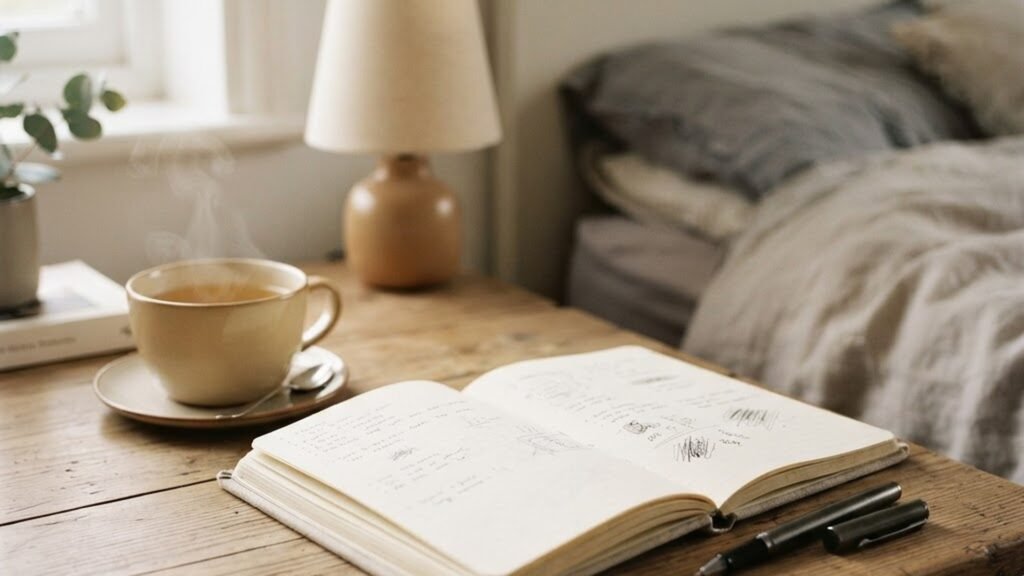
Starting is mostly a matter of removing obstacles rather than adding motivation. The notebook should live where the writing will happen: on the bedside table, in the work bag, beside the coffee machine. The pen should be one that is pleasant enough to forget it is a pen. The first entry should be written on the day the decision is made rather than the beginning of next week, next month, or the new year, because the calendar is a serial procrastinator’s best friend. Nothing should be prepared in advance, because preparation is only ever a more dignified form of delay.
What to write is the other question that defeats beginners, and the answer is shorter than the fears around it. A five-minute journal does not need subjects so much as a simple, repeatable prompt, something like one good thing from the day and one thing tomorrow could improve. Some writers prefer a single sentence about the strongest feeling of the day. Others choose a line of gratitude, an honest complaint, or note of something small but exact: the colour of the evening sky, a stranger’s unexpected kindness, the smell of the coffee. The purpose of the prompt is not to produce content. It is to remove the unbearable blankness of the page, which is where most blank pages are lost.
The physical form of the practice matters less than everyone hopes. Some people need the particular friction of paper and stay loyal to cheap spiral notebooks kept in desk drawers. Others write in the same notes app that holds their shopping lists, which has the quiet advantage of always being within arm’s reach. There are apps built around precisely this habit, with prompts and streaks and gentle reminders, and they suit some temperaments beautifully. The only truly wrong choice is whatever makes the practice feel like a piece of software being used rather than a person thinking out loud. A notebook with a broken spine and terrible handwriting usually outlasts the elegant bullet-journal system, for the same reason that an old pair of walking shoes outlasts the unused gym membership.
Honesty is the practice’s quiet multiplier, and it does not require dramatic confession. A journal entry that says, truthfully, that today was grey and the meeting was tedious and the dinner was fine has more value than a page of performed positivity, because the notebook is not an audience. Writing that is shaped to impress an imaginary reader stops being a place to think and becomes a place to pose. What actually helps is the opposite: the page exists precisely because there is no judgment in it. People who keep this habit for years tend to write the same way they speak to themselves in the car, unpolished and unbothered, and that is where the value collects, one ordinary line at a time.
The benefits are subtler than the habit’s evangelists promise, and more durable. The discipline of naming a day’s feeling is a small act of clarity that rewards attention for the rest of the day. The record accumulates into something rare: an unedited account of a life, with its weather. There is real satisfaction in reading, a year later, a line about a small ordinary Tuesday that memory would otherwise have flattened into nothing. And there is a quietly practical side that surprises people: entries become a memory of what was tried and what happened, an archive of decisions and their reasons, an unusual record of what was wanted before it arrived, and a record of what worked and what did not.
Failure, in this practice, is a feature rather than a collapse. Everyone misses days, and the habit’s real test is what happens after the missing. People who keep journals for decades do not miss nothing; they miss plenty, and simply resume without ceremony. The entry after a week’s silence does not need to explain or apologise, only to observe something in the present hour. Beginners who learn to do this are being trained in something larger than journaling, which is the art of returning to good habits without guilt.
A month into the practice, most people notice a small shift that is difficult to describe without sounding precious. The day begins to disclose itself more readily, providing details worth writing down, because the habit asks questions of the day as it happens. Noticing improves with practice, in the way that anything improves with practice: the mind, classifying its hours as material, starts collecting. Five minutes in, the day has been witnessed and finished, which is a form of closure that scrolling, streaming, and the rest of the evening’s ordinary rituals rarely provide. It has become the day’s full stop, and it arrives without a single notification.
Hard days deserve their own mention, because they are where the practice proves itself. The instinct on a difficult day is to skip writing entirely, to press the day flat and move on, and it is exactly then that two sentences are most useful. A journal that has been honest on ordinary days becomes somewhere that can hold an honest line about an extraordinary one, and the page is entirely indifferent to whether that line is eloquent. There is a reason the habit is frequently recommended alongside whatever else a person is carrying, and it is not that notebooks solve problems. It is that problems behave differently once they have been written down: reread the next morning, the sourceless dread of the evening usually reveals a shape, a pattern, sometimes even a next step. Journaling gives difficult days a container, and containers make things easier to carry.
The practice scales down beautifully for shared households, too. A page on the kitchen counter becomes the family message board: one line by each person at dinner, one small something from the day, one small something about tomorrow. Young children can join before they can write, providing an oral sentence for a parent to record. The point is not to produce a family archive, though enough such books have become treasures later in life. The point is that attention is one of the few gifts that costs absolutely nothing, and a shared minute of noticing each other’s days at the table is attention, paid in full.
The five-minute journal is not therapy, able to untangle grief or settle arguments, though many therapists recommend the habit as a complement rather than a cure. It is not productivity either; it produces no metrics and optimises nothing. That bareness is its character. In a day of quantified steps and scored sleep, the practice remains defiantly unmeasurable, one page among thousands, read by nobody, valuable only to its writer. That almost nothing about it can be gamified is beginning to feel like the point: it is five minutes of a day that belong entirely to the person living it, which may be the cheapest luxury still available.