A perspective piece from The Listening Market
There was a time when owning something felt permanent. A DVD sat on a shelf. A music collection lived in a binder of CDs. Software arrived in a box with a manual. None of it required a monthly payment, and none of it could be taken away by a server outage or a policy update. That world feels distant now, not because anyone chose to leave it behind, but because the economy quietly reorganised itself around a different idea: that everything worth having should be rented indefinitely.
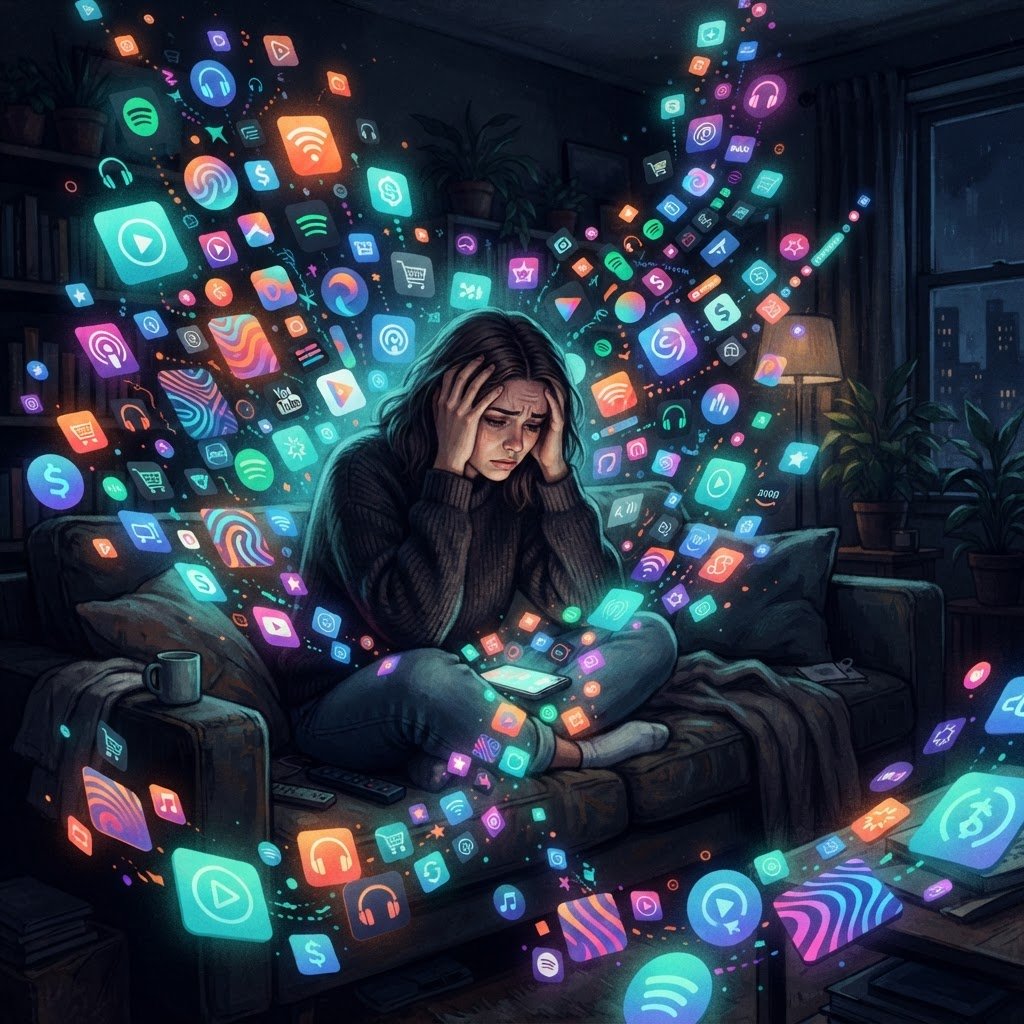
Subscription fatigue is not a single complaint. It is the slow accumulation of a dozen small frustrations that, together, have produced a genuine cultural shift in how people feel about paying for things. The streaming service that quietly raised its price for the third time. The fitness app that auto-renewed during a forgotten free trial. The software that moved from a one-time purchase to a monthly plan without offering an alternative. The phone, the laptop, the car, the washing machine, the toothbrush — each one now carrying its own micro-subscription, its own little monthly withdrawal from an account that never quite balances.
The average household in Australia now pays for more subscriptions than many of its members can name. Studies in recent years have found that people consistently estimate their monthly subscription spending at around half of what it actually is. The gap between perception and reality is not a failure of intelligence. It is a feature of the model. Subscriptions are designed to be invisible, to fade into the background of monthly statements, to renew without fanfare and without ceremony. The business logic is simple: a customer who forgets is a customer who stays.
What has changed is that the forgetting is no longer accidental. It is a deliberate act of financial self-management. People are auditing their subscriptions with the same attention they once reserved for big purchases. They are cancelling services they barely use, sharing accounts with family members, rotating between platforms month by month, and increasingly, asking a more fundamental question: whether the subscription offers enough value to justify its permanence in their lives.
The streaming industry was the first to feel the backlash, but it will not be the last. For years, the streaming model expanded through abundance: more platforms, more shows, more reasons to subscribe. At some point, the mathematics inverted. A person who wanted to watch the shows everyone was talking about needed three or four separate subscriptions, each with its own increasing price tag and its own rotating library. The value proposition of streaming — cheaper than cable, more choice, no ads — started to look less like a revolution and more like a more expensive version of what it replaced. The return of shared passwords, ad-supported tiers, and annual plans are all signs of companies trying to manage the same problem from the other side: customers who are no longer willing to pay indefinitely for content they consume sporadically.
Beyond entertainment, the subscription model has spread to areas that once seemed immune. Mattresses come with sleep-tracking subscriptions. Cars offer heated seats as a monthly add-on. Printers require ink subscriptions. Pet food arrives on a schedule that does not always match the pet’s eating habits. The logic behind each one is reasonable in isolation — predictable revenue, ongoing service, convenience for the customer. In aggregate, though, the experience is something else entirely: a monthly tax on modern life, levied by dozens of companies, each taking a small slice, none responsible for the whole.
The psychology of subscription fatigue is worth examining. A one-time purchase, even an expensive one, comes with a kind of emotional closure. The money is spent, the item is owned, the transaction is complete. A subscription denies that closure. The payment never ends, which means the decision never fully settles. Every month, at some level of awareness, the question lingers: is this still worth it? That question, asked across a dozen services, creates a low but persistent hum of anxiety that many people describe as a feeling of being nickeled and dimed by their own lifestyle.
Younger consumers have been the first to articulate this discomfort in economic terms. For a generation that has grown up inside the subscription economy, the model is not novel but default, and defaults are meant to be questioned. What they have noticed is that the subscription economy, despite its promise of flexibility, tends to produce the opposite: a kind of financial inertia where services are retained not out of enthusiasm but out of the friction of cancellation. The companies that make cancellation easy tend to build trust. The ones that bury it behind phone calls and retention pages tend to breed resentment that outlasts the relationship.
The response from the market has been interesting. A new category of tools has emerged to help people manage their subscriptions, track their spending, and cancel unused services with a few taps. Banks now offer subscription dashboards as a standard feature. Comparison sites help identify which services overlap and which can be dropped without loss. The very friction that companies built into their retention strategies has become a business opportunity for others willing to remove it. It is a small but telling sign that the market recognizes subscription fatigue as a real and growing problem.
Some categories are more vulnerable to the backlash than others. Services that deliver ongoing, tangible value — cloud storage that is used daily, software that is essential for work, insurance that provides peace of mind — tend to survive the pruning. Services that deliver sporadic value — the streaming platform watched only when a new season drops, the fitness app opened twice in January, the news subscription read on weekends — are the first to go. The distinction is not about price but about perceived return. People will pay for a subscription that pays them back, in time saved, joy delivered, or problems solved. They will not pay for one that sits idle, quietly draining an account while offering nothing in return but the option to engage.
The broader economic context matters here. In a period of sustained cost-of-living pressure, subscriptions are not immune. They are, in fact, uniquely exposed, because they represent discretionary spending that can be cut without losing anything tangible. A person can cancel a streaming service and still watch free-to-air television. They can cancel a meal kit subscription and still eat. The subscription economy, which grew fat during a period of cheap money and abundant disposable income, is now facing the test of a tighter economic moment, and some of its assumptions are being stress-tested for the first time.
There is also a deeper philosophical question that subscription fatigue surfaces: the question of ownership. In a world where everything is rented, what does a person actually own? A music library that lives on a server can be edited, censored, or removed by the company that hosts it. A film collection on a streaming platform can disappear overnight because of a licensing dispute. The sense of building a personal collection, a canon of taste, a set of cultural artifacts that belong to an individual — that sense is eroded by the subscription model, which treats culture as a flowing river rather than a standing library. For some, this is liberating. For others, it is a quiet loss that they feel but struggle to name.
The companies that will thrive in the post-fatigue era are the ones that take the problem seriously rather than dismissing it. Transparency about pricing. Easy cancellation. Genuine value that justifies the ongoing cost. These are not radical ideas, but they cut against the grain of an industry that has, for years, optimised for retention through friction rather than for loyalty through satisfaction. The shift is already visible in the most successful subscription businesses, which are investing in product quality and customer experience rather than in dark patterns and lock-in clauses.
Subscription fatigue is not a rejection of the model itself. Most people subscribe to things they love and would not cancel them willingly. The fatigue is with the excess: the accumulation, the invisibility, the presumption that any service worth offering is worth charging for monthly. The future of the subscription economy is not collapse but correction. Fewer services, clearer value, happier customers. That is not a radical vision, but it is a necessary one, and the companies that reach it first will be the ones that survive the reckoning that is already underway.
What started as a convenient way to access music and movies has become a monthly ledger of obligations that many people no longer fully understand or fully endorse. The correction is not coming. It is here, happening quietly in living rooms and on phone screens, one cancelled subscription at a time.