
A perspective piece from The Listening Market
Walk into any café in a decent-sized city this year and the menu tells a story. The espresso machine is still there, but next to it sits a jug of something golden, fermented, and vaguely medicinal. The pastry cabinet has a croissant, but also a gluten-free muffin made from a flour that did not exist a decade ago. The milk station offers oat, almond, soy, and something called barista-grade coconut that foams like the real thing. None of this feels strange anymore. It feels like breakfast.
Food trends in 2026 are less about novelty and more about normalisation. The ingredients and eating habits that once occupied the fringe — fermented condiments, adaptogenic drinks, insects as protein, lab-grown meat — have not exactly gone mainstream in the way their early proponents imagined. Instead, they have been absorbed into the background of ordinary eating, quietly reshaping what a normal meal looks like without anyone declaring a revolution.
The most visible shift is the continued rise of functional eating. The idea that food should do something beyond satisfy hunger has moved from wellness circles into the supermarket aisle. Products that once sat in health food stores now occupy prime shelf space: yoghurts with specific probiotic strains, snacks infused with nootropics, bread fortified with prebiotic fibre. The marketing language has evolved from vague promises of feeling good to specific claims about gut health, cognitive performance, and sleep quality. Whether these claims always hold up under scrutiny is another matter, but the cultural signal is clear. People are no longer just asking whether food is tasty or filling. They are asking what it does.
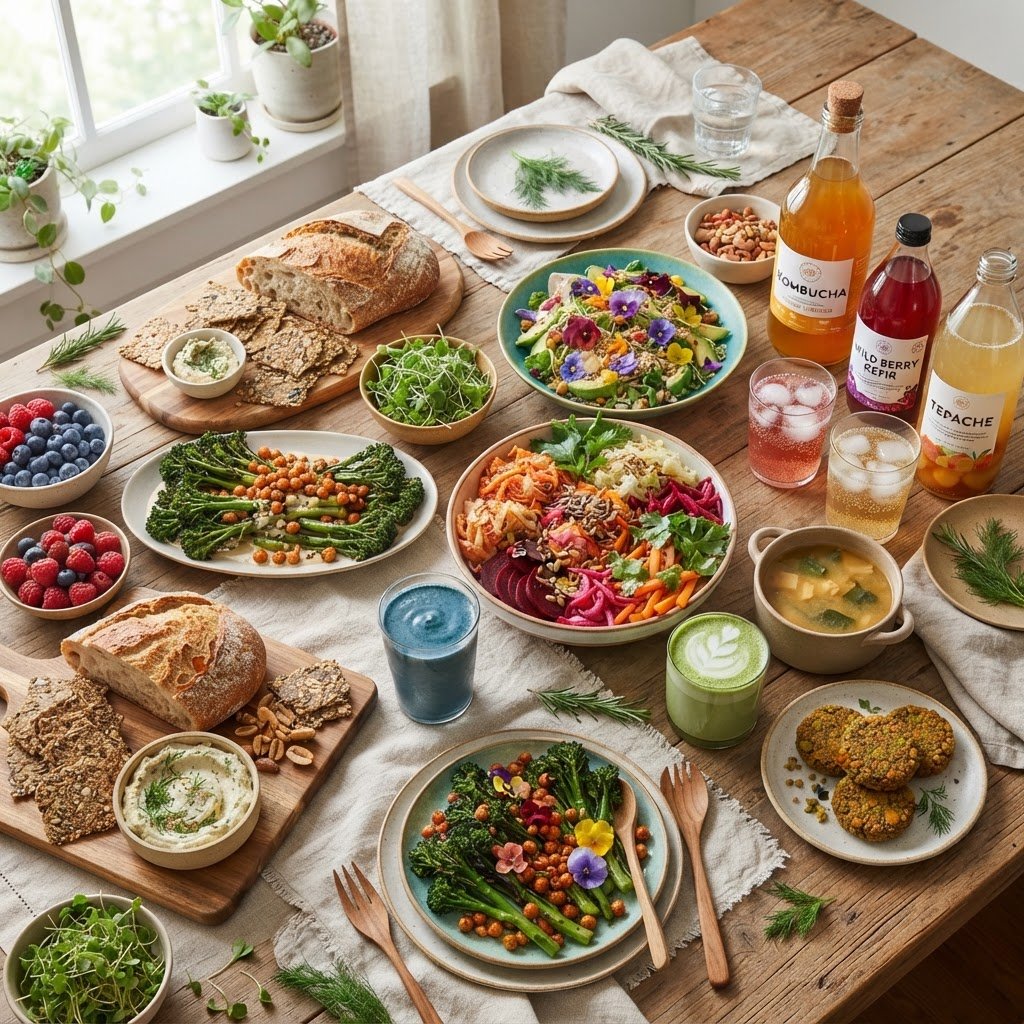
The gut health obsession, which seemed like it might peak and fade, has instead deepened and diversified. The conversation has moved beyond probiotics to the wider ecosystem of the microbiome, and the products have followed. Fermented foods are no longer a niche category but a pantry staple. Kombucha has competition from a growing field of fermented cousins: water kefir, tepache, kvass, and drinks made from ingredients that sound more like skincare than beverages. The sour, tangy, slightly funky flavour profile that once divided rooms has become a mainstream taste, especially among younger eaters who grew up with it as a default rather than an acquired preference.
Plant-based eating has undergone its own quiet evolution. The early phase was defined by imitation: burgers that bled, sausages that sizzled, chicken that peeled apart in a way that mimicked the original. The current phase is something different. Rather than trying to replicate meat, many products are now celebrating vegetables for what they are. Mushroom-based dishes that lean into umami rather than disguising it. Jackfruit that is presented as itself, not as a pulled pork substitute. The language has shifted from plant-based to plant-forward, a subtle but important distinction that reflects a growing comfort with vegetables as a primary ingredient rather than a stand-in for something else.
The cost-of-living pressure that has shaped so much of the last few years has left its mark on food habits in ways that may outlast the economic cycle itself. Cooking at home, once a necessity for some and a pleasure for others, has become a deliberate choice driven by both budget and quality. The pandemic-era sourdough boom has matured into a genuine home-baking habit for many households, and the skills learned during those strange months have not been forgotten. People who never baked before now make their own bread weekly, not because they cannot afford to buy it, but because the homemade version tastes better, costs less, and fills the kitchen with a smell that no shop can replicate.
The relationship between food and sustainability has also shifted from abstract concern to practical habit. Reducing food waste has become a point of pride, not just a environmental gesture. Root-to-stem cooking, which uses every part of a vegetable, has moved from restaurant kitchens into home cooking, driven partly by economy and partly by a genuine shift in values. Nose-to-tail eating, once the preserve of adventurous diners, is now more widely understood and practised. The culture has moved from a mindset of abundance and disposability to one of respect and resourcefulness, and the food on the plate reflects it.
One of the more unexpected developments is the rise of what might be called high-low eating. This is the phenomenon where people are simultaneously more adventurous and more frugal, splurging on a single exceptional ingredient while cutting costs on everything else. A dinner might feature an expensive cut of locally sourced lamb alongside a very cheap, very good pasta made from pantry staples. The indulgence is selective, not absent. People are not eating less well, but they are being more deliberate about where the money goes, and the result is a more interesting, more variable food culture than the one defined by either constant luxury or constant austerity.
The influence of social media on food trends remains enormous but is evolving. The era of the elaborate, visually striking dish designed primarily for a photo seems to be waning, replaced by a hunger for authenticity and simplicity. What performs well now is not the towering, improbable creation but the honest, imperfect, deeply appetising plate: a bowl of pasta with a rough-hewn sauce, a loaf of bread with an irregular crumb, a roast chicken that looks like something a real person actually cooked. The aesthetic has shifted from aspiration to identification, from wanting to eat what celebrities eat to wanting to eat what a competent friend would make.
Global flavours continue to expand the everyday palate, but the pattern has changed. Rather than the broad, sometimes reductive borrowing of past decades, the current wave is more specific and more respectful. Diners are learning the difference between regional cuisines within countries that were once treated as monolithic. The rise of specific regional Mexican, Vietnamese, and West African cooking reflects a more curious and more informed food culture, one that treats the world’s cuisines as distinct traditions to be understood rather than ingredients to be sampled.
Technology’s role in all of this is more pervasive than it appears. Online grocery shopping has normalised access to ingredients that once required a specialty store. Recipe apps customise suggestions based on dietary needs, budget constraints, and what is already in the cupboard. AI meal planners generate weekly plans that minimise waste and maximise nutrition. The kitchen itself is getting smarter, with ovens that recognise what is being cooked and adjust accordingly, and refrigerators that track expiry dates and suggest recipes based on what needs using up. None of this is flashy. It is the quiet infrastructure of a changed relationship with food.
The decline of ultra-processed food, often predicted and often deferred, shows signs of being real this time. Not because people have abandoned convenience, but because the definition of convenient is shifting. A ready meal that is made from recognisable ingredients, with a short and readable list of contents, is increasingly available at a price that competes with the heavily processed alternative. The market is responding to a demand that has been building for years: food that is fast without being fake, convenient without being compromised.
The drinks cabinet tells its own version of the story. The non-alcoholic category has moved well beyond the token option. Bars now offer cocktails that are genuinely complex, genuinely interesting, and entirely alcohol-free, made with the same care as their traditional counterparts. The choice to not drink is no longer a statement. It is simply a choice, and the culture has adjusted with remarkable speed to treat it as such. The functional drinks that have exploded across supermarket shelves — sparkling teas, adaptogenic sodas, botanical infusions — are filling the social space that alcohol once owned, not by imitating it, but by offering something different and, for many, better.
What ties all these threads together is a reorientation of values around food. The excess of the previous decade, defined by abundance, novelty, and spectacle, is giving way to something more grounded. Quality over quantity. Knowledge over novelty. Simplicity over spectacle. This is not a retreat from pleasure. If anything, it is a deeper pursuit of it, recognised not in the most expensive or the most elaborate but in the most genuinely satisfying. The food trends of 2026, taken together, point to a culture that is learning to eat well by paying closer attention to what well actually means.
The plate is smaller, plainer, and more deliberate than it was a few years ago. It is also more interesting, more personal, and more connected to the people who grew, cooked, and shared it. The trends that matter are not the ones that make headlines. They are the ones that change what shows up on the table, week after week, without anyone needing to call them a trend at all.




