
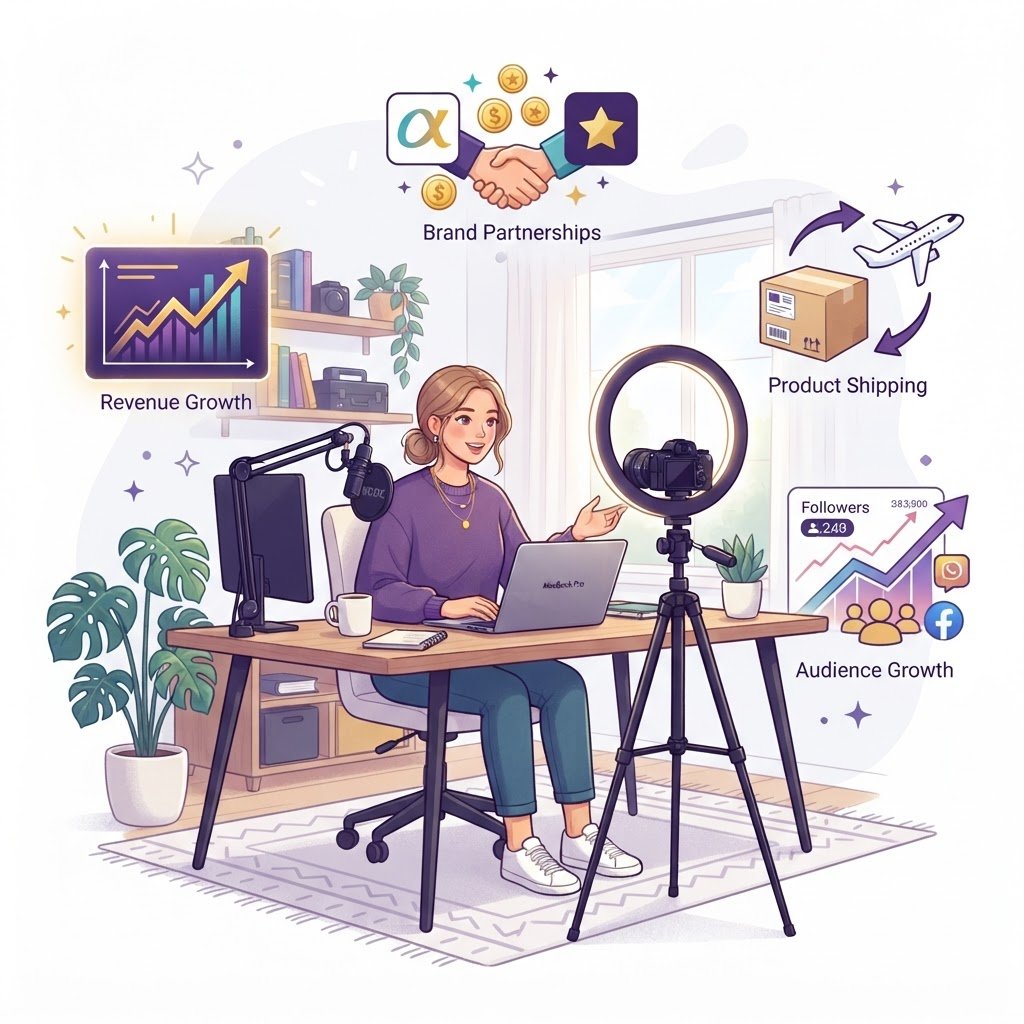
TITLE: The Creator Economy Is Becoming a Real Business Industry
FOCUS_KEYWORD: creator economy business industry
SEO_TITLE: The Creator Economy Is Becoming a Real Business Industry
META_DESCRIPTION: From solo passion projects to structured businesses, the creator economy is maturing into a legitimate industry with real revenue and infrastructure.
CATEGORY: Business
A perspective piece from The Listening Market
A decade ago, the idea of making a living by posting videos, writing newsletters, or sharing photographs online was met with a healthy dose of scepticism. It was seen as a niche pursuit, something a handful of lucky individuals managed to turn into a career while everyone else treated it as a hobby. The term “creator” itself was still new, and the infrastructure to support someone trying to build a business around their content was practically nonexistent. Fast forward to 2026, and the landscape has shifted so fundamentally that the creator economy is no longer a fringe phenomenon. It is a real business industry, complete with revenue models, professional services, and an infrastructure that rivals traditional sectors.
The numbers tell part of the story. According to a report by Goldman Sachs, the creator economy was projected to reach nearly half a trillion dollars by 2027. That projection now looks conservative. The growth has been driven not just by more people creating content but by the maturation of the ecosystem around them. What was once a collection of individuals with cameras and laptops has become a network of small businesses, agencies, and platforms that support content creation as a profession. There are accountants who specialise in creator finances. There are lawyers who draft brand partnership contracts. There are production studios that rent space to creators who need professional environments without the overhead of owning one. The scaffolding is there, and it is sturdy.
Part of what has driven this shift is the diversification of revenue streams. In the early days, creators relied heavily on advertising revenue from platforms. A video had to go viral to generate meaningful income, and the relationship between effort and reward was unpredictable at best. Today, the revenue picture looks completely different. Creators are earning through subscription models, where audiences pay a monthly fee for exclusive content. They are launching their own product lines, from merchandise to skincare to coffee brands. They are licensing their content to media companies. They are earning speaking fees, booking consulting engagements, and building courses that teach others what they have learned. The result is that a creator’s income is no longer tied to the whims of an algorithm. It is diversified, predictable, and in many cases, substantial.
The rise of the newsletter industry is a particularly striking example. Platforms that allow writers to charge subscribers directly have created a category of creators who look more like independent publishers than influencers. These are people who have built audiences around expertise — finance, technology, cooking, politics — and who deliver value through written analysis rather than visual content. Their businesses look remarkably like traditional media companies, except they are often run by a single person with a laptop. Some of the top newsletter creators are generating seven-figure annual revenues with operating costs that would make a traditional publisher weep with envy. The model works because the audience relationship is direct. There is no advertiser intermediary, no algorithm deciding who sees what. The creator owns the relationship with their readers, and that ownership is the foundation of a sustainable business.
Brand partnerships have also evolved significantly. What used to be a transactional exchange — a creator posts about a product in exchange for payment — has become something more strategic. Brands are now entering long-term relationships with creators, treating them as brand ambassadors rather than one-off advertising channels. The contracts are more sophisticated, often including equity stakes, revenue sharing, or co-branded product development. This shift reflects a deeper understanding of what creators actually offer. They are not just distribution channels. They are trusted voices with engaged audiences, and that trust is worth more than a single post. According to Influencer Marketing Hub, brands are expected to spend more than ever on creator partnerships in 2026, with a growing portion of that budget going to long-term collaborations rather than one-off campaigns.
The professionalisation of the creator economy is also visible in how creators are structuring their businesses. Many have moved beyond the solo operator model and are building teams. A successful creator in 2026 might employ a video editor, a social media manager, a business development lead, and a virtual assistant. They are forming LLCs, hiring accountants, and thinking about their businesses the way any entrepreneur would. There are creator-focused business management firms that handle everything from tax planning to contract negotiation, allowing creators to focus on what they do best while ensuring the business side is handled professionally. This is not a hobby any more. It is a business, and it is being run like one.
Education has emerged as a significant sector within the creator economy itself. Creators who have figured out how to grow an audience, monetise content, and build a brand are now teaching others how to do the same. This has created a second layer of the economy — creators teaching creator skills. There are online courses, mentorship programmes, and community platforms dedicated to helping people navigate the business of being a creator. Some of these educational offerings are genuinely valuable, providing practical guidance from people who have done it successfully. Others are less substantive, promising overnight success in exchange for a hefty course fee. The market is sorting itself out, as markets tend to do, but the fact that this educational layer exists at all is further evidence that the creator economy has matured into something with depth and complexity.
The platforms themselves have also evolved. They are no longer just hosting content. They are building tools that help creators run their businesses. Analytics dashboards that once showed basic view counts now provide insights into audience demographics, engagement patterns, and revenue forecasting. E-commerce integrations allow creators to sell products directly from their content. Payment systems have been streamlined so that creators can manage multiple revenue streams from a single dashboard. The platforms have realised that their survival depends on the success of their creators, and they are investing accordingly. This has created a more stable foundation for the industry as a whole.
There are, of course, challenges that come with this maturation. The question of what happens when a creator’s audience moves on is one that every creator business faces eventually. Unlike a traditional company that might have a product line spanning decades, a creator’s product is often their own personality and perspective. Audiences can be fickle, and the cultural relevance that drives engagement today may not last forever. Smart creators are thinking about this and building businesses that can outlast their personal brand. They are launching product lines that exist independently of their content. They are building media companies that can operate with or without their direct involvement. They are thinking about succession in a way that few would have considered a few years ago.
There is also the matter of burnout. The pressure to produce content consistently, to maintain audience engagement, and to keep up with the demands of running a business is intense. The creator economy has created opportunities that did not exist before, but it has also created a work culture that can be relentless. Unlike traditional employment, where there are boundaries between work and personal life, the creator’s work and life are often deeply intertwined. Every experience is potential content. Every moment of downtime is an opportunity to engage with the audience. This is not a sustainable model for everyone, and the industry is starting to acknowledge that. Conversations about mental health, boundaries, and sustainable work practices are becoming more common, and some creators are openly restructuring their businesses to allow for a healthier balance.
The regulatory landscape is another factor that will shape the industry’s future. As the creator economy has grown, it has attracted the attention of regulators who are grappling with questions about advertising disclosure, tax compliance, and consumer protection. The rules are still being written, and how they land will have implications for how creators operate. But regulation is not necessarily a threat. In many cases, it is a sign that an industry has grown large enough to warrant formal oversight, and that oversight can provide legitimacy that benefits the serious players while weeding out the bad actors.
What is perhaps most remarkable about the creator economy’s evolution is how normal it all feels now. Ask a teenager what they want to be when they grow up, and “content creator” is as common an answer as “doctor” or “engineer.” Parents who once worried about their children spending too much time on screens are now watching them build businesses on those same screens. Universities are offering courses in digital media and content strategy. Banks are lending to creators based on their audience metrics and revenue history. The infrastructure, the vocabulary, and the cultural acceptance have all caught up to the reality. The creator economy is no longer an experiment. It is an industry, and it is here to stay.
The implications extend beyond the creators themselves. Traditional media companies are taking note, partnering with creators rather than competing against them. Advertisers are shifting budgets away from traditional channels and toward creator-led content. Even the way products are developed and launched is changing, with creators becoming involved in the design process rather than simply being hired to promote the finished product. The lines between creator, brand, and media company are blurring, and the result is a more integrated, more authentic form of commerce that reflects how people actually discover and engage with the things they buy.
This is not to say that every person who picks up a camera will build a business. The vast majority of creators still operate at a small scale, and that is perfectly fine. Not every creator needs to build an empire. But the fact that the option exists — that someone with a perspective, a skill, and a willingness to work can build something real — that is what makes this moment different. The creator economy has grown up. It has revenue models and business plans and professional services and regulatory scrutiny. It looks, in other words, like a real industry. Because that is exactly what it has become.




