
A perspective piece from The Listening Market
For years, the word holiday carried a specific expectation. It meant going somewhere, doing something, seeing as much as possible before the return flight. Itineraries were packed, schedules were tight, and the measure of a good trip was how much was experienced. Returning home tired was not a sign of failure but of success. The holiday was an achievement, and like all achievements, it required effort.
Something has shifted. Quietly, without fanfare, a different kind of holiday has begun to take hold. Not a holiday of ticking off landmarks or chasing sunsets from precarious viewpoints, but a holiday designed around a single, radical idea: rest. The wellness holiday built around stillness rather than activity is becoming one of the most sought-after travel experiences of the moment, and its rise says something profound about the relationship between modern life and the human need to recover from it.
The Exhaustion That Drove the Change
To understand why rest-focused holidays are growing, it helps to understand what people are resting from. The years since 2020 have been defined by a particular kind of tiredness, not the physical exhaustion of manual labour but the diffuse, persistent fatigue of always being available. Notifications, messages, deadlines, news cycles, the low hum of anxiety that accompanies a world that never seems to slow down. The boundaries between work and rest eroded. The boundary between being awake and being engaged dissolved. Many people arrived at their holidays already depleted and proceeded to fill them with the same intensity that had depleted them.
The realisation that holidays were not restoring people was slow but widely shared. Surveys began to show that a significant portion of travellers returned from their trips feeling more tired than when they left. The standard holiday model, with its emphasis on movement and consumption, was producing the opposite of what it was supposed to produce. Instead of returning recharged, people returned needing another holiday to recover from the one they had just taken.
The wellness holiday designed around rest is a direct response to this. It is not laziness or a lack of curiosity that drives it. It is a clear-eyed recognition that the body and mind have limits, and that those limits have been tested for too long.
What a Rest Holiday Actually Looks Like
The image that comes to mind when hearing the phrase wellness holiday often involves white robes, cucumber water, and a schedule of yoga classes at dawn. Some rest-focused retreats do follow this model. But the new wave of wellness holidays is broader and more varied than the traditional spa resort.
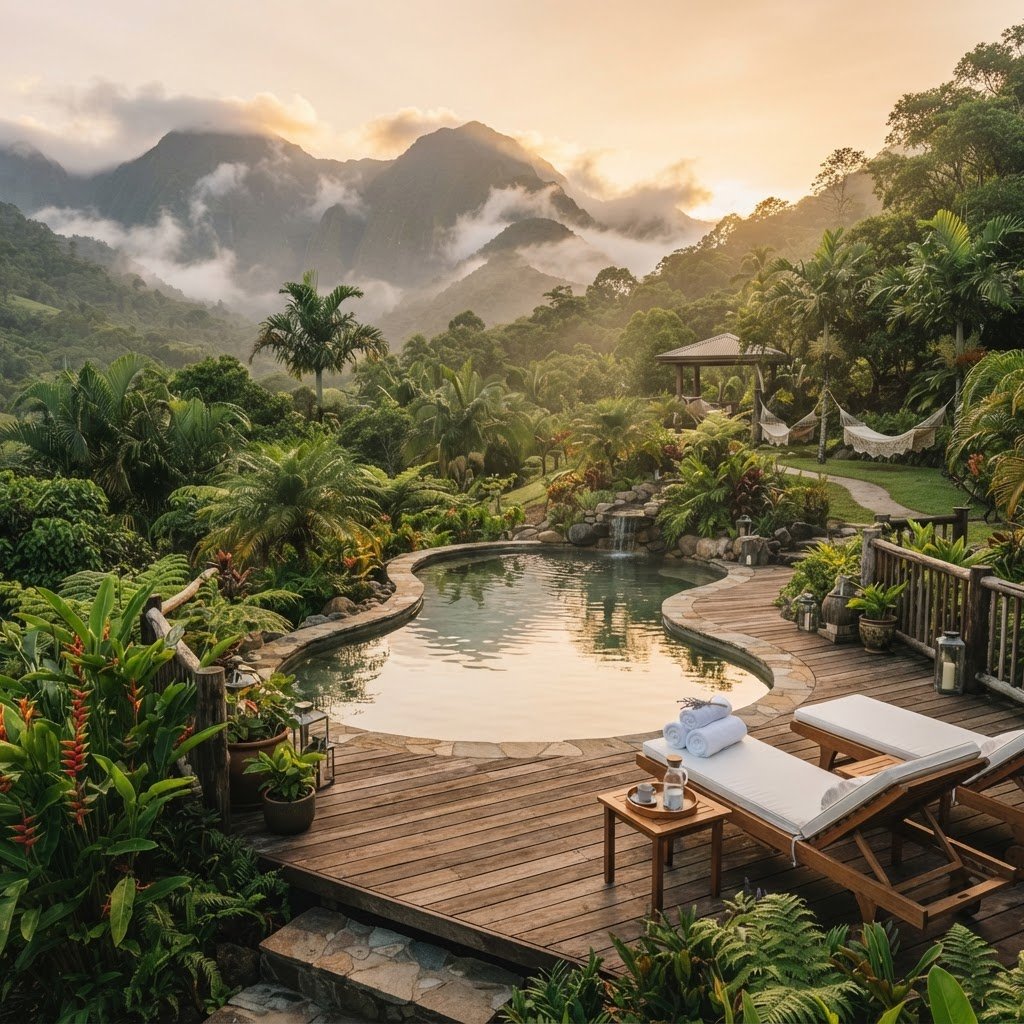
A rest holiday might involve a quiet cabin in the countryside with no agenda beyond walking, reading, and sleeping. It might mean a stay at a retreat centre where phones are surrendered at check-in, meals are communal and unhurried, and the daily schedule consists of little more than meditation, gentle movement, and long stretches of silence. It might be a beachside hotel that has deliberately removed televisions from its rooms and replaced them with bookshelves. It might be a forest lodge where the only activity on offer is the opportunity to do nothing in beautiful surroundings.
The common thread is not a specific activity but the absence of obligation. There is nothing that has to be done. No museum that must be visited, no restaurant that must be booked, no landmark that must be photographed. The holiday is not a list to be completed but a space to be inhabited. The value is in the emptiness, in the deliberate removal of demands.
The Counterintuitive Luxury of Doing Nothing
There is something almost radical about choosing to do nothing on holiday. For a culture that equates value with productivity, the idea of spending money to simply exist feels transgressive. The pressure to justify a holiday with evidence of its worth, photographs, stories, experiences to share, runs deep. A rest holiday produces none of these things. It cannot be easily displayed or quantified. It resists the currency of social proof.
This is precisely its appeal. The rest holiday is a rebellion against the performance of living. It says that not every experience needs to be documented, not every trip needs to produce content, and not every moment needs to be optimised. It treats rest not as the absence of productivity but as a good in itself, something worth protecting and experiencing fully.
The luxury is not in the thread count of the sheets or the quality of the massage. It is in the freedom from expectation. The freedom to wake up without an alarm. To eat when hungry and stop when full. To walk without a destination. To sit and watch the light change across a field without feeling that the time could be better spent. This is a luxury that money can buy, but only if the money is spent on removing things rather than adding them.
The Science of Rest and Recovery
The growing interest in rest-focused holidays is not purely intuitive. There is an expanding body of research on the physiology of stress and recovery that supports what people are increasingly feeling. Chronic stress, the kind produced by constant availability and relentless cognitive demand, affects the body in measurable ways. Cortisol levels remain elevated. Sleep quality deteriorates. Inflammation increases. The immune system weakens. Over time, the body moves from a state of adaptation to a state of depletion.
Recovery from this kind of stress cannot be achieved through a single weekend off. It requires sustained periods of low demand, during which the nervous system can shift from sympathetic activation, the fight-or-flight mode, to parasympathetic dominance, the rest-and-digest mode. This is not something that can be rushed or scheduled into a one-hour spa appointment.
The rest holiday provides the conditions for this shift. The removal of daily stressors, the slowing of pace, the reduction of sensory input, the regular sleep that comes from unstructured days. These are not indulgences. They are the biological prerequisites for genuine recovery. The fact that people are beginning to treat them as essential rather than optional suggests a maturing understanding of what health actually requires.
Who Is Choosing These Holidays and Why
The demographic drawn to rest-focused wellness holidays is broader than might be expected. It is not only the overworked executive or the burnt-out professional, though both are well represented. It includes young people in their twenties who have never known a workplace without digital tethers. Parents who need time away from the relentless demands of family life. Older travellers who have done the itineraries, seen the sights, and are now looking for something different.
What unites them is not age or income but a shared hunger for permission to stop. Permission that, for many, is difficult to grant themselves in daily life. The rest holiday externalises that permission. It places the individual in an environment where stopping is not only allowed but encouraged, where the absence of activity is treated as the point rather than the failure.
The appeal also reflects a shift in how people define a good life. For a long time, the good life was measured by how much was accumulated, experienced, achieved. The rest holiday suggests a different measure: how much space, how much quiet, how much freedom from demand. It is a small but telling indicator that for an increasing number of people, the most valuable thing money can buy is the opportunity to do nothing with it.
The Industry Response
The travel industry has been quick to respond to this demand. Hotels and resorts that once competed on the breadth of their activity programmes are now competing on the depth of their stillness. Retreat centres offering silence, digital detox, and guided rest have multiplied. Booking platforms have added filters for rest-focused and low-activity holidays. Travel agents report that clients increasingly ask not what there is to do at a destination but whether there is anywhere they can simply be.
The response has not been without its contradictions. Some wellness retreats have packaged rest with the same intensity they once applied to adventure, scheduling every minute with meditation sessions, sound baths, and breathwork classes. The result can feel less like rest and more like a different kind of performance. The most successful rest-focused destinations have recognised this tension and responded by offering less, not more. Fewer scheduled activities. Fewer options. More space, more silence, more trust that guests know what they need if given the room to find it.
A Lasting Shift or a Passing Trend
It is tempting to dismiss the rest holiday as a trend, a fashionable response to a temporary cultural mood that will pass when the economy shifts or the next wellness fad arrives. But the forces driving it are not temporary. The conditions that produce chronic stress, constant connectivity, blurred boundaries, the acceleration of daily life, are not receding. If anything, they are intensifying. The need for genuine, sustained recovery is not going to diminish. It is going to grow.
The rest-focused wellness holiday may well become a permanent fixture of the travel landscape, not as a replacement for other kinds of travel but as a recognised and respected category in its own right. A holiday that exists not to escape life but to recover from it. A holiday whose success is measured not by how much was seen but by how restored the traveller feels upon return.
There is a quiet wisdom in this shift. It suggests that people are learning, slowly and in their own ways, that rest is not the reward for work. It is the foundation that makes all work, all experience, all life possible. And that sometimes, the most meaningful thing a person can do with their time away is exactly nothing at all.




