A perspective piece from The Listening Market
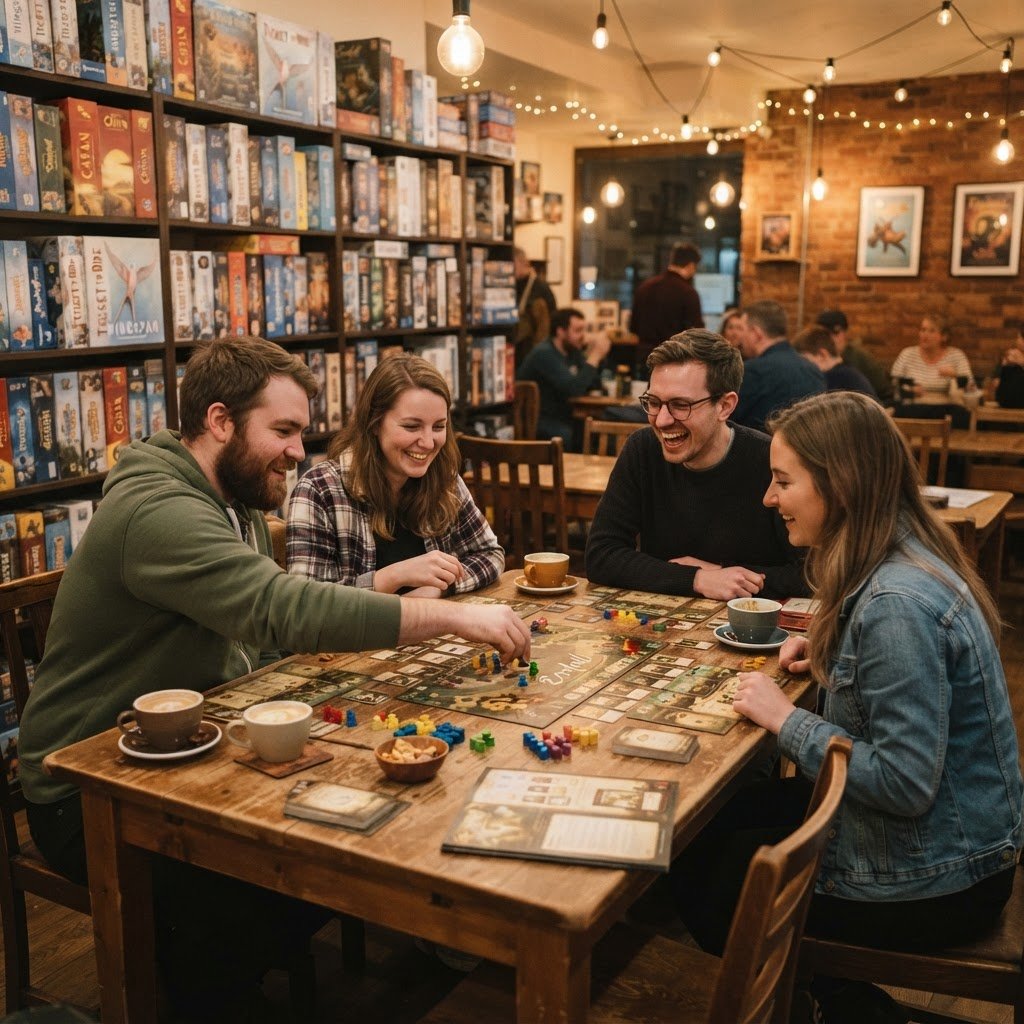
On a Friday night in 2026, a growing number of people are not at a bar, a cinema, or scrolling through a streaming service. They are sitting around a table with friends, rolling dice, drawing cards, and arguing about the rules of a game they just learned. The room is warm, the coffee is good, and nobody is looking at a phone. This is the board game cafe, and it is quietly becoming one of the most popular social destinations of the year.
The rise of board game cafes is not an accident or a fluke. It is the product of several cultural currents that have been building for years and have finally converged into something that feels both novel and necessary. To understand why these spaces are thriving, it helps to look at what they are offering that other forms of social entertainment are not. Because the appeal is not really about the games. The games are the vehicle. The real draw is something more fundamental: a space where people can be fully present with each other, without the mediation of a screen.
The screen problem is at the heart of it. For the better part of two decades, socialising has become increasingly digital. Texts replace phone calls, video calls replace visits, and social media replaces actual social interaction. Even when people gather in person, phones are on the table, notifications interrupt conversations, and attention is divided between the people in the room and the endless feed of the device in everyone’s pocket. The result is a kind of low-grade dissatisfaction, a sense that social interaction has become shallower, more fragmented, and less satisfying. People are not connecting the way they used to, and many of them know it.
Board game cafes offer a solution to this problem that is both simple and effective. When you are playing a board game, you cannot also be scrolling Instagram. The game demands attention. It requires you to look at the person across the table, to listen to what they are saying, to react, to engage. The phone goes in the bag, and for two or three hours, the people in the room are actually present with each other. It sounds simple, almost trivially so, but for a generation raised on digital distraction, the experience of unbroken, focused social interaction has become rare enough to feel almost luxurious.
The cafes themselves have evolved to meet this demand. The early board game cafes were functional but unglamorous: a few shelves of games, some folding tables, and a coffee machine. The new generation is something different entirely. These are designed spaces, with warm lighting, comfortable seating, and atmospheres that feel more like stylish living rooms than game shops. The food and drink offerings have levelled up too. Many board game cafes now serve craft beer, specialty coffee, and proper food menus. They are competing with restaurants and bars on ambiance and quality, and they are winning a share of the market that would have seemed improbable a few years ago.
The social dynamics of board gaming are part of what makes these cafes work so well. Unlike going to a film or a concert, where the activity is passive and the social interaction is limited to before and after, board gaming is inherently social and interactive. Everyone is involved, everyone has a role, and the conversation flows naturally around the game. It is also remarkably good at breaking the ice. There is something about a shared activity with clear rules and a common goal that makes it easier for people to relax and be themselves. People who would never dream of going to a bar alone are perfectly comfortable walking into a board game cafe, joining a table, and meeting new people over a game.
The variety of games available has expanded enormously. The days when board gaming meant Monopoly, Scrabble, or Risk are long gone. The modern board game industry produces hundreds of new titles every year, ranging from quick, casual party games that take fifteen minutes to learn and play, to deep, strategic experiences that can last an entire evening. Board game cafes typically have libraries of hundreds of titles, and staff who can recommend the right game for the right group. This means that whether you are a competitive strategist, a casual socialiser, or someone who has not played a board game since childhood, there is something for you. The accessibility of the experience has been a major factor in its growth.
There is also a generational dimension to this trend that is worth noting. The same younger generations that are driving the resurgence of physical books, vinyl records, and film photography are gravitating toward board games for similar reasons. These are people who have grown up saturated in digital entertainment, and they are actively seeking out analogue experiences. The tactility of physical components, the sound of dice on a table, the satisfaction of placing a tile in exactly the right spot. These sensory details matter in a world where so much entertainment is intangible. Board games offer something that can be touched, held, and shared in a physical space, and that physicality is part of their appeal.
The economics of board game cafes are also interesting. From a business perspective, they benefit from a combination of factors that make them more resilient than many other hospitality ventures. The games themselves are a one-time investment that can be used for years. The food and drink margins are good. And the dwell time, the length of time customers spend in the venue, is significantly longer than a typical cafe or bar. People come for a game and stay for three hours, ordering multiple rounds of drinks and food. The model works, and entrepreneurs are taking notice. New board game cafes are opening in cities and towns that would never have supported one a decade ago.
The competitive aspect of board gaming should not be overlooked either. In a culture that has become uncomfortable with overt competition in social settings, board games offer a safe, structured way to compete. The rules are clear, the stakes are low, and everyone understands that the competition is part of the fun. There is a joy in trying to win, in building a clever strategy, in the dramatic moment when a plan comes together or falls apart. But there is also a joy in losing well, in laughing at your own mistakes, in the shared experience of a game that went in an unexpected direction. Board games create stories, and those stories become the shared memories that bring people back.
The future of board game cafes looks bright. As more people seek out screen-free social experiences, and as the quality of both the games and the venues continues to improve, the trend shows no sign of slowing. Some cafes are expanding into larger spaces, adding event nights, tournaments, and themed evenings. Others are partnering with local businesses to offer combined experiences, like a board game night at a brewery or a pop-up cafe at a community centre. The format is flexible enough to adapt, and the core appeal is strong enough to endure.
In a world where so much of social life has migrated online, the board game cafe represents something quietly radical. It is a space designed for being together, in person, with nothing between you and the people you are with except a table and a game. It is a reminder that the best entertainment does not require a screen, an algorithm, or a subscription. It just requires a few people willing to sit down and play. And in 2026, more people than ever are willing to do exactly that.