A perspective piece from The Listening Market
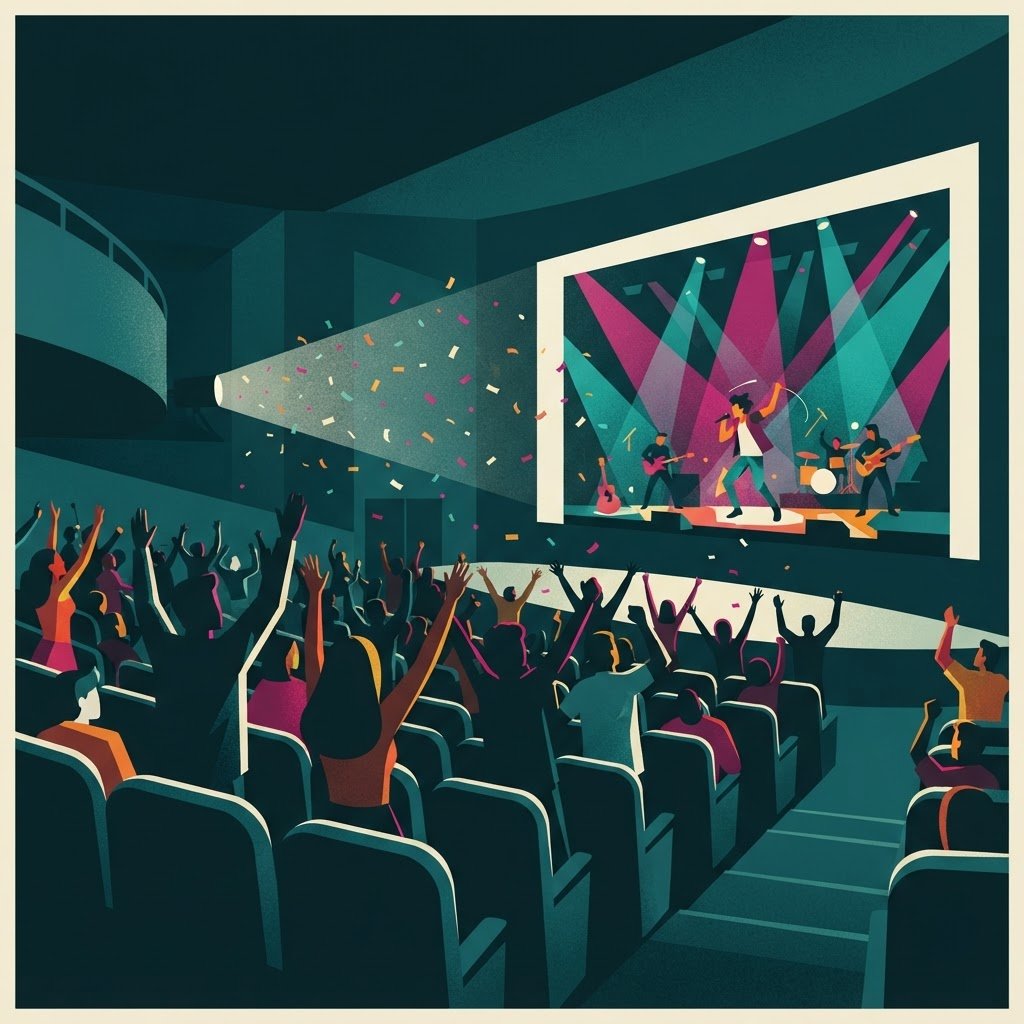
The cinema does not usually smell like a stadium, but on one October night in 2023 it came close. Rows of fans arrived in sequins and friendship bracelets, sang along at full voice, danced in the aisles, and filmed the ceiling when their favourite song began. The film on screen was not a thriller or a franchise sequel. It was a recording of a concert, three hours of a pop tour that most of the audience had failed to get tickets for, priced like a cinema ticket instead of a resale-market mortgage. The screenings sold out in minutes. A format that had spent decades as a quiet corner of the film world suddenly looked like the smartest ticket in town.
Concert films, long treated as archive material for the already-converted, are having a genuine renaissance. The revival has been building for a few years, powered by a handful of record-breaking releases, and it says something interesting about what audiences want from a night out when the night out itself has become complicated.
A format with a long memory
The concert film is older than the music video. From the late 1960s onward, filmmakers repeatedly tried to bottle the live experience, with a handful of titles becoming landmarks. A certain 1984 Talking Heads film, shot over several nights and edited into a joyous, ascending whole, is still studied in film schools as proof that a performance could be directed like a narrative. Documentaries about festivals and touring bands kept the form alive through the decades that followed, and loyal followings always showed up. But commercially, the genre was understood as a niche proposition, a limited-release affair that lived comfortably in art houses and late-night television.
The economics were part of the problem. A concert film demanded the same production effort as a scripted feature without the same broad audience, and its natural lifespan was short: a few screenings, a television sale, then a long tail on home video for the devoted. Distributors saw the math and mostly stayed away.
What changed
Three things rearranged the mathematics almost simultaneously. The first was the scale of modern touring. The biggest tours of this era are cultural events on the order of a World Cup, with ticket demand far exceeding supply. When a tour plays a few dozen stadiums in a continent of millions of fans, the overwhelming majority of the audience will never get inside the venue. That unserved demand is exactly the gap a cinema screening fills, and the tours that tested the idea found that scarcity in the arena translated into abundance in the cinema.
The second change was the event-cinema infrastructure itself. Venues had spent years building the muscle for live broadcasts of opera, theatre, and sport, complete with premium ticketing and singalong etiquette. Concert films slotted into machinery that already knew how to make a screening feel like an occasion rather than a viewing. Add the modern premium screen, with sound systems that genuinely rival what a stadium delivers to its worst seats, and the proposition became compelling: a better view than most people could ever buy, at a fraction of the price.
The third change was social. The modern fan culture that fills arenas is fluent in collective participation, from choreographed chants to dress codes. A cinema screening could never replicate a mosh pit, but it could offer the other half of the live experience: being in a room with thousands of people who love the same thing. Audiences who came expecting to sit quietly discovered instead that they were allowed to sing, and the screenings became events in their own right, generating their own social media afterlife.
Why the industry noticed
The headline numbers did the arguing. A handful of these films opened to figures that rivaled mid-budget Hollywood releases, on production budgets a fraction of the size, and their legs proved the demand was not a novelty spike. The calculus was attractive in other ways too. A concert film serves the artist’s ecosystem without cannibalising it: it advertises the tour, feeds merchandise sales, and extends the life of a show that would otherwise evaporate when the road ended. For cinemas, hungry for reliable content in a squeezed decade, the genre delivered something rare, a repeatable event that sold premium seats and filled weekday nights.
The trend has since widened beyond the biggest pop stars on the planet. Legacy acts have brought restored classics back to cinemas and found new generations waiting. Independent and older artists have used theatrical screenings to reach cities their tours never visit. Filmmakers, meanwhile, have remembered that the genre allows formal ambition, that a concert can be shot with the care of a feature and cut with the rhythm of the music itself, and a new wave of directors has begun treating performance cinema as a craft worth reinventing rather than a product to be point-and-shooted.
A second life after the credits
The renaissance does not end at the cinema exit. Streaming platforms, hungry for exclusive content that does not require a production army, have become enthusiastic buyers of performance films, and a theatrical run now functions as the opening act of a long digital afterlife. An artist’s catalogue gains a durable artefact: a document of the tour, the costumes, the arrangements, the crowd, preserved at a quality that fan-shot phone clips can never approach. For acts whose audiences are scattered across continents, the film reaches markets the tour skipped, and the filmed show becomes an entry point for new listeners rather than merely a souvenir for existing ones.
The wave has also widened in genre and geography. Global pop acts from Asia and Latin America have taken their films to the international box office and found audiences that traditional distribution had long underestimated. Orchestras, opera productions, and even long-running residencies have borrowed the playbook, discovering that a well-shot performance travels further than the venue’s capacity. What began as a handful of pop superstars testing an idea has become a genuine category, one that the industry now plans for from the first day of tour rehearsals rather than discovering accidentally at the editing desk.
The honest limits
The renaissance has boundaries worth naming. A recording is not a substitute for presence, and no one in the industry pretends otherwise; the films work best as companions to touring, not replacements for it. The genre also leans on the strength of the act being filmed, since a great concert film is still mostly a great concert, and weaker shows do not become better in a larger format. There is a risk of overharvesting, too. If every tour automatically spawns a film, the occasion shrinks, and what currently feels special could settle into routine.
But those are the worries of an industry that has suddenly found a working formula, and the formula is working precisely because it respects what audiences actually missed. The big-screen concert does not sell the music so much as the room: the shared gasp at the opening notes, the ache of the slow song, the strange collective permission to feel things loudly in public for a few hours.
Two hours of volume
The renaissance of the concert film is really a story about the resilience of the communal experience. In an era when almost every form of entertainment can be consumed alone on a phone, the genre quietly insists that some content belongs to crowds, and crowds keep proving the point by arriving in costume. The cinema was told for years that it could only survive on spectacle it alone could deliver. It turns out that a rock show, a symphony of light and volume and a few thousand hearts, counts.
The next time a cinema lobby fills with fans dressed for a venue that does not exist past the auditorium doors, it will be tempting to call the scene odd. It would be more accurate to call it the new normal. The concert film did not come back because the industry missed it. It came back because, under the right conditions, a recording of a crowd singing in one city can become the sound of crowds singing in a thousand others, and that is a kind of live music after all.