A perspective piece from The Listening Market
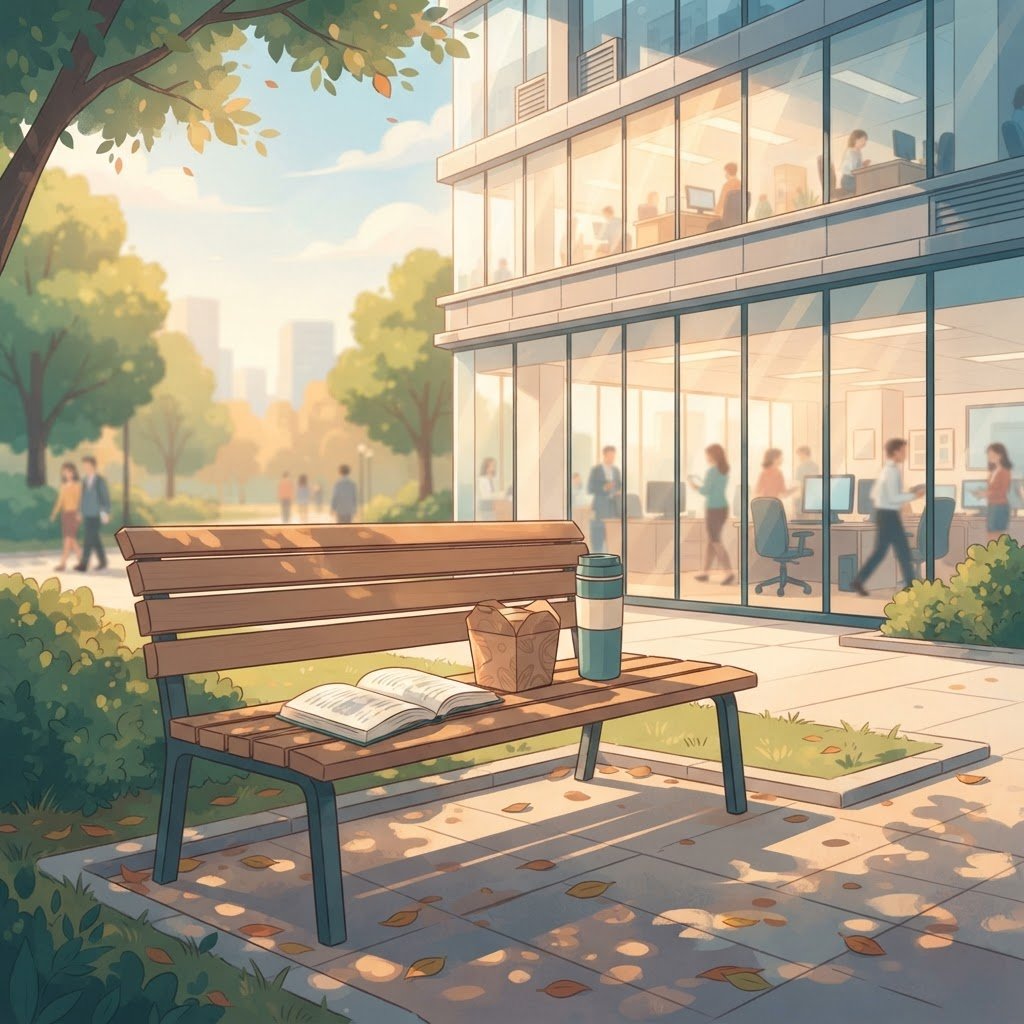
At half past twelve on a Tuesday, the office kitchen is empty. The microwaves sit cold, the long table that was bought to encourage people to linger has a single coffee cup on it, and the fridge door opens and closes with the hurried rhythm of someone grabbing a container to carry back to a desk. Upstairs, on a video call that was scheduled over the lunch hour without anyone objecting, a sandwich is eaten off-camera between muted microphones. This is the modern lunch break: technically occurring, practically extinct.
The disappearance of the midday pause is one of those cultural shifts that happened without anyone voting for it. No executive ever announced that lunch was cancelled. No policy was rewritten. Yet across offices, home desks, and hybrid schedules, the proper lunch break has been thinning out for years, replaced by crumbs of eating wedged between meetings, and the costs of that erosion are only now being counted.
How the break got eaten
The lunch break was never just about food. In the decades when it was protected, it functioned as a daily seam in the workday, a point where the rhythm changed, the room changed, and the mind was allowed to idle. People walked, gossiped, ran errands, or simply sat somewhere that was not a desk. The break was unproductive by design, and that was its entire value.
Several forces conspired against it. The first was the meeting creep, the slow tendency of calendars to fill every gap that did not have a formal occupant. Calendar software made it effortless to schedule across the noon hour, and socially it became awkward to object, since declining a meeting over lunch began to look like an eccentricity rather than a boundary. The second force was the inbox economy, in which a working lunch at the desk came to signal commitment. Somewhere along the way, eating a proper meal away from the screen started to read as a lack of seriousness, a distortion that rewarded the appearance of effort over the substance of it.
Then came the remote and hybrid years, which dissolved the physical cues that once enforced the pause. When the kitchen is eight steps from the desk and the desk is inside the home, the boundary between working time and eating time becomes a matter of pure willpower, and willpower tends to lose to the next notification. Many people discovered that their lunch had become a bag of crisps scrolled alongside a spreadsheet, taken at the same chair, in the same posture, with the same screen an arm’s length away.
What the research keeps finding
The irony is that the workday sacrificed to productivity is measurably less productive. Studies on attention have shown for years that the human mind does not sustain deep focus for unbroken stretches, and that detaching from a task, genuinely detaching, not switching to a different screen, is what restores it. Lunch eaten at the desk produces the illusion of continuity while the quality of thinking quietly degrades across the afternoon. The afternoon slump that many try to fix with caffeine is, in part, a debt incurred at noon.
The physiological ledger is just as damning. Eating while working tends to mean eating faster and with less attention, which is associated with poorer digestion and less satisfaction from the same food. Staying seated and mentally clenched through the noon hour removes the most natural movement window in the day, the walk to the shop or the stroll that people who commute by car used to at least get incidentally. The break was doing quiet health work all along, and its disappearance has removed it silently.
The push to take it back
The response is beginning to take shape in several places at once. Some countries have treated the break as a matter of law rather than custom. In Spain, workers have long had a right to a midday pause, and France’s landmark right-to-disconnect legislation, alongside explicit protections on breaks, has made the always-on lunch-at-desk posture a legal risk rather than a badge of honour. Elsewhere, the change is being driven from below by employees who emerged from the remote years with a clarified sense of what they will and will not trade away, and who increasingly treat a real lunch break as part of the wage.
Companies, in turn, have started to notice that break culture is cheap to fix and surprisingly visible. Some have gone as far as closing meeting rooms during the noon hour, a policy that sounds radical until it is tried, at which point it mostly reveals how many of those midday meetings never needed to exist. Others have reopened kitchens and cafeterias with the deliberate intention of creating a place worth walking to, recognising that a break will not survive on willpower alone but flourishes when the environment carries some of the weight. The most effective intervention remains the oldest one: leaders who visibly leave their desks to eat, since no amount of wellness signage survives a manager who schedules one-to-ones through the noon hour.
For individuals, the recovery rarely requires a manifesto. It usually begins with treating the break as an appointment with a start and an end, defended the way any important meeting is defended. It means physically leaving the desk if the day allows it, or at least the room, and letting the mind drift rather than shovel more input into it. The people who rebuild the habit often describe the same discovery: the work was not actually helped by being welded to, and the afternoon pays back the stolen hour with interest.
Around the world, a different clock
The desk lunch is not a universal law; it is a local habit wearing the costume of necessity. In parts of Europe and Latin America, the midday break remains a genuine institution, with offices that empty for a proper meal and restaurants that build their entire business model on the noon rush. In Greece and Italy, the afternoon pause survived modernisation rather than being rediscovered through wellness research. In Japan, where the working day has its own intensity, lunch remains one of the few socially protected hours. The contrast is instructive, because it shows that the disappearing break is not an inevitable consequence of modern work but a choice that some cultures never made and see no reason to start making.
An economy has grown around the break’s absence, which helps explain its persistence. The meal-deal fridge, the delivery apps built for desks, the protein bars marketed as lunch replacements: entire product lines have been optimised for the eating-at-the-computer occasion, making the compressed lunch feel not only normal but supported. The infrastructure of the proper break, the affordable cafés near offices, the staffed kitchens, the nearby parks worth walking to, withered in many places precisely as demand retreated. Rebuilding the habit means rebuilding some of that landscape too, and the employers and city planners doing so are finding the appetite was never actually gone, merely unfed.
A small ceremony worth keeping
There is something almost ceremonial about a proper lunch, and the ceremony is the point. It marks the day’s halfway point, gives the morning a finishing line and the afternoon a fresh start, and for most of working history it did this without anyone needing to justify it with studies. The break survived for so long because it made intuitive sense to bodies and communities, long before it made sense in productivity data.
The lunch break will not be rescued by nostalgia, and it does not need to be. It needs only to be recognised for what it is: one of the last unclaimed hours of the day, currently being consumed by meetings and guilt. Taking it back is not a retreat from ambition. It may be one of the few remaining productivity hacks that is also a pleasure, which is a rare enough combination to be worth guarding with a calendar invite and a closed laptop.