
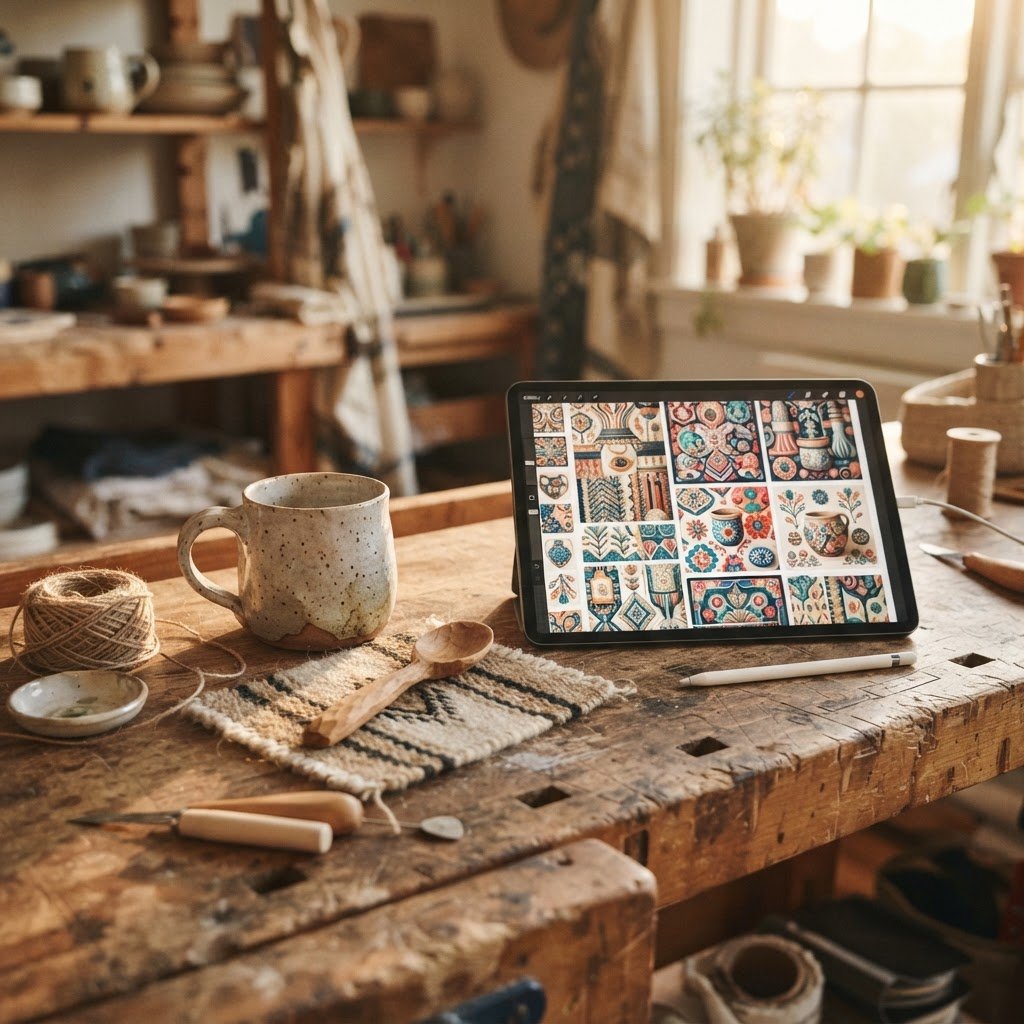
A perspective piece from The Listening Market
There is a particular kind of silence in a workshop where someone is making something by hand. The rasp of sandpaper, the hiss of a plane, the quiet tap of a joiner setting a chisel. These sounds have been with humans for thousands of years, and in 2026, they carry a weight they did not carry a decade ago. Not nostalgia, exactly, but something more grounded. Proof that a person was here.
The assumption, a few years ago, was that artificial intelligence would first replace repetitive labour and then, gradually, white-collar work. What has happened is stranger and more interesting than that. AI has been remarkably good at generating text, images, music, and code, things once thought to require human creativity. But its very competence has reframed what people value. When a polished essay or a professional illustration can be produced in seconds by a machine, the thing that becomes scarce and meaningful is the unmistakable trace of a human hand and a human decision.
This is not a philosophical point. It is showing up in markets, in prices, and in behaviour.
The Saturation Effect
Digital spaces are now flooded with AI-generated content. Product descriptions, blog posts, social media captions, even photographs and illustrations arrive in quantities no human team could match. The initial novelty has worn off. People are developing an instinct, not always conscious, for recognising the sheen of machine-generated work. It is smooth, competent, and oddly forgettable. When everything sounds the same, the thing that sounds different stands out.
This saturation is creating a counter-movement. Consumers are searching for markers of authenticity. They want to know who made something, where it came from, and whether a real person touched it. A ceramic mug thrown on a wheel, with slight asymmetry and a finger mark in the glaze, tells a story. A factory-perfect mug, or an AI-designed one, does not.
Provenance as Premium
The word provenance, once the domain of art dealers and wine collectors, is entering everyday commerce. Small makers are finding that buyers will pay significantly more when they can see the process, meet the maker, or even visit the studio. A loaf of bread baked by a named baker in a visible oven carries information. It carries human intent. That information has value, and people are willing to pay for it.
This extends beyond food and craft. Independent clothing brands that document their supply chains, furniture makers who sign their work, and even software developers who write in a recognisable personal voice are finding that transparency is not just ethical, it is commercially powerful. In a world of anonymous, machine-produced plenty, knowing the origin of a thing has become a luxury.
The Imperfection Premium
There is a particular irony at work. For decades, consumers sought perfection, uniform products free from blemish or variation. Mass production delivered this, and it was valued. But when a machine can generate something flawless every time, imperfection becomes the signature of humanity. The slightly uneven row of stitching on a hand-bound notebook, the natural variation in a block-printed textile, the unpredictability of a wood grain, these are not flaws to be corrected. They are evidence of a person.
Makers who once apologised for inconsistency are now charging for it. The story of how each piece came to be, the hours spent, the decisions made, the moments of doubt or discovery, is part of what the customer buys. The product is not just an object but a trace of attention, and attention is what machines simulate but do not truly have.
How Markets Are Responding
Artisanal markets have seen a resurgence, but not in the way seen in earlier decades. They are no longer a weekend hobby scene. They are serious commercial spaces where makers earn living wages. Craft fairs, independent online marketplaces, and neighbourhood studios have professionalized. Customer expectations are higher. The quality is higher. And the prices reflect a growing understanding that human-made means scarce.
Mainstream retailers are noticing too. Several have begun introducing human-made lines or highlighting the makers behind their products. The implication is telling. They have access to cheaper, machine-produced goods than ever before, and yet they are choosing to stock and promote the more expensive, human-made alternative because that is what customers are drawn to.
The Deeper Signal
What is happening beneath the surface is a renegotiation of value. For a long time, the cheapest, most efficient version of a product was assumed to be the rational choice. Efficiency was king. But efficiency, as it turns out, is exactly what AI is best at. When everything can be made cheaper and faster by machines, cost and speed stop being differentiators. They become baseline expectations.
What rises above that baseline is meaning. A gift made by hand tells the recipient something. A painting created over weeks by a person who could have generated something similar in minutes tells a viewer something. The labour itself, the time and care, is the message. This is why handmade gifts feel different from bought ones, and why commissioned art still carries weight in an age of infinite digital images.
A Reckoning for Authenticity
There is a shadow side to all of this. As the value of human-made rises, the incentive to fake it does too. Products stamped with handmade labels that were actually factory-produced. AI-generated art presented as original human work. Content written by machines and sold as personal essays. The market is still early in developing the tools to distinguish genuine human creation from convincing imitation. But the desire for that distinction is growing, and where demand grows, systems eventually follow.
Certification systems, maker directories, and transparent supply chains are beginning to appear. Some are formal, others are simply the social reputation of a maker who films their process and lets customers visit their studio. The point is not to police authenticity but to make it visible, because visible authenticity is now worth money.
What This Means Going Forward
The most likely future is not one where machines replace all human making, nor one where handmade goods take over the market. It is a split. Machine-produced goods will dominate the cheap, functional, and abundant end of the spectrum. Human-made will dominate the meaningful, the gifted, the collected, and the personal. The two will coexist, but they will serve different purposes.
For makers, this is not a threat. It is a clarification. The rise of AI has drawn a line that was always blurred. When everything could be mass-produced, the handmade was simply an alternative, often an inferior one for practical purposes. Now that everything can also be machine-generated, the handmade is something else entirely. It is proof of presence. It is evidence that a person chose, shaped, and finished something because they believed it mattered.
In a world where machines can make almost anything, the things that a person decided to make, and the visible traces of that decision, are becoming some of the most valuable objects in the room.




