TITLE: Why More People Are Choosing Smaller Living Spaces on Purpose
FOCUS_KEYWORD: smaller living spaces on purpose
SEO_TITLE: Why More People Are Choosing Smaller Living Spaces on Purpose
META_DESCRIPTION: Across cities and suburbs, people are deliberately choosing smaller homes. The reasons go far beyond affordability.
CATEGORY: Insights
A perspective piece from The Listening Market
For most of modern history, the size of a home has been treated as a direct measure of success. A bigger house meant a better life. More square footage was more room for happiness, more wall space for identity, more closets for the accumulation of things that presumably made life richer. The cultural script was clear and largely unquestioned. People worked hard, earned more, and bought larger homes as a reward. The dream was a house with rooms that were rarely entered and a yard that required weekends to maintain. For a long time, this made sense to enough people that entire suburbs were built around the premise. But something has shifted, and it has shifted quietly enough that many people have not fully registered what is happening.
More people are choosing smaller living spaces, and they are doing it on purpose. This is not a story about being priced out of larger homes, though affordability is certainly part of the context. It is a story about people who could afford more space deciding that they do not want it. The motivations are varied, personal, and surprisingly consistent across different age groups and income levels. What is emerging is not a trend driven by necessity but a preference driven by a reevaluation of what a home is actually for.
The most obvious factor is the cost, and it would be dishonest to pretend otherwise. The financial reality of maintaining a large home has become increasingly difficult to ignore. Mortgage payments are only the beginning. There are property taxes that scale with square footage. Heating and cooling costs that rise with every additional room. Insurance premiums that climb with value. Maintenance that never ends, from roof repairs to gutter cleaning to the slow, inevitable decay of materials exposed to weather and time. When someone sits down and calculates the true cost of a large home, the number is often staggering. And the question that follows is simple: what is all that space actually providing in return?
For an increasing number of people, the answer is: not much. The spare bedroom that gets used twice a year for guests. The formal dining room that hosts dinner parties that never happen. The home gym that becomes a storage room within six months. These spaces exist in millions of homes across the country, maintained at significant cost, serving no regular purpose. They are artifacts of a template for living that was inherited rather than chosen. When people start questioning that template, the large home begins to look less like an asset and more like a burden. The smaller home, by contrast, begins to look like freedom.
Freedom is the word that comes up most often in conversations about this shift. Not freedom in the abstract, but a very specific kind of freedom that comes from having less to maintain. A smaller home takes less time to clean. Less money to heat and cool. Less energy to keep organised. Every room is used regularly, which means every room earns its keep. There is no dead space, no room that exists purely because the floor plan included it. The home becomes a tool that is precisely suited to its purpose rather than a sprawling monument to a life that is not actually being lived.
The environmental dimension of this choice is also significant, and it is becoming more explicit. A smaller home has a smaller carbon footprint. This is not a complicated equation. Less space means less energy consumption, fewer building materials, and less land devoted to residential development. For people who are thinking seriously about their environmental impact, downsizing is one of the most effective individual actions available. It is more impactful than buying a more efficient car or installing solar panels, though those things matter too. The reason is simple: the home is where most of a person’s energy consumption happens. Reducing the size of that home reduces the baseline from which all other consumption is calculated. According to research from the University of Michigan, smaller homes can reduce household energy consumption by up to 40% compared to average-sized homes.
There is also a psychological dimension that is harder to quantify but no less real. Large spaces can create a subtle but persistent sense of unease. Rooms that are empty feel expectant, as though they are waiting to be filled. Closets that are half-full invite accumulation. Space, it turns out, does not just hold things. It creates a pull toward more. A smaller home resists this pull by default. When storage is limited, purchasing decisions become more intentional. When rooms are multifunctional, they tend to be used more thoughtfully. The constraints of a smaller space, rather than feeling restrictive, can feel liberating. They impose a discipline that many people find relieving rather than confining.
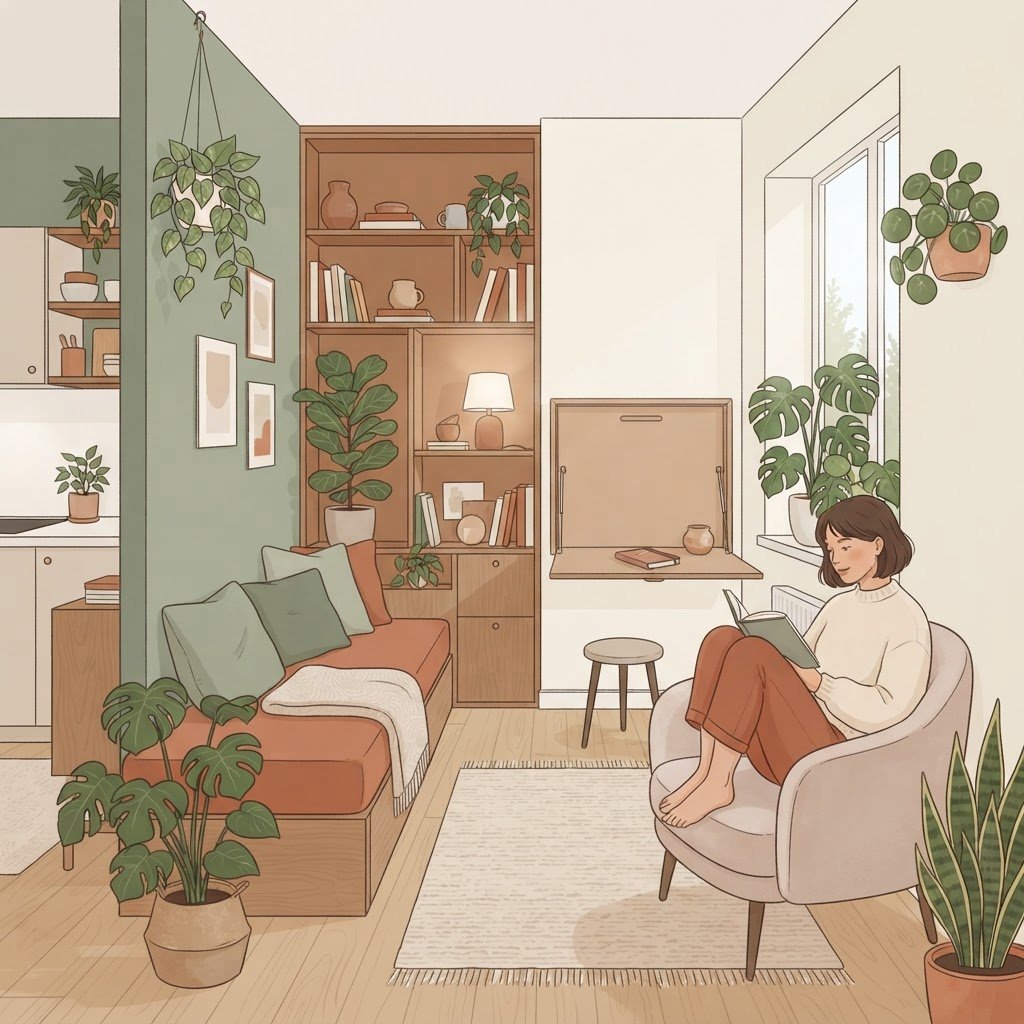
The rise of remote work has played an interesting role in this shift. When people began working from home en masse, the initial instinct for many was to create dedicated home offices. This drove demand for larger spaces, at least temporarily. But over time, something changed. People realised that a dedicated office was not always necessary. A desk in a corner, a fold-down table, a chair that could be tucked away at the end of the day — these solutions worked just as well for many people. The realisation that a workspace did not require a dedicated room opened up new possibilities for living in less space. If the office could be a corner of the living room, then the living room did not need to be separate from the office, and the home did not need to be as large as the old model suggested.
The demographic picture is also worth considering. Younger adults, many of whom have been priced out of the housing market entirely, are approaching the question of home size with a different set of assumptions. They have grown up in a world where homeownership is less attainable than it was for previous generations, and they have adapted accordingly. For some, smaller living is simply what is available. But even among those who can afford more, there is a noticeable lack of enthusiasm for the large suburban home that defined their parents’ generation. The appeal of walkable neighbourhoods, proximity to amenities, and a lower maintenance burden often outweighs the appeal of square footage. This is not a compromise. It is a preference, and it is reshaping what the housing market looks like.
Older adults are also part of this story. Empty nesters who no longer need five bedrooms for two people are increasingly choosing to downsize, sometimes dramatically. The appeal is practical — less maintenance, lower costs, fewer stairs — but it is also emotional. A smaller home can feel more manageable at a stage of life when energy and mobility are considerations. It can also feel more connected. Smaller homes tend to be closer to town centres, which means easier access to community, services, and social life. For people who have spent decades in a car-dependent suburb, the shift to a smaller home in a more connected location can feel like a homecoming rather than a retreat.
The design world has responded to this shift in interesting ways. Furniture that is modular, multi-functional, and proportioned for smaller spaces has moved from niche to mainstream. Storage solutions that maximise every cubic metre have become a category unto themselves. Architects and builders are designing homes that feel spacious despite being small, using high ceilings, natural light, and open floor plans to create a sense of airiness that defies the square footage. The best small homes do not feel small. They feel considered. Every element has been chosen with intention, and the result is a space that supports the life of its occupant rather than demanding attention and maintenance.
There is a risk in romanticising small living. It is not universally wonderful. For families with children, space matters in ways that are not just about storage. Kids need room to play, to have privacy, to spread out. A cramped home can create tension, and the reality of sharing close quarters with multiple people is not always the idyllic, closeness-building experience that enthusiasts describe. There are also accessibility considerations. Not all small spaces are well-designed, and a poorly designed small home can feel claustrophobic and dysfunctional. The choice to live small, like any housing choice, depends on the specific needs and circumstances of the people involved.
But what is undeniable is that the default assumption — bigger is better — is no longer going unchallenged. People are asking questions that previous generations did not ask. What is the space for? What is it costing, not just in money but in time and energy? What could be done with the resources that a larger home would consume? These are not questions of deprivation. They are questions of intention. And the answers, for a growing number of people, point toward less space rather than more.
The most telling sign of this shift is not the number of people who have already downsized. It is the number of people who are thinking about it. The idea that a smaller home could be a deliberate choice, made from a position of agency rather than constraint, has entered the mainstream. It is discussed at dinner tables, explored on social media, and reflected in the types of homes that builders are choosing to construct. The cultural script is being rewritten, and the new version does not measure success in square feet. It measures it in something more elusive and more personal: a sense that the space someone lives in is the right space for the life they are actually living. That, more than any square footage, is what a home is supposed to provide.