
A perspective piece from The Listening Market
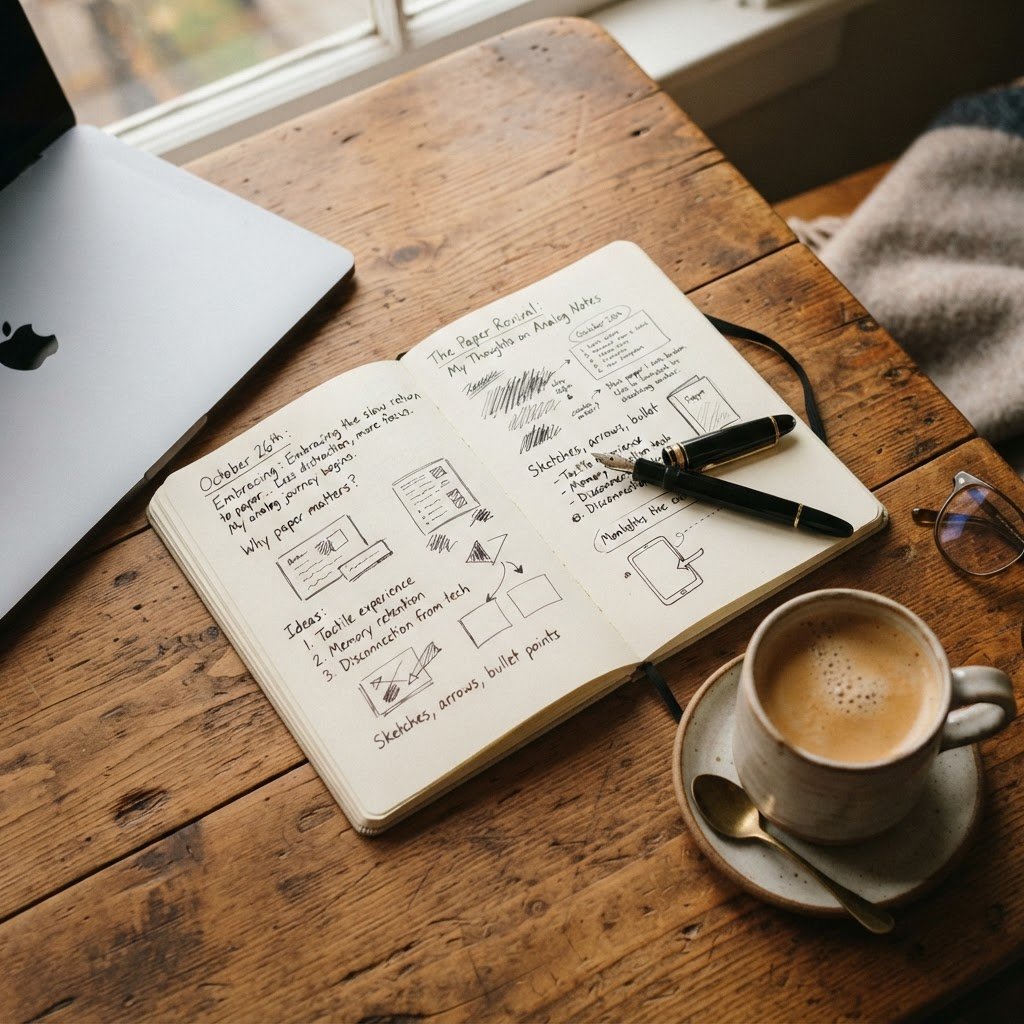
The digital planner was supposed to be the future. It synced across devices. It reminded you of meetings. It colour-coded your week and archived your past with a search function that could find a note from three years ago in under a second. By every measurable standard, it was superior to a paper notebook. And yet, paper notebooks are selling again, and in some categories, they are outselling their digital counterparts.
This is not nostalgia. The people buying notebooks are not the same people who romanticise typewriters or vinyl records, at least not entirely. They are knowledge workers, students, entrepreneurs, and creatives who have tried the digital tools and come back to paper with a specific intent. The return is not about rejecting technology. It is about recognising that different tools serve different purposes, and some purposes are better served by something that does not beep.
The limits of infinite possibility
Digital planners can do almost anything, and that is precisely the problem. When a tool can organise tasks in seventeen ways, display them in four views, and integrate with six other apps, the effort required to configure and maintain the system can exceed the effort it was supposed to save. The tool becomes a project in itself, and the project is never finished because there is always another setting to adjust, another integration to enable, another way to arrange the same information.
Paper notebooks have no settings. They cannot be reconfigured. The structure is whatever the user draws on the page, and once it is drawn, it stays. This inflexibility, which sounds like a limitation, is actually the source of their appeal. A notebook does not tempt its owner into spending twenty minutes choosing between a list view and a board view. It simply holds whatever is written in it, and it does so without demanding any further attention.
The psychological term for this is constraint satisfaction. When the options are limited, the mind adapts to the constraints and gets on with the work. When the options are unlimited, the mind loops, optimising the system instead of using it. Many people who returned to paper did so after realising they had spent more time managing their productivity system than being productive.
What handwriting does to the brain
There is a growing body of research suggesting that handwriting engages different cognitive processes than typing. The act of forming letters by hand requires a level of motor coordination and spatial awareness that typing does not. This additional cognitive engagement appears to improve memory retention and conceptual understanding, at least in the contexts that have been studied, which include lecture note-taking and language learning.
The mechanism is not fully understood, but the general hypothesis is that the slower, more deliberate process of handwriting forces the brain to process information more deeply. When typing, it is possible to transcribe speech nearly verbatim without engaging with the content. When writing by hand, the speed limitation forces selection and summarisation, which requires comprehension. The notebook, in this sense, is not just a storage medium. It is a thinking tool that works because of, not despite, its constraints.
This has practical implications. People who take meeting notes by hand tend to remember the content of the meeting better than those who type, even if the typed notes are more complete. Students who study from handwritten notes often perform better on conceptual questions than those who study from typed notes. The notebook is doing something the laptop cannot, and the something is related to how the brain processes information when the hand is involved.
The absence of notifications
A paper notebook has never sent a notification, and it never will. It does not vibrate, flash, or display a red badge demanding attention. When it is closed, it is closed. There is no ambient awareness of unread items, pending tasks, or incoming messages. The notebook sits there, inert, until someone picks it up and opens it.
This absence is not merely a nice feature. It is the foundation of a different relationship with work. When a task list lives in a phone app, it shares space with everything else the phone does. Checking a task means unlocking the phone, which means seeing the home screen, which means seeing the icons for email and messages and social media, each one a potential interruption. The notebook has no such side effects. Opening it leads to one place and one place only.
The cost of digital context switching has been documented extensively. Every time attention shifts from one app to another, there is a residual cognitive penalty that lasts several seconds, sometimes longer. Over the course of a day, these penalties accumulate. A notebook, by virtue of being a single-purpose object, eliminates an entire category of context switching. It does one thing, and it does it without competing for attention.
The tangibility of progress
There is something satisfying about a notebook that fills up. The pages accumulate. The spine thickens. The weight in the hand increases. When a notebook is finished, it is a physical object that represents a period of work, a record of thought that can be held and shelved. A digital planner that has been used for six months looks exactly the same as one that has just been installed.
This tangibility matters more than it might seem. Progress is easier to feel when it has a physical form. A stack of completed notebooks on a shelf is a visible record of effort that does not require opening an app to confirm. The absence of this physical evidence is one of the quiet disadvantages of digital tools. They are efficient, but they are also invisible, and for some people, that invisibility makes the work feel less real.
There is also a permanence to paper that digital formats cannot quite match. A notebook written five years ago can be opened and read without compatibility concerns. The ink has not been corrupted by a software update. The pages have not been accidentally deleted by a sync error. The notebook is a stable record, and stability has a value that is easy to overlook until it is lost.
The hybrid approach
What has emerged is not a wholesale rejection of digital tools but a more thoughtful division of labour. Many people now use both, with each medium handling what it does best. Digital calendars handle scheduling and reminders, because they are shared, synchronised, and can send alerts. Digital tools handle collaborative work, because multiple people need access to the same information in real time.
Notebooks handle the rest. Thinking, planning, brainstorming, meeting notes, daily task lists, journaling. The work that is private, that benefits from slowness, and that does not need to be searchable because it is meant to be processed, not stored. The notebook is for the thinking part. The digital tool is for the coordination part. Together, they form a system that is more effective than either one alone.
This hybrid approach is pragmatic rather than ideological. It does not require a commitment to minimalism or a distrust of technology. It requires only the recognition that the best tool for a task is the one that helps complete the task with the least overhead, and that for certain kinds of thinking, paper has properties that digital cannot replicate.
Why the notebook will survive
The notebook has survived every technological revolution that was supposed to make it obsolete. The personal computer did not kill it. The smartphone did not kill it. The tablet, designed specifically to replicate the experience of writing on paper, did not kill it. Each wave of technology was supposed to offer a superior alternative, and each time, the notebook persisted.
The reason is not sentimentality. The notebook persists because it does something that nothing else does. It provides a surface for thinking that is free from the demands and distractions of networked life. It works without batteries, without updates, and without accounts. It does not track usage, collect data, or serve advertisements. It is a private space in an era when privacy has become scarce.
The people buying notebooks in 2026 are not rejecting the future. They are choosing a tool that fits a need, and the need is older than any technology. It is the need to think clearly, to record thoughts before they disappear, and to do so in a way that engages the hand and the mind together. The notebook does this simply and reliably, and it turns out that simple and reliable are qualities worth paying for.




