A perspective piece from The Listening Market
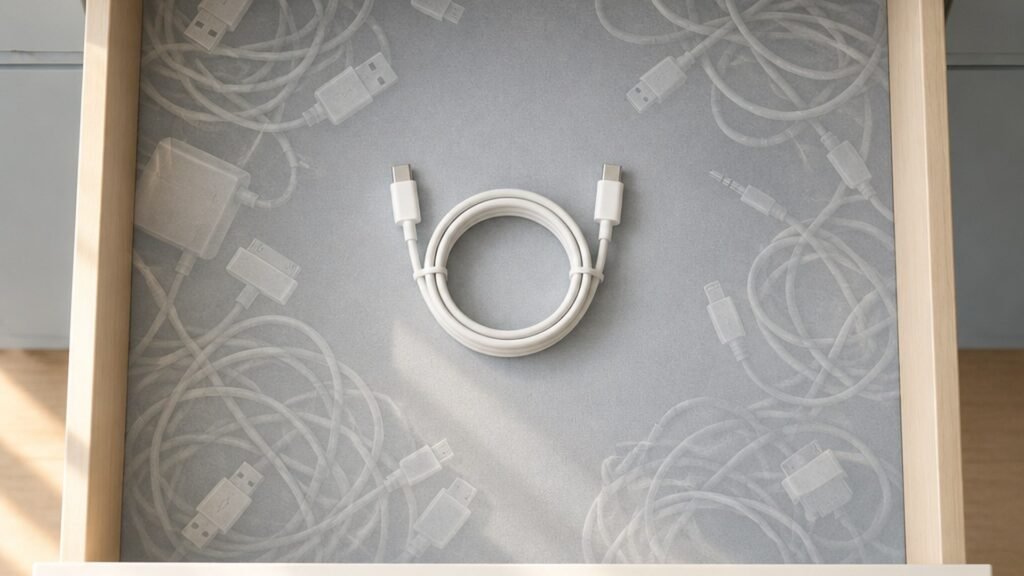
There is a drawer in nearly every home that nobody wants to open. It smells faintly of dust and old rubber, and inside it lives a tangle of cables that nobody can fully explain: a phone charger from three phones ago, a laptop brick with a round tip that fits nothing in the house, a micro-USB cable kept “just in case,” and at least three identical-looking wires that behave in mysteriously different ways. For two decades, the cable drawer was a small monument to technological fragmentation. Now, almost without anybody announcing it, that drawer is quietly going extinct. The reason has a name printed on both ends of nearly every new cable sold today: USB-C.
The story of how one small connector became the universal standard is less about engineering romance and more about a simple, powerful idea whose time finally came. For years, every electronics maker had an interest in proprietary ports and plugs. A company that owned the charging format owned the accessories business too, and customers who bought a drawer full of branded cables were, from a commercial point of view, customers with a gentle lock around their wrists. Fragmentation was not an accident of history. It was a business model.
The regulation that ended the format wars
The turning point arrived not in a Silicon Valley keynote but in a Brussels meeting room. European regulators, tired of a mountain of electronic waste generated by incompatible chargers, pushed a common-sounding rule: devices sold in Europe must charge over USB-C. The directive focused initially on phones and small electronics, but its effect rippled far wider. Once the world’s largest manufacturers had to redesign their flagship products around a single port for one enormous market, it made little sense to keep a different port for everywhere else.
The most visible surrender came from the company that had most famously resisted. For years, the smartphone maker with the lightning-quick, proprietary connector insisted that its own format was better, sleeker, and safer. Then the calculus changed. The same phone that stubbornly kept its own port for over a decade now ships with USB-C, and the transition that once seemed unthinkable passed with surprisingly little drama. Customers adapted in an afternoon, which revealed how low the emotional attachment to a charging port had been all along.
That is the quiet power of standardization. It rarely arrives with excitement. It arrives with a shrug, which is precisely what happens when technology finally gets out of the way.
One cable, many jobs
What made USB-C genuinely different from earlier attempts at universality was not just its shape but its ambition. Older standards mostly carried power or carried data, and did one or the other grudgingly. USB-C was designed to carry almost everything at once: charging at high wattages enough to power a full-size laptop, data at speeds fast enough to move a hard drive’s contents in minutes, and video good enough to run an external monitor. One cable could, in principle, join a laptop to its charger, its screen, its backup drive, and its docking station.
The docking station point is where the change became visible in daily life. A modern work desk can now be reduced to a single cable. Plug it in and the laptop collects power, an external display, a keyboard, a mouse, speakers, and ethernet, all through one connection. Unplug it and everything stays behind, waiting for tomorrow. The desk stops being a nest of wires and becomes a clean, almost Scandinavian surface. For people who work from home and moved their lives into the spare bedroom, that simplicity has quietly become one of the small pleasures of the setup.
The same consolidation is happening throughout the house. Cameras, drones, handheld consoles, tablets, earbuds, e-readers, power banks, portable speakers, and even torches and electric kettles now share one format. The travel bag tells the same story. Where a trip once demanded a pouch of chargers particular to each device, a single brick and a couple of USB-C cables now cover almost everything, and international travel adapters have shrunk accordingly.
The catch hiding in the drawer’s replacement
It would be tidy to end the story there, but any honest account of USB-C must admit that the standard carries its own quiet confusion. The plug is universal; the capability behind it is not. Two identical-looking cables can differ enormously: one may carry only a trickle of power and slow data, while its twin handles a hundred watts and blistering transfer speeds. The small labels that explain the difference, when they exist at all, use a numbering scheme that grows more befuddling by the year. A shopper who simply buys “a USB-C cable” may still bring home the wrong one, which means fragmentation has not entirely died. It has just moved from the shape of the plug to the small print on the box.
There is a lesson in that. Standards solve the visible problem first, and the invisible problems survive to confuse another day. The sensible response is not nostalgia for the old chaos but a simple new habit: buy good cables, keep only a few, and let the rest go. The drawer of forty cables was never useful, only anxious. A small set of capable, clearly labelled USB-C cables does everything the pile once pretended to do.
What the single port teaches about owning less
There is a quieter side effect of the convergence worth noticing: it changes what people own without asking permission. In the fragmented era, owning a device meant owning its accessories, and a household with a dozen gadgets implicitly owned a hundred cables, most of them filling drawers as insurance against a future need that never came. Ownership was bulky by design, because every purchase dragged a small tail of chargers, adapters, and spares behind it.
A single standard quietly cuts that tail off. One household needs, at most, a few cables and a couple of chargers, all interchangeable, all replaceable from any shop on any street. The accessory stops being a loyalty tax on a device brand and becomes a plain commodity, like batteries or shoelaces. Something similar is happening in the choice between repairing and replacing: when the port is universal, the accessory pile a person already owns survives every upgrade, and the old instinct to buy a new charging kit with every phone quietly starves.
The earning is small per household and enormous in aggregate, which is the signature of every real standardisation success story. Multiply a drawer emptied by a few hundred million households, and the humble plug turns out to have been a sustainability policy all along, disguised as a convenience. From drawer to landfill to elimination, the humble cable has completed a journey almost nobody expected it to take.
Why this moment matters beyond cables
The deeper significance of USB-C is what it says about how technology matures. The first phase of a technology’s life is about difference: competing formats, competing philosophies, passionate arguments about which connector, which platform, which ecosystem is superior. The second phase is about disappearance. The winning technology stops being a topic of conversation and becomes a plain fact of life, like screws and threads, like the shape of a plug, like the width of a doorframe.
USB-C has crossed that line. Nobody debates it at dinner parties. Nobody chooses it. It is simply the cable, the way the web is simply the web. That is the highest compliment a piece of infrastructure can receive: it has become boring enough to be trusted.
There is a second, equally important consequence. Universal charging is quietly becoming one of the more effective quiet environmental policies of the decade. When chargers no longer ship in every box because every box no longer needs its own, millions of plastic-wrapped power bricks stay unmade. When a cable outlives three devices, fewer cables are bought, and fewer end up in the bin. Electronic waste is one of the fastest-growing waste streams on the planet, and reducing it rarely comes from grand gestures. It comes from small, unglamorous decisions like agreeing on one plug.
The cable drawer will linger in homes for a while yet, as transitional objects always do. Its contents will age gently, growing more obsolete each year, and one afternoon, without ceremony, it will be emptied into an e-waste bin by somebody who realises nothing in it has been touched since the move. That is how these stories always end: not with a burial, but with a slow forgetting.
The new drawer
Something else will replace it, of course. Already a new category is accumulating in another drawer: USB-C cables that are good, USB-C cables that are suspicious, and the one genuinely excellent cable that is always in the other jacket pocket. But that drawer will hold five things rather than fifty, and five is a number a home can live with.
The connector in the wall has become a small piece of proof that the technology industry is capable, occasionally, of agreeing on something and then getting out of the way. The debate that once filled forums and comment sections has been settled not by the most passionate argument but by a rule, a wattage rating, and a shape that a child can plug in correctly in the dark.
In the end, the story of USB-C is the story of every good standard: it made the argument irrelevant. The drawer is emptying, and almost nobody noticed. That is exactly how the best changes arrive.