
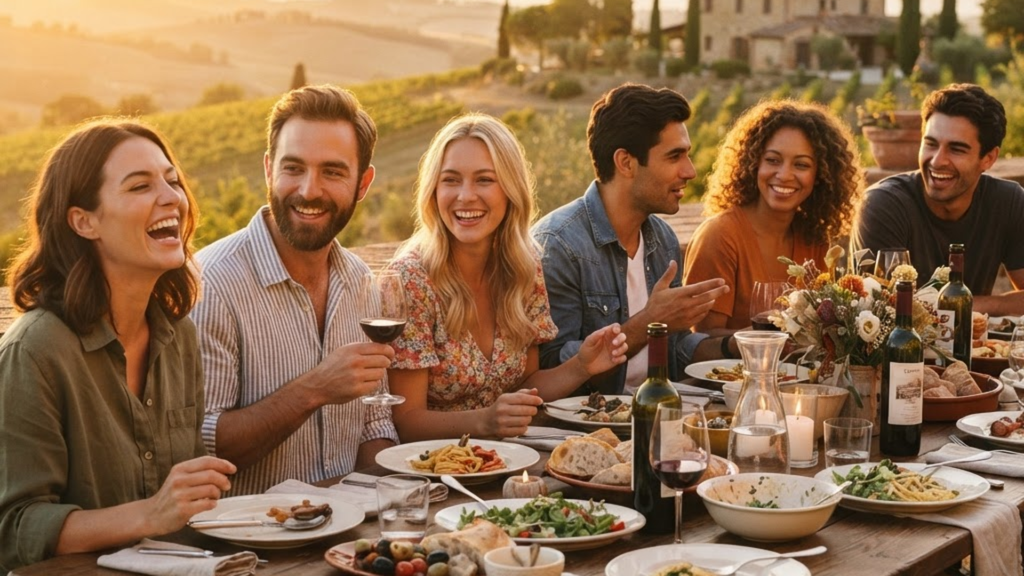
A perspective piece from The Listening Market
There is a particular kind of silence that fills a room when someone is unpacking a new purchase. It is not disappointment, exactly. It is something quieter — a recognition, maybe, that the thing in your hands is just a thing. The newness fades fast. The box gets broken down for recycling. And what remains, more often than not, is a faint residue of wanting that never quite resolved into satisfaction.
Now think of the last time a friend told you about a trip, a concert, a long dinner that stretched into the early hours. Notice how the story grows in the telling. Notice the way the person’s face changes — how they lean in, how they laugh at a detail that only they remember. The experience did not just happen and end. It is still happening, still yielding something, every time it is recalled.
This is not a romantic observation. It is, increasingly, an economic one. Across the world, people are quietly redirecting their money away from objects and toward moments — and the data is beginning to say so plainly.
The Numbers Behind the Shift
According to a report by GetYourGuide and Earnest Analytics, which analyzed anonymized data from roughly 100 million U.S. credit and debit card accounts, American consumer spending on experiences grew by 32 percent in the twelve months ending August 2024, compared to the twelve months ending January 2019. Over that same period, overall spending on consumer goods — including basics like groceries — grew by 21 percent. But the gap widens dramatically when you isolate discretionary goods: spending on non-essential physical items grew by just 5 percent. Experiences didn’t just outpace goods. They left them behind.
The travel sector tells a similar story. American Express’s 2026 Global Travel Trends Report found that 40 percent of global respondents plan to spend more on travel in 2026 than they did the year before. Among Millennials and Gen Z, 74 percent described travel as “non-negotiable” — a word that sits oddly next to headlines about cost-of-living pressure, but that makes more sense when you understand what people are actually choosing to protect.
Even where spending is contracting, it is contracting unevenly. Deloitte’s 2025 Holiday Retail Survey found that U.S. shoppers expected to cut their spending on retail goods by 14 percent year-over-year, while spending on experiences would decline by a far smaller 6 percent. When wallets tighten, things are the first to go. Moments are the last to be given up.
The Research That Predicted All of This
Long before the spending data caught up, psychologists were already pointing in this direction. In a landmark 2003 study published in the Journal of Personality and Social Psychology, researchers Leaf Van Boven and Thomas Gilovich found that people who spent discretionary income on life experiences were consistently happier than those who spent it on material possessions. The finding was not marginal. Across multiple experiments and surveys, the experiential advantage held — people felt their money was better spent when it purchased something they did rather than something they owned.
The reasons are worth pausing on. Experiences, the researchers argued, are more resistant to the corrosive effects of comparison. A new car invites you to measure it against your neighbor’s. A vacation does not work that way. It is yours in a way that resists ranking. Experiences also become a part of your identity in a way objects cannot. You are not the person who owns a particular watch. You are the person who hiked to that ridge at sunrise, who got lost in that market in Marrakech, who stayed up talking until three in the morning in a hostel kitchen with strangers who became friends.
A widely cited study by the Harris Group found that 72 percent of Millennials would rather spend money on experiences than on material things. That figure has aged remarkably well. What began as a generational preference has hardened into something closer to a cultural default.
The Generational Engine
Younger consumers are not merely participating in this shift. They are accelerating it. PwC reported that Gen Z cut overall spending by 13 percent between January and April 2025, with the steepest declines in categories like apparel, accessories, and electronics. This is not frugality for its own sake. It is a recalibration of what spending is for. The same report described what PwC called a “spending reset” — a movement away from material gift-giving toward shared traditions and experiences.
Writing in Forbes, Jeff Fromm noted that by 2030, Gen Z and Millennials together will account for more than half of all U.S. leisure travel, up from just one-third in 2023. Eventbrite’s research has shown that 89 percent of Millennials attended at least one live event in the previous twelve months, and that the appetite for concerts, festivals, and communal gatherings has continued to climb. These are not isolated signals. They describe a generation — two generations, really — that has quietly decided that presence matters more than possession.
Part of this is economic. Younger people came of age amid financial crises, pandemics, and housing markets that priced them out of the very milestones that once anchored adult life. If homeownership feels distant and a new car feels like a depreciating liability, the logic of spending on a weekend away or a night out becomes less impulsive and more pragmatic. You cannot be priced out of a memory.
The Loneliness Factor
There is another current running beneath all of this, and it may be the deepest one. In June 2025, the World Health Organization released estimates linking loneliness to approximately 871,000 deaths each year — roughly 100 deaths every hour. The WHO’s Commission on Social Connection has framed loneliness and social isolation as global public health concerns on the scale of smoking or obesity. This is not a metaphor. It is a measurement.
Experiences, almost by definition, are social. You can buy a jacket alone. You can unwrap a device alone. But a dinner, a festival, a trip, a class — these are things that tend to involve other people. When GetYourGuide’s CEO Johannes Reck described the shift toward experiential spending, he connected it directly to what he called the loneliness epidemic in America: “travel experiences provide the human connection we crave for.” That framing may come from a travel company with a commercial interest, but the underlying observation aligns with what the WHO and decades of social psychology have found. People are not just buying fun. They are buying proximity to each other.
The Harvard Graduate School of Education has reported that 81 percent of adults who are lonely also experience anxiety or depression, compared with 29 percent of those who are less lonely. The distance between those two numbers is the distance between a life lived in accumulation and a life lived in connection. It is not surprising that people are reaching for the latter.
What Brands and Markets Are Watching
The experience economy is no longer a fringe concept. McKinsey has tracked the growing dominance of digital and experiential spending as a defining structural trend in consumer markets. Online travel agencies have seen spending through their platforms grow by 188 percent compared to pre-pandemic baselines, far outpacing growth in flights and accommodation. People are not just traveling more. They are investing more in what they do when they get there.
GetYourGuide’s data identified a segment they call “super-spenders” — travelers who spend 18 percent more on experiences than the average and account for 60 percent of the entire travel market’s spend. These are not luxury consumers in the traditional sense. They are not necessarily buying first-class seats or five-star rooms. They are buying depth: guided tours, local encounters, immersive activities that promise something a photograph alone cannot capture. Their behavior suggests that the premium of the future is not status. It is authenticity.
This has implications well beyond travel. Retailers are watching as foot traffic to stores declines while attendance at pop-ups, workshops, and community events rises. Brands that once competed on product specifications are now competing on the quality of the moments they can facilitate. The most successful physical retail spaces of 2026 are not stores in the conventional sense. They are stages.
The Quiet Revaluation of a Life
Step back from the reports and the percentages, and what emerges is something more personal. The shift toward experiences over things is not simply a change in consumption. It is a quiet revaluation of what a life is made of.
There is a reason the stories people tell about their best purchases rarely involve the purchases themselves. They involve who was there. They involve what the weather did. They involve the wrong turn that led to the right place. Objects sit in drawers. Experiences sit in people. And people, it turns out, are the only things that compound.
None of this means that material goods are meaningless. A well-made tool, a beautiful object, a book you return to — these have their own kind of durability. But they are the exceptions, and deep down most people know it. The closet that is already full. The drawer that no longer closes. The device that was exciting for a week and then became invisible. These are the ordinary endings of material consumption, and they are endings. A story about a cold swim on a hot day, told for the fifth time to someone who has never heard it, has no ending at all.
The choice more and more people are making is not radical. It is, if anything, a return — to something older and less complicated than the consumer culture of the late twentieth century. Before the era of mass accumulation, before the fetishization of novelty, people measured the goodness of a life by what they did and who they did it with. The technology changed. The impulse did not.
What is different now is that the data has finally caught up with the intuition. The psychologists showed it first. The spending patterns confirmed it. The public health research explained why. And the people making these choices — quietly, one dinner or one trip or one sold-out concert at a time — are proving it every day.
Experiences over things is not a slogan. It is a shift, and it is already here.