
A perspective piece from The Listening Market
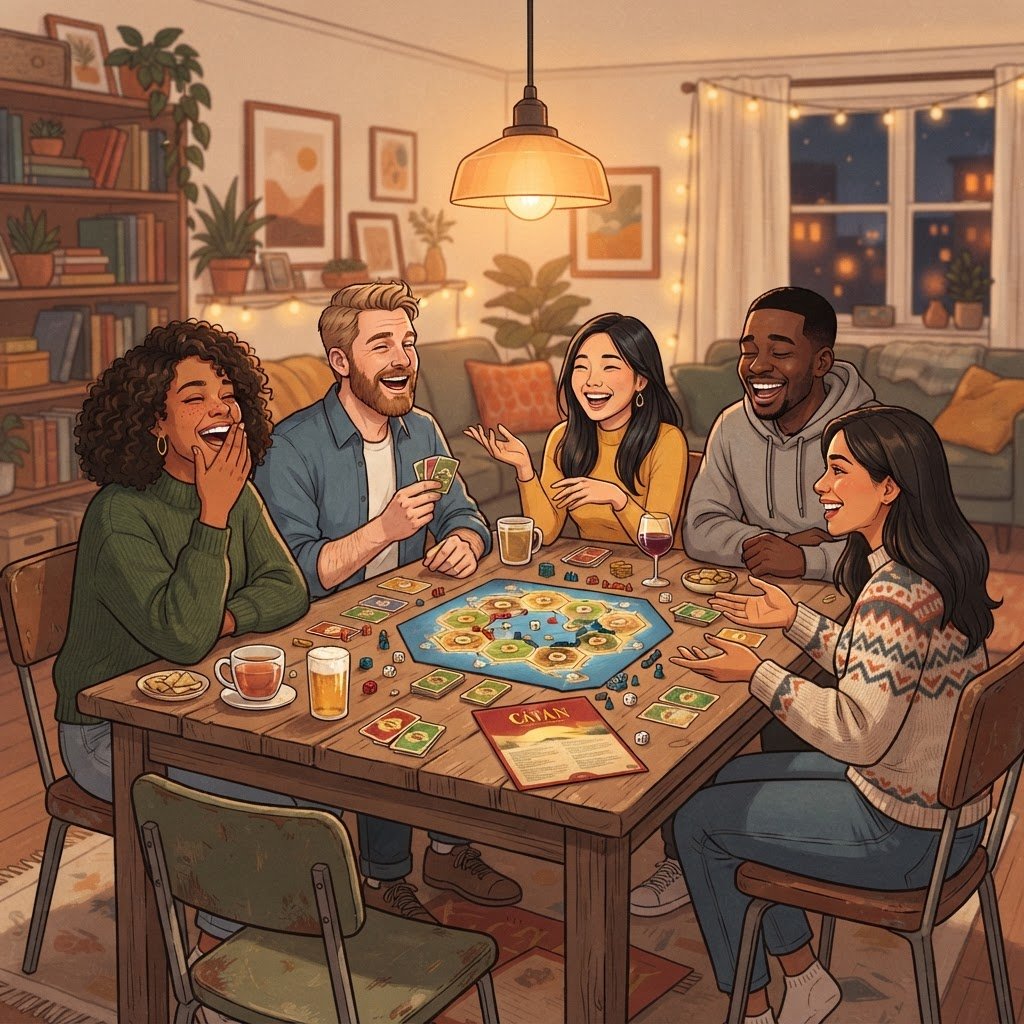
The image of a board game night used to belong to a specific kind of nostalgia. A rainy Sunday, a family gathered around a worn copy of Monopoly, someone arguing about the rules, the game ending in mild acrimony and a bowl of unfinished snacks. It was a memory, not a current activity. Board games were something people remembered doing, not something they actually did on a Friday night. That image has been quietly overturned. Board games are back. Not as a retro curiosity, not as an ironic throwback, but as a genuine and growing form of entertainment that people choose on purpose.
The resurgence has been building for years, but it has reached a point where it can no longer be called niche. Board game cafés have multiplied in cities around the world. Board game sections in shops have expanded. Crowdfunding campaigns for new games regularly raise sums that would have been unimaginable a decade ago. And the audience has broadened far beyond the stereotype of the hobbyist — it now includes people who would never have described themselves as board game people, but who have discovered that an evening spent around a table with friends, a deck of cards, and a set of dice is a genuinely good way to spend time.
What Changed
The board games that drove this comeback are not the ones most people grew up with. The classics — Monopoly, Scrabble, Cluedo — still sell, and they still have a place on shelves. But the games that have captured the current enthusiasm are different. They are designed by a new generation of game designers who treated board games as a creative medium worthy of innovation. They introduced mechanics that go beyond roll-and-move. Cooperative games where players work together against the game itself. Social deduction games where the challenge is reading people, not reading rules. Strategy games with enough depth to reward repeated play but enough elegance to be taught in fifteen minutes.
This matters because the old criticism of board games — that they are boring, slow, and prone to eliminating players who then sit and watch — was often fair. The new generation of games addressed these problems directly. Play times are more controlled. Rules are clearer. Player elimination is rare. The experience is designed to be engaging for everyone at the table for the full duration, not just for the person winning. The result is a form of entertainment that competes on quality, not on nostalgia.
The Social Magnetism
What board games offer that screens do not is presence. A video game can be played alone. A streaming service is designed for solo consumption. Social media provides a simulation of connection without the substance. A board game, by its nature, requires people to be in the same room, at the same table, paying attention to each other. The game is the excuse, but the real product is the interaction. The conversation that happens between turns. The negotiation, the bluffing, the laughter when someone makes a catastrophic mistake. The shared experience of something that cannot be paused, skipped, or scrolled past.
This is not a small thing in a culture where so much social interaction has been mediated by screens. People are hungry for in-person connection, not as a replacement for digital communication but as a complement to it. Board games provide a structure for that connection. They give people something to do together that is not just talking, which can feel forced, and not just watching, which is passive. The game creates a shared focus, and the social interaction flows naturally from it. For a generation that has spent years socialising through text and images, the physicality of a board game — pieces to hold, cards to shuffle, a table to sit around — feels refreshingly tangible.
The Café Phenomenon
The rise of board game cafés has been both a symptom and a driver of the comeback. These are not cafés that happen to have a few games on a shelf. They are businesses built around the idea that people will pay for the experience of playing games in a social setting, with food and drink as part of the package. They employ staff whose job is to teach games to new players, recommend games based on a group’s preferences, and keep the shelves stocked with a curated selection. The model works because it lowers the barrier to entry. A person who has never played a modern board game can walk in, sit down, and be playing within minutes, guided by someone who knows the rules.
The café phenomenon also reveals something about how the audience for board games has shifted. These are not dedicated hobbyist spaces. They are mainstream social venues, frequented by couples on dates, groups of friends, work colleagues after hours, and families looking for something to do on a weekend afternoon. The demographic is broad, and the mood is casual. The message is that board games are not a subculture. They are an option, like going to a cinema or a restaurant, and one that more people are choosing.
A Counterweight to Digital Fatigue
It is probably not a coincidence that the board game resurgence has accelerated during a period when people have been spending more time than ever in front of screens. The pandemic pushed digital consumption to unprecedented levels, and while the acute phase has passed, the habits it established have not fully receded. Work is still largely screen-based. Entertainment is still largely screen-based. Socialising is still partly screen-based. Into this context, board games offer something that is deliberately and entirely non-digital.
There is no screen to look at. No notification to interrupt. No algorithm curating the experience. The game exists on the table, in physical form, and it unfolds at the pace of the people playing it. This is not a rejection of digital entertainment. It is a rebalancing. People are not abandoning screens. They are recognising that a life spent entirely in front of screens is missing something, and board games are a way to fill that gap that is social, engaging, and fun.
Where It Goes From Here
The board game market shows no signs of contracting. New games are being published at a rate that makes it impossible for even dedicated hobbyists to keep up. The quality bar is rising, as designers and publishers compete for attention in a crowded field. The audience is still growing, as more people discover the hobby through cafés, friendships, and the simple appeal of a good game.
The comeback of board games is not a trend in the way that a fashion trend is a trend — something that rises, peaks, and fades. It is more like a return. A recognition that a form of entertainment that has existed for centuries still has something to offer, and that the version of it being created today is better than it has ever been. The table is still there. The chairs are still there. The only thing that changed is that people are sitting down again.