
A perspective piece from The Listening Market
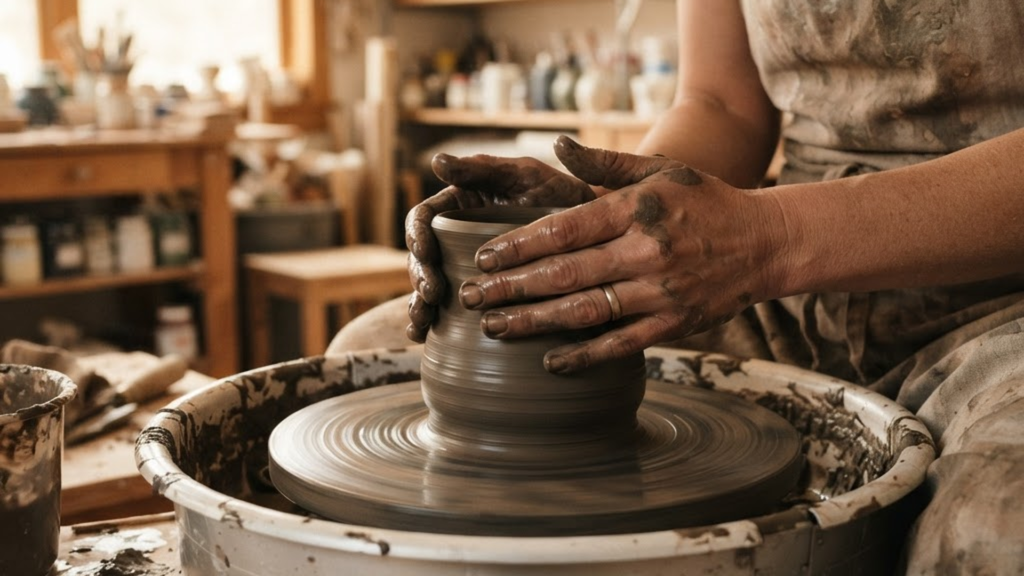
There is a particular silence that settles around a pottery wheel. The hum of the motor, the wet slide of clay between palms, the faint hiss of water being drawn into the spinning mass — it is a silence made of doing, not of absence. For a growing number of people, that silence has become the point.
After more than a decade of deepening immersion in digital life — the feeds, the notifications, the endless scroll — something unexpected is happening. People are walking away from their screens, at least for a few hours, and picking up things their hands have forgotten. Clay. Wool. Timber. Soil. The offline hobbies that once defined evenings and weekends are quietly, insistently coming back.
Not as a trend. Not as a hashtag. As a need.
The Exhaustion of Always-On
It is worth considering how unusual the last decade has been. For most of human history, leisure was tactile. People whittled, sewed, gardened, baked, built, and repaired. Hobbies were not an escape from a device — they were simply what one did with unclaimed time. The smartphone era compressed that landscape dramatically. Leisure became vertical, infinite, and largely frictionless. Open an app, swipe, scroll, repeat.
The cost of that compression is now becoming legible. According to the American Psychological Association’s 2023 Stress in America survey, nearly two-thirds of adults identified the news and social media as significant sources of stress in their lives. A separate study published in JAMA Psychiatry in 2023 found that adolescents who spent more than three hours per day on social media faced a heightened risk of mental health problems, including depression and anxiety symptoms. The data does not say that screens are evil. But it does say that the way most people use them is extracting a toll — one measured in fractured attention, shallow sleep, and a persistent, low-grade restlessness.
Offline hobbies offer something that the digital world, despite its vastness, struggles to provide: a sense of completion. A thrown pot is finished. A knitted row is a knitted row. A garden bed weeded is a garden bed weeded. There is a beginning, a middle, and an end — a structure that infinite feeds deliberately refuse.
What the Hands Remember
Talk to anyone who has recently returned to a craft, and a similar vocabulary emerges. People speak of being “pulled back.” They describe a sensation of recognition, as though their hands had been waiting. A woman in her thirties, an office worker who recently enrolled in a beginner’s pottery course, described it this way: “I sat down at the wheel and my shoulders dropped. I hadn’t realised how high they’d been.”
That physical description matters. The body keeps its own record of engagement. When hands are occupied with a material that resists — clay that slumps, timber that splits, wool that tangles — the nervous system receives a signal that the endless ambient vigilance of digital life can be stood down. There is, in that moment, nothing to refresh. Nothing to check. The material in front of you is the entire world.
Psychologists call this state flow. The concept, popularised by Mihaly Csikszentmihalyi, describes a condition of deep absorption in an activity where time distorts, self-consciousness recedes, and the doer and the doing become difficult to separate. Flow is notoriously difficult to achieve online, where every interaction is punctuated by the possibility of interruption. Offline hobbies, by contrast, create it almost by default. The hands are busy. The mind follows.
The Quiet Boom in Craft
The resurgence is visible in the numbers, though the numbers only tell part of the story. The Craft Yarn Council reported that during and after the pandemic, knitting and crochet saw a sustained surge in participation, with notable growth among younger demographics — a pattern that has not fully receded. Community education providers in Australia, the United Kingdom, and the United States have noted waiting lists for pottery, woodwork, and printmaking courses that would have been unthinkable a decade ago. Independent craft supply retailers, many of which had been in long decline, have reported steady revenue growth since 2021.
Then there is the evidence written on kitchen tables and balconies. A sourdough starter on the windowsill. A half-finished scarf trailing from a project bag. Seedlings in repurposed containers. These are small acts, but they are widespread, and they share a common impulse: the desire to make something real, something that exists outside a screen and does not require a battery.
Why the Return Is Different This Time
It would be easy to frame this as nostalgia — a reach backward toward a simpler, slower past. But that reading misses something important. The people returning to offline hobbies are not rejecting technology. They are surrounded by it. Many of them discovered these crafts through digital channels: YouTube tutorials, Instagram accounts, online marketplaces for handmade tools and supplies. The digital world is the vector for the return to the physical one.
What has changed is not the availability of screens but the relationship to them. There is a growing awareness that constant connectivity has not delivered on its promise of enrichment. Information is abundant, but wisdom feels scarce. Connection is instantaneous, but loneliness is widespread. Entertainment is infinite, but boredom — genuine, fertile boredom, the kind that gives birth to creativity — has been engineered out of existence. Offline hobbies are, among other things, a way of reclaiming that boredom and finding it is not empty after all.
This is why the current revival of craft feels different from the nostalgia waves that preceded it. It is not about aesthetics, not about the curated rustic charm of a mason jar. It is about agency. In a digital environment where algorithms decide what people see, what they think about, and what they want, the act of choosing to sit with a lump of clay or a length of wood is a small assertion of authorship over one’s own attention.
The Social Life of Making
One of the quieter discoveries of this return to offline hobbies is that making things by hand is, paradoxically, a way of being with people. Not in the performative sense of sharing a photo, but in the old sense — sitting in a room with others, working alongside them, talking or not talking, the rhythm of the work holding the social space together.
Knitting circles, community gardens, shared makerspaces, and informal woodworking groups have become refuges of a particular kind of social contact: low-stakes, unhurried, and anchored in something physical. Research published in the journal PLOS ONE in 2018 by Dr. Anne Kirketerp and colleagues found that textile craft groups were associated with improved social wellbeing and reduced loneliness among participants. The craft itself seemed to matter less than the gathering it enabled — though the craft was what made the gathering possible.
In an era where much social life is mediated, asynchronous, and subject to the pressures of self-presentation, the craft group offers something simpler. You show up. You bring your materials. You sit. The conversation moves at the pace of the work. It is the kind of social contact that does not require performance and does not leave anyone wondering whether they said the wrong thing in a group chat three days ago.
The Economics of Small Things
There is also an economic dimension to this return, and it is worth being honest about it. Offline hobbies are not free. Clay costs money. Yarn costs money. A decent set of chisels costs real money. A garden requires space, which, for many people living in dense urban environments, is the most expensive material of all. The revival of offline hobbies is, in part, a revival enabled by a certain level of material security, and that should be acknowledged rather than glossed.
But within that honesty is another observation: people are choosing to spend on making rather than on consuming. The shift is subtle but significant. A Saturday spent woodworking is a Saturday not spent shopping. A winter spent knitting is a winter spent producing rather than acquiring. For some, the handmade object — a rough ceramic bowl, a wooden spoon, a hand-knitted jumper — has become more valuable than the store-bought equivalent, not because it is finer but because it carries the imprint of its maker. It is proof that time was spent on something that mattered.
What the Hands Teach the Mind
Perhaps the most significant thing about the return of offline hobbies is not the objects they produce but the inner posture they cultivate. Craft teaches patience — not as an abstract virtue, but as a practical necessity. Clay must dry before it can be fired. Timber must be planed before it can be joined. Seeds must be sown before they can be harvested. None of these processes can be accelerated, and the attempt to do so usually ruins the work.
This is a radical idea in a culture that has optimised for speed and frictionlessness. Offline hobbies insist on their own tempo. They cannot be hacked or optimised. They ask for attention, repetition, and a willingness to fail and begin again. They are, in the best sense, inefficient — and that inefficiency turns out to be precisely what is missing from much of contemporary life.
The person who learns to throw a pot also learns, whether they know it or not, to tolerate imperfection. The first bowl will be lopsided. The tenth will be better. The hundredth will be something else entirely. This arc of slow improvement — visible, tangible, unhurried — is deeply counter to the instant-gratification logic of the digital world, and deeply nourishing to the part of the self that has been starved of it.
A Quiet Comeback
It is unlikely that offline hobbies will ever again occupy the central place in daily life that they held before the screen became the default object of attention. The digital world is not going away, and most people do not want it to. The smartphone is a tool of extraordinary utility, and the communities, knowledge, and connection it enables are real and valuable.
But something has shifted, and it shows no sign of shifting back. People have remembered that their hands can do more than tap and swipe. They have remembered that time spent making is not time wasted. They have remembered, in a way that perhaps only the body can remember, that there is a particular satisfaction in pressing a thumb into wet clay and feeling it yield, in pulling a length of yarn through a needle, in watching a seedling push through dark soil toward the light.
The return of offline hobbies is not a revolution. It is quieter than that, and more durable. It is the sound of people putting down their phones and picking up their lives — one lump of clay, one row of stitches, one freshly planed plank at a time. It is, in the end, a simple act of remembering what was always there, waiting, patient as the materials themselves.