A perspective piece from The Listening Market
The way people learn has always reflected the constraints of their era. In agrarian societies, knowledge was passed through apprenticeship and oral tradition, tied to the rhythms of seasons and the limits of daylight. The industrial age brought mass education, with its standardised curricula, fixed timetables, and classrooms designed to produce workers for a world of factories and offices. The internet age began to loosen those constraints, making information freely available but still largely packaged in the old formats: hour-long lectures, semester-long courses, thousand-page textbooks. What is emerging now is something different, something that fits the texture of contemporary life rather than fighting against it. It is called microlearning, and it is changing how people acquire new skills.
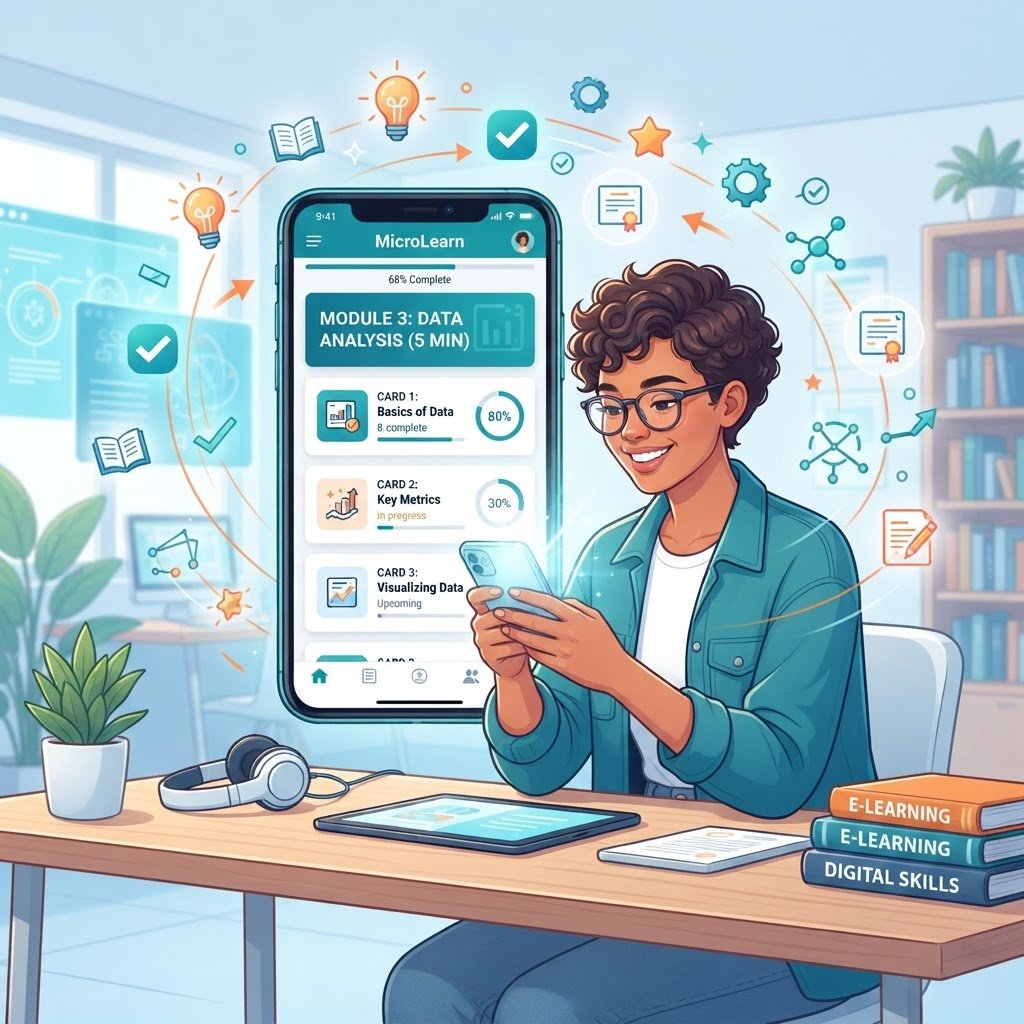
Microlearning is exactly what the name suggests: learning in small increments. Instead of committing to a ten-week course or a three-year degree, a person might spend five minutes a day on a vocabulary app, watch a two-minute explainer on a coding concept, or complete a quick quiz on project management principles during a lunch break. The content is broken into modular units that can be consumed independently, in any order, at any pace. The appeal is obvious. In a world where time is fragmented and attention is contested, the promise of meaningful learning in tiny parcels is immensely attractive.
The drivers behind microlearning’s rise are both technological and social. On the technology side, smartphones have put a learning device in every pocket, and the infrastructure for delivering bite-sized content has matured rapidly. Adaptive algorithms can now personalise the sequence of lessons based on a learner’s performance, surfacing material at the right level of difficulty at the right time. Gamification elements, borrowed from the design language of video games, add streaks, points, and badges that tap into the same motivational systems that keep people coming back to social media. The result is a learning experience that is not just convenient but genuinely engaging.
On the social side, the nature of work is changing in ways that make continuous learning a necessity rather than a luxury. The half-life of a professional skill is shrinking. Technologies, tools, and best practices that were cutting edge five years ago are now table stakes, and the pace of change is accelerating. In this environment, the idea of front-loading all education into the first two decades of life and then coasting on that knowledge for the next forty is increasingly untenable. People need to learn continuously, and they need to do it without stepping away from their careers and lives to sit in a classroom.
Microlearning answers this need by fitting into the gaps. The commute, the queue, the ten minutes between meetings, the quiet moment after dinner: these become learning opportunities. The aggregate effect is substantial. Five minutes a day amounts to thirty hours a year, which is roughly the contact time of a university module. The difference is that those thirty hours are distributed across the year in a way that reinforces retention rather than concentrated into a block that is largely forgotten within weeks.
The science of learning lends support to this approach. Research on spaced repetition, the practice of reviewing material at increasing intervals, has consistently shown that distributing learning over time produces better long-term retention than massing it into single sessions. The brain appears to consolidate memories more effectively when learning is interleaved with other activities and sleep. Microlearning, almost by accident, aligns with these principles. By its very nature, it spaces learning out and breaks it into small doses, which is closer to how the brain naturally acquires and retains information.
There is also a psychological advantage. For many adults, the prospect of learning something new is intimidating, not because the material is beyond them but because the commitment feels overwhelming. A course that requires ten hours a week for twelve weeks is a daunting prospect for someone already juggling work, family, and other obligations. A five-minute daily habit is not. The low barrier to entry makes it easier to start, and starting is often the hardest part. Once the habit is established, the momentum carries people further than they expected.
Critics of microlearning raise valid concerns. There is a difference, they argue, between knowing a collection of facts and understanding a complex system. Some subjects require deep, sustained engagement that cannot be achieved in five-minute increments. Learning a language through flashcards is useful, but it will not produce fluency without extended practice in real conversation. Understanding machine learning requires more than watching short videos; it requires working through problems, making mistakes, and building intuition over time. Microlearning, the critique goes, is good for breadth but poor for depth.
This is a fair criticism, but it may be asking microlearning to do something it was never designed to do. The best use of microlearning is not as a replacement for deep study but as a complement to it. It excels at building foundational knowledge, reinforcing concepts, and maintaining skills over time. For acquiring a broad base of understanding, for keeping knowledge fresh, and for introducing people to new domains, it is remarkably effective. When deeper mastery is needed, it can serve as the entry point that gives learners the confidence and basic literacy to pursue more substantial study.
The corporate world has been quick to adopt microlearning for employee training, and the reasons are telling. Traditional training programmes, with their full-day workshops and multi-day offsites, are expensive, disruptive, and often ineffective. Employees return from training and forget most of what they learned within days. Microlearning delivers training in small, relevant doses that can be accessed at the point of need, when the knowledge is immediately applicable. A salesperson about to enter a negotiation can review a two-minute refresher on objection handling. A manager facing a difficult conversation can watch a short video on giving feedback. The learning is contextual, timely, and therefore more likely to stick.
The educational implications are significant. If microlearning can deliver effective training at a fraction of the cost and time of traditional methods, it has the potential to democratise access to skills development on a global scale. A worker in a developing country with a smartphone and a few minutes a day can access the same learning content as someone in a major Western city. The playing field is not level, and connectivity, language, and literacy remain barriers, but the direction of travel is clear. Knowledge is becoming more modular, more accessible, and more suited to the realities of how people live and work.
There is a philosophical dimension to all of this that is worth considering. The industrial model of education was built on the assumption that learning is a distinct activity, separate from the rest of life, occurring in a specific place at a specific time. Microlearning dissolves that separation. Learning becomes woven into the fabric of daily life, indistinguishable from the other small activities that fill a day. This is closer to how learning occurred for most of human history, before the invention of the classroom. The apprentices learning a trade in a medieval workshop were not attending a course. They were learning in the context of their work, in small increments, over time. Microlearning, in a sense, is a return to an older pattern, enabled by new tools.
The risk is that in celebrating the convenience and efficiency of microlearning, we lose sight of the value of difficulty. Some of the most important things a person can learn require struggle, patience, and sustained effort. The discomfort of grappling with a hard concept for hours, of reading a dense text that resists easy understanding, of failing and trying again, is not a bug to be eliminated but a feature of genuine learning. If microlearning trains people to expect all knowledge to come in easy, bite-sized portions, it may erode the tolerance for the kind of hard, slow learning that produces not just skills but wisdom.
The answer, as with most things, is balance. Microlearning is a powerful tool, one of the most important developments in education in decades. It is not the only tool. The most effective learners will be those who use it for what it does well while knowing when to set it aside and go deep. The future of learning is not exclusively micro or exclusively macro. It is a mix, with each mode serving its purpose, and the skill of knowing which to use when becoming itself one of the most important things a person can learn.